JEE Main Physics — Mechanics previous year questions with solutions.
The water is filled up to a height of $12m$ in a tank having vertical sidewalls. A hole is made in one of the walls at a depth $h$ below the water level. The value of $h$ for which the emerging stream of water strikes the ground at the maximum range is _____ $m$.
Two billiard balls of equal mass $30g$ strike a rigid wall with same speed of $108\mathrm{kmph}$ (as shown) but at different angles. If the balls get reflected with the same speed, then the ratio of the magnitude of impulses imparted to ball $a$ and ball $b$ by the wall along $X$ direction is: 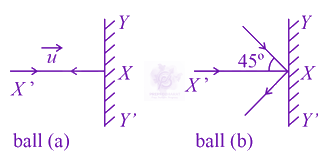
Which of the following is not a dimensionless quantity?
Match List I with List II. <table class="pyq-table"><tbody><tr><td></td><td>List-I</td><td></td><td>List-II</td></tr><tr><td>a</td><td>Capacitance, C</td><td>i</td><td>${M}^{1}{L}^{1}{T}^{-3}{A}^{-1}$</td></tr><tr><td>b</td><td>Permittivity of free space, ${\epsilon }_{0}$</td><td>ii</td><td>${M}^{-1}{L}^{-3}{T}^{4}{A}^{2}$</td></tr><tr><td>c</td><td>Permeability of free space, ${\mu }_{0}$</td><td>iii</td><td>${M}^{-1}{L}^{-2}{T}^{4}{A}^{2}$</td></tr><tr><td>d</td><td>Electric field, E</td><td>iv</td><td>${M}^{1}{L}^{1}{T}^{-2}{A}^{-2}$</td></tr></tbody></table>Choose the correct answer from the options given below
In the reported figure of earth, the value of acceleration due to gravity is same at point $A$ and $C$ but it is smaller than that of its value at point $B$ (surface of the earth). The value of $OA:AB$ will be $x:5$. The value of $x$ is 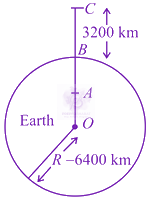
The period of oscillation of a simple pendulum is $T=2\pi \sqrt{\frac{L}{g}}.$ Measured value of $L$ is $1.0m$ from meter scale having a minimum division of $1\mathrm{mm}$ and time of one complete oscillation is $1.95s$ measured from stopwatch of $0.01s$ resolution. The percentage error in the determination of $'g'$ will be:
A ball is thrown up with a certain velocity so that it reaches a height $h.$ Find the ratio of the two different times of the ball reaching $\frac{h}{3}$ in both the directions.
A light cylindrical vessel is kept on a horizontal surface. Area of the base is $A.$ A hole of cross-sectional area $a$ is made just at its bottom side. The minimum coefficient of friction necessary to prevent sliding the vessel due to the impact force of the emerging liquid is 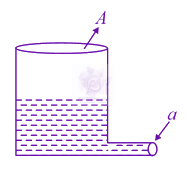
A particle is projected with velocity ${v}_{0}$ along $x$-axis. A damping force is acting on the particle which is proportional to the square of the distance from the origin i.e. $ma=-\alpha {x}^{2}.$ The distance at which the particle stops:
What will be the projection of vector $\vec{A}=\hat{i}+\hat{j}+\hat{k}$ on vector $\vec{B}=\hat{i}+\hat{j}?$
The magnitude of vectors $\vec{\mathrm{OA}},\vec{\mathrm{OB}}$ and $\vec{\mathrm{OC}}$ in the given figure are equal. The direction of $\vec{\mathrm{OA}}+\vec{\mathrm{OB}}-\vec{\mathrm{OC}}$ with $x-$axis will be: 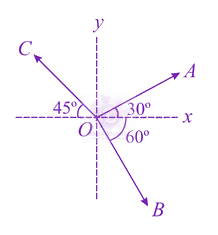
Given below are two statements: one is labelled as Assertion A and the other is labelled as Reason R. Assertion A : Body $P$ having mass $M$ moving with speed $u$ has head-on collision elastically with another body $Q$ having mass $m$ initially at rest. If $m\ll M$, body $Q$ will have a maximum speed equal to $2u$ after collision. Reason R : During elastic collision, the momentum and kinetic energy are both conserved. In the light of the above statements, choose the most appropriate answer from the options given below:
If time $(t),$ velocity $(v),$ and angular momentum $(l)$ are taken as the fundamental units. Then the dimension of mass $(m)$ in terms of $t,v$ and $l$ is:
A person is swimming with a speed of $10m{s}^{-1}$ at an angle of $120^{\circ}$ with the flow and reaches to a point directly opposite on the other side of the river. The speed of the flow is $xm{s}^{-1}.$ The value of $x$ to the nearest integer is ______.
Electric field of a plane electromagnetic wave propagating through a non-magnetic medium is given by $E=20\mathrm{cos}(2\times {10}^{10}t-200x)V{m}^{-1}.$ The dielectric constant of the medium is equal to: (Take ${\mu }_{r}=1)$
A body of mass $(2M)$ splits into four masses ${m,M-m,m,M-m},$ which are rearranged to form a square as shown in the figure. The ratio of $\frac{M}{m}$ for which, the gravitational potential energy of the system becomes maximum is $x:1.$ The value of $x$ is ________. 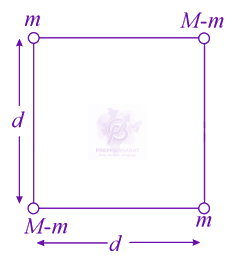
Two vectors $\vec{X}$ and $\vec{Y}$ have equal magnitude. The magnitude of $(\vec{X}-\vec{Y})$ is $n$ times the magnitude of $(\vec{X}+\vec{Y})$. The angle between $\vec{X}$ and $\vec{Y}$ is :
<table class="pyq-table"><tbody><tr><td>List-$I$</td><td>List-$\mathrm{II}$</td></tr><tr><td>$(a)$ $MI$ of the rod (length $L,$ Mass $M,$ about an axis $\perp$ to the rod passing through the midpoint)</td><td>$(i)$ $\frac{8M{L}^{2}}{3}$</td></tr><tr><td>$(b)$ $MI$ of the rod (length $L,$ Mass $2M,$ about an axis $\perp$ to the rod passing through one of its end)</td><td>$(\mathrm{ii})$ $\frac{M{L}^{2}}{3}$</td></tr><tr><td>$(c)$ $MI$ of the rod (length $2L,$ Mass $M,$ about an axis $\perp$ to the rod passing through its midpoint)</td><td>$(\mathrm{iii})$ $\frac{M{L}^{2}}{12}$</td></tr><tr><td>$(d)$ $MI$ of the rod (Length $2L,$ Mass $2M,$ about an axis $\perp$ to the rod passing through one of its end)</td><td>$(\mathrm{iv})$ $\frac{2M{L}^{2}}{3}$</td></tr></tbody></table>Choose the correct answer from the options given below:
Two identical particles of mass $1\mathrm{kg}$ each go round a circle of radius $R$, under the action of their mutual gravitational attraction. The angular speed of each particle is:
A block of mass $m$ slides on the wooden wedge, which in turn slides backward on the horizontal surface. The acceleration of the block with respect to the wedge is: Given $m=8\mathrm{kg},M=16\mathrm{kg}$ Assume all the surfaces shown in the figure to be frictionless. 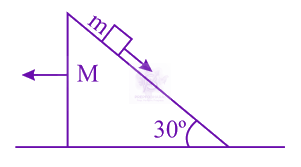
A particle of mass $m$ moves in a circular orbit under the central potential field, $U(r)=\frac{-C}{r}$, where $C$ is a positive constant. The correct radius - velocity graph of the particle's motion is :
The velocity-displacement graph of a particle is shown in the figure. 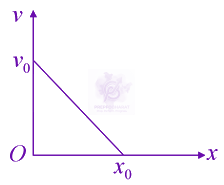 The acceleration-displacement graph of the same particle is represented by :
A uniform metallic wire is elongated by $0.04m$ when subjected to a linear force $F.$ The elongation, if its length and diameter is doubled and subjected to the same force will be _________ $\mathrm{cm}.$
Statement-I : Two forces $(\vec{P}+\vec{Q})$ and $(\vec{P}-\vec{Q})$ where $\vec{P}\perp \vec{Q},$ when act at an angle ${\theta }_{1}$ each other, the magnitude of their resultant is $\sqrt{3({P}^{2}+{Q}^{2})},$ when they act at an angle ${\theta }_{2},$ the magnitude of their resultant becomes $\sqrt{2({P}^{2}+{Q}^{2})}.$ This is possible only when ${\theta }_{1}<{\theta }_{2}.$ Statement-II : In the situation given above. ${\theta }_{1}=60^{\circ}$ and ${\theta }_{2}=90^{\circ}$ In the light of the above statement, choose the most appropriate answer from the options given below :