JEE Main Physics — Mechanics previous year questions with solutions.
The masses and radii of the earth and moon are $({M}_{1},{R}_{1})$ and $({M}_{2},{R}_{2})$ respectively. Their centres are at a distance $r$ apart. Find the minimum escape velocity for a particle of mass $m$ to be projected from the middle of these two masses :
The magnitude of vectors $\vec{\mathrm{OA}},\vec{\mathrm{OB}}$ and $\vec{\mathrm{OC}}$ in the given figure are equal. The direction of $\vec{\mathrm{OA}}+\vec{\mathrm{OB}}-\vec{\mathrm{OC}}$ with $x-$axis will be: 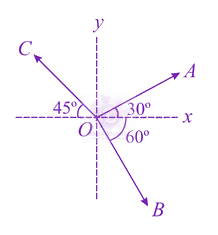
The magnitude of vectors $\vec{\mathrm{OA}},\vec{\mathrm{OB}}$ and $\vec{\mathrm{OC}}$ in the given figure are equal. The direction of $\vec{\mathrm{OA}}+\vec{\mathrm{OB}}-\vec{\mathrm{OC}}$ with $x-$axis will be:<br><img src="https://prepforbharat.s3.ap-south-1.amazonaws.com/exam/615f0e999476412f48314daf/Physics/images/Mathematics_in_Physics/648b5a6b417cc3fb48d673be/question_1__q_648b5a6b417cc3fb48d673be__cdn-question-pool.getmarks.app__f958ec96-79f7-46ca-804b-4243d3868bea-image__8fc9b51105_final_ppt_sync.png" alt="JEE Main 2021 Physics, Mathematics in Physics — question figure">
The length of metallic wire is ${l}_{1}$ when tension in it is ${T}_{1}$. It is ${l}_{2}$ when the tension is ${T}_{2}$. The original length of the wire will be :
The length of a metal wire is ${\ell }_{1},$ when the tension in it is ${T}_{1}$ and is ${\ell }_{2}$ when the tension is ${T}_{2}.$ The natural length of the wire is:
The instantaneous velocity of a particle moving in a straight line is given as $v=\alpha t+\beta {t}^{2}$, where $\alpha$ and $\beta$ are constants. The distance travelled by the particle between $1s$ and $2s$ is:
The initial velocity ${v}_{i}$ required to project a body vertically upward from the surface of the earth to reach a height of $10R$, where $R$ is the radius of the earth, may be described in terms of escape velocity ${v}_{e}$ such that ${v}_{i}=\sqrt{\frac{x}{y}}\times {v}_{e}$. The value of $x$ will be
The initial mass of a rocket is $1000\mathrm{kg}$. Calculate at what rate the fuel should be burnt so that the rocket is given an acceleration of, $20{ms}^{-2}$. The gases come out at a relative speed of $500{ms}^{-1}$, with respect to the rocket: $[\text{Use}g=10m{s}^{-2}]$
The height of victoria's falls is $63m$. What is the difference in the temperature of water at the top and at the bottom of the fall? [Given $1\mathrm{cal}=4.2J$ and specific heat of water $=1\mathrm{cal}{g}^{-1}{C\circ }^{-1}]$
The force is given in terms of time $t$ and displacement $x$ by the equation $F=A\mathrm{cos}Bx+C\mathrm{sin}Dt$ The dimensional formula of $\frac{AD}{B}$ is:
The following bodies, $(1)$ a ring $(2)$ a disc $(3)$ a solid cylinder $(4)$ a solid sphere, of same mass $m$ and radius $R$ are allowed to roll down without slipping simultaneously from the top of the inclined plane. The body which will reach first at the bottom of the inclined plane is [Mark the body as per their respective numbering given in the question] 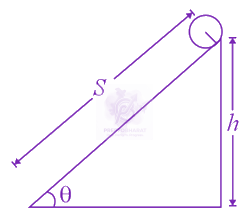
The figure shows two solid discs with radius $R$ and $r$ respectively. If mass per unit area is the same for both, what is the ratio of $MI$ of bigger disc around axis $AB$ (Which is $\perp$ to the plane of the disc and passing through its centre) of $MI$ of smaller disc around one of its diameters lying on its plane? Given $M$ is the mass of the larger disc. ($MI$ stands for a moment of inertia) 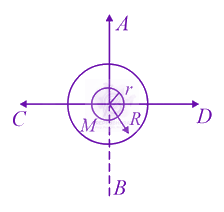
The disc of mass $M$ with uniform surface mass density $\sigma$ is shown in the figure. The center of mass of the quarter disc (the shaded area) is at the position $(\frac{xa}{3\pi },\frac{xa}{3\pi })$ where $x$ is _______ . (Round off to the Nearest Integer) [$a$ is an area as shown in the figure] 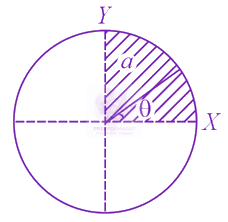
The diameter of a spherical bob is measured using a vernier callipers. $9$ divisions of the main scale, in the vernier callipers, are equal to $10$ divisions of vernier scale. One main scale division is $1\mathrm{mm}.$ The main scale reading is $10\mathrm{mm}$ and ${8}^{\mathrm{th}}$ division of vernier scale was found to coincide exactly with one of the main scale division. If the given vernier callipers has positive zero error of $0.04\mathrm{cm},$ then the radius of the bob is _____________ $\times {10}^{-2}\mathrm{cm}.$
The coefficient of static friction between two blocks is $0.5$ and the table is smooth. The maximum horizontal force that can be applied to move the blocks together is _______$N$ (take $g=10{ms}^{-2})$ 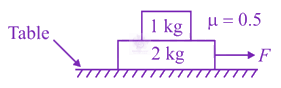
The coefficient of static friction between a wooden block of mass $0.5\mathrm{kg}$ and a vertical rough wall is $0.2.$ The magnitude of the horizontal force that should be applied on the block to keep it adhere to the wall will be______$N$. $⌈g=10m{s}^{-2}]$
The centre of a wheel rolling on a plane surface moves with a speed ${v}_{0}.$ A particle on the rim of the wheel at the same level as the centre will be moving at a speed $\sqrt{x}{v}_{0}.$ Then the value of $x$ is $.$
The boxes of masses $2\mathrm{kg}$ and $8\mathrm{kg}$ are connected by a massless string passing over smooth pulleys. Calculate the time taken by box of mass $8\mathrm{kg}$ to strike the ground starting from rest. $(g=10m{s}^{-2})$ 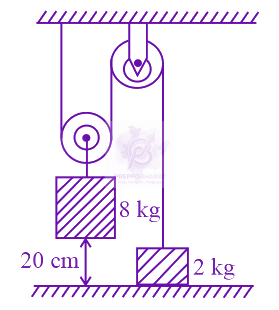
The average translational kinetic energy of ${N}_{2}$ gas molecules at $_________C\circ$ becomes equal to the $K.E.$ of an electron accelerated from rest through a potential difference of $0.1\mathrm{volt}.$ (Given ${k}_{B}=1.38\times {10}^{-23}J{K}^{-1})$ (Fill the nearest integer).
The area of cross-section of a railway track is $0.01{m}^{2}.$ The temperature variation is $10^{\circ}C.$ Coefficient of linear expansion of material of track is ${10}^{-5}C-1\circ .$ The energy stored per meter in the track is $J{m}^{-1}.$ (Young's modulus of material of track is ${10}^{11}N{m}^{-2}$)
The angular speed of truck wheel is increased from $900\mathrm{rpm}$ to $2460\mathrm{rpm}$ in $26$ seconds. The number of revolutions by the truck engine during this time is ______. (Assuming the acceleration to be uniform).
The angular momentum of a planet of mass $M$ moving around the sun in an elliptical orbit is $\vec{L}$. The magnitude of the areal velocity of the planet is :
The angle between vector $(\vec{A})$ and $(\vec{A}-\vec{B})$ is : 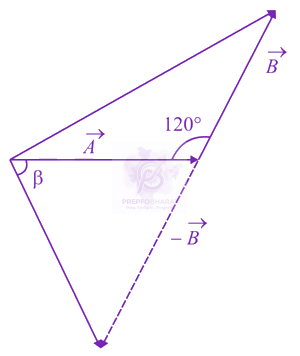
The angle between vector $(\vec{A})$ and $(\vec{A}-\vec{B})$ is :<br><img src="https://prepforbharat.s3.ap-south-1.amazonaws.com/exam/615f0e999476412f48314daf/Physics/images/Mathematics_in_Physics/648b5a6b417cc3fb48d67413/question_1__q_648b5a6b417cc3fb48d67413__cdn-question-pool.getmarks.app__d50634a7-afb5-4efa-b069-eae20a8bec04-image__3ec37d0b87_final_ppt_sync.png" alt="JEE Main 2021 Physics, Mathematics in Physics — question figure">