JEE Main Physics — Mechanics previous year questions with solutions.
Two vectors $\vec{P}$ and $\vec{Q}$ have equal magnitudes. If the magnitude of $\vec{P}+\vec{Q}$ is $n$ times the magnitude of $\vec{P}-\vec{Q},$ then angle between $\vec{P}$ and $\vec{Q}$ is
Statement I: If three forces ${\vec{F}}_{1},{\vec{F}}_{2}$ and ${\vec{F}}_{3}$ are represented by three sides of a triangle and $\vec{{F}_{1}}+\vec{{F}_{2}}=-{\vec{F}}_{3},$ then these three forces are concurrent forces and satisfy the condition for equilibrium.<br>Statement II: A triangle made up of three forces $\vec{{F}_{1}},\vec{{F}_{2}}$ and $\vec{{F}_{3}}$ as its sides were taken in the same order, satisfies the condition for translatory equilibrium.<br>In the light of the above statements, choose the most appropriate answer from the options given below:
A mass of $50\mathrm{kg}$ is placed at the center of a uniform spherical shell of mass $100\mathrm{kg}$ and radius $50m$. If the gravitational potential at a point, $25m$ from the center is $V\mathrm{kg}{m}^{-1}$. The value of $V$ is:
A body rotating with an angular speed of $600\mathrm{rpm}$ is uniformly accelerated to $1800\mathrm{rpm}$ in $10\mathrm{sec}.$ The number of rotations made in the process is
A cord is wound round the circumference of wheel of radius $r$, The axis of the wheel is horizontal and the moment of inertia about it is $I$. A weight $mg$ is attached to the cord at the end. The weight falls from rest. After falling through a distance $h,$ the square of angular velocity of wheel will be
$\mathrm{Assertion}A:$ If $A,B,C,D$ are four points on a semi-circular arc with a centre at $O$ such that $|\vec{AB}|=|\vec{BC}|=|\vec{CD}|.$ Then, $\vec{AB}+\vec{AC}+\vec{AD}=4\vec{AO}+\vec{OB}+\vec{OC}$ $\mathrm{Reason}R:$ Polygon law of vector addition yields $\vec{AB}+\vec{BC}+\vec{CD}+\vec{AD}=2\vec{AO}$ 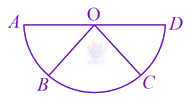 In the light of the above statements, choose the most appropriate answer from the options given below.
The time period of a satellite in a circular orbit of the radius $R$ is $T.$ The period of another satellite in a circular orbit of the radius $9R$ is:
The planet Mars has two moons, if one of them has a period $7$ hours, $30$ minutes and an orbital radius of $9.0\times {10}^{3}\mathrm{km}.$ Find the mass of Mars. ${$ Given $\frac{4{\pi }^{2}}{G}=6\times {10}^{11}{N}^{-1}{m}^{-2}{\mathrm{kg}}^{2}}$
A particle is moving with uniform speed along the circumference of a circle of radius $R$ under the action of a central fictitious force $F$ which is inversely proportional to ${R}^{3}$. Its time period of revolution will be given by :
A solid disc of radius $a$ and mass $m$ rolls down without slipping on an inclined plane making an angle $\theta$ with the horizontal. The acceleration of the disc will be $\frac{2}{b}g\mathrm{sin}\theta$, where $b$ is _______. (Round off to the Nearest Integer) ($g=$ acceleration due to gravity) ($\theta =$ angle as shown in figure) 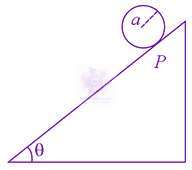
A stone is dropped from the top of a building. When it crosses a point $5m$ below the top, another stone starts to fall from a point $25m$ below the top. Both stones reach the bottom of building simultaneously. The height of the building is :
Match List I with List II.<br><table class="pyq-table"><tbody><tr><td colspan="2" rowspan="1">List I</td><td colspan="2" rowspan="1">List II</td></tr><tr><td>(a)</td><td>$\vec{C}-\vec{A}-\vec{B}=0$</td><td>(i)</td><td><img src="https://prepforbharat.s3.ap-south-1.amazonaws.com/exam/615f0e999476412f48314daf/Physics/images/Mathematics_in_Physics/648b5a6a417cc3fb48d67301/question_1__q_648b5a6a417cc3fb48d67301__cdn-question-pool.getmarks.app__b6c349fb-53c1-4e10-b1fe-828e32653b15-image__3b91df2772_final_ppt_sync.png" alt="JEE Main 2021 Physics, Mathematics in Physics — question figure 1"></td></tr><tr><td>(b)</td><td>$\vec{A}-\vec{C}-\vec{B}=0$</td><td>(ii)</td><td><img src="https://prepforbharat.s3.ap-south-1.amazonaws.com/exam/615f0e999476412f48314daf/Physics/images/Mathematics_in_Physics/648b5a6a417cc3fb48d67301/question_2__q_648b5a6a417cc3fb48d67301__cdn-question-pool.getmarks.app__8dcfe9df-eb9f-48ba-8cc4-cfd2b2c16819-image__2f6e4b06d3_final_ppt_sync.png" alt="JEE Main 2021 Physics, Mathematics in Physics — question figure 2"></td></tr><tr><td>(c)</td><td>$\vec{B}-\vec{A}-\vec{C}=0$</td><td>(iii)</td><td><img src="https://prepforbharat.s3.ap-south-1.amazonaws.com/exam/615f0e999476412f48314daf/Physics/images/Mathematics_in_Physics/648b5a6a417cc3fb48d67301/question_3__q_648b5a6a417cc3fb48d67301__cdn-question-pool.getmarks.app__e1726169-6520-4d6a-92bb-b0147017581e-image__8def3f0e02_final_ppt_sync.png" alt="JEE Main 2021 Physics, Mathematics in Physics — question figure 3"></td></tr><tr><td>(d)</td><td>$\vec{A}+\vec{B}=-\vec{C}$</td><td>(iv)</td><td><img src="https://prepforbharat.s3.ap-south-1.amazonaws.com/exam/615f0e999476412f48314daf/Physics/images/Mathematics_in_Physics/648b5a6a417cc3fb48d67301/question_4__q_648b5a6a417cc3fb48d67301__cdn-question-pool.getmarks.app__1019a326-88c2-4ad4-8b38-ec52abb6bdc9-image__957699a43d_final_ppt_sync.png" alt="JEE Main 2021 Physics, Mathematics in Physics — question figure 4"></td></tr></tbody></table>Choose the correct answer from the options given below:
A planet revolving in elliptical orbit has : A. a constant velocity of revolution. B. has the least velocity when it is nearest to the sun. C. its areal velocity is directly proportional to its velocity. D. areal velocity is inversely proportional to its velocity. E. to follow a trajectory such that the areal velocity is constant. Choose the correct answer from the options given below:
A particle of mass $M$ originally at rest is subjected to a force whose direction is constant but magnitude varies with time according to the relation $F={F}_{0}[1-{(\frac{t-T}{T})}^{2}]$ where ${F}_{0}$ and $T$ are constants. The force acts only for the time interval $2T$. The velocity $v$ of the particle after time $2T$ is:
Match List - I with List - II.<table class="pyq-table"><tbody><tr><td></td><td>List - I</td><td></td><td>List - II</td></tr><tr><td>a</td><td>Torque</td><td>i</td><td>${\mathrm{MLT}}^{-1}$</td></tr><tr><td>b</td><td>Impulse</td><td>ii</td><td>${\mathrm{MT}}^{-2}$</td></tr><tr><td>c</td><td>Tension</td><td>iii</td><td>${\mathrm{ML}}^{2}{T}^{-2}$</td></tr><tr><td>d</td><td>Surface Tension</td><td>iv</td><td>${\mathrm{MLT}}^{-2}$</td></tr></tbody></table>Choose the most appropriate answer from the option given below :
Inside a uniform spherical shell : (a) The gravitational field is zero. (b) The gravitational potential is zero. (c) The gravitational field is the same everywhere. (d) The gravitation potential is the same everywhere. (e) All the above. Choose the most appropriate answer from the options given below:
Which of the following equations is dimensionally incorrect? Where $t=$time, $h=$height, $s=$surface tension, $\theta =$angle, $\rho =$density $,a,r=$radius, $g=$ the acceleration due to gravity, $V=$volume, $p=$pressure, $W=$work done, $\tau =$torque, $\epsilon =$permittivity, $E=$electric field, $J=$current density, $L=$length.
Four identical hollow cylindrical columns of mild steel support a big structure of mass $50\times {10}^{3}\mathrm{kg}.$ The inner and outer radii of each column are $50\mathrm{cm}$ and $100\mathrm{cm}$ respectively. Assuming uniform local distribution, calculate the compression strain of each column. [use $Y=2.0\times {10}^{11}\mathrm{Pa},g=9.8m{s}^{-2}$]
A uniform thin bar of mass $6\mathrm{kg}$ and length $2.4$ meter is bent to make an equilateral hexagon. The moment of inertia about an axis passing through the centre of mass and perpendicular to the plane of hexagon is ___________ $\times {10}^{-1}\mathrm{kg}{m}^{2}.$
A force $\vec{F}=(40\hat{i}+10\hat{j})N$ acts on a body of mass $5\mathrm{kg}$. If the body starts from rest, its position vector $\vec{r}$ at time $t=10s$ will be
Moment of inertia of a square plate of side $l$ about the axis passing through one of the corner and perpendicular to the plane of square plate is given by:
The position of the centre of mass of a uniform semi-circular wire of radius $R$ placed in $x-y$ plane with its centre at the origin and the line joining its ends as $x-$axis is given by, $(0,\frac{xR}{\pi }).$ Then, the value of $|x|$ is $.$
Two discs have moments of intertia ${I}_{1}$ and ${I}_{2}$ about their respective axes perpendicular to the plane and passing through the centre. They are rotating with angular speeds, ${\omega }_{1}$ and ${\omega }_{2}$ respectively and are brought into contact face to face with their axes of rotation coaxial. The loss in kinetic energy of the system in the process is given by:
Three students ${S}_{1},{S}_{2}$ and ${S}_{3}$ perform an experiment for determining the acceleration due to gravity $(g)$ using a simple pendulum. They use different lengths of pendulum and record time for different number of oscillations. The observations are as shown in the table. <table class="pyq-table"><tbody><tr><td>Student No.</td><td>Length of pendulum $(\mathrm{cm})$</td><td>Number of oscillations $(n)$</td><td>Total time for $n$ oscillations</td><td>Time period $(s)$</td></tr><tr><td>$1.$</td><td>$64.0$</td><td>$8$</td><td>$128.0$</td><td>$16.0$</td></tr><tr><td>$2.$</td><td>$64.0$</td><td>$4$</td><td>$64.0$</td><td>$16.0$</td></tr><tr><td>$3.$</td><td>$20.0$</td><td>$4$</td><td>$36.0$</td><td>$9.0$</td></tr></tbody></table>(Least count of length $=0.1m$, least count for time $=0.1s$) If ${E}_{1},{E}_{2}$ and ${E}_{3}$ are the percentage errors in $g$ for students $1,2$ and $3$, respectively, then the minimum percentage error is obtained by student no $.$