JEE Main Physics — Mechanics previous year questions with solutions.
The angle between vector $(\vec{A})$ and $(\vec{A}-\vec{B})$ is : 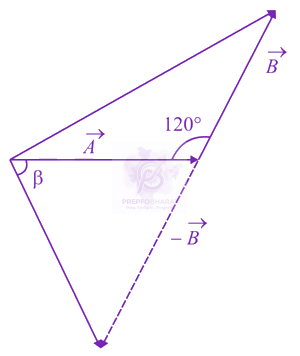
A steel block of $10\mathrm{kg}$ rests on a horizontal floor as shown. When three iron cylinders are placed on it as shown, the block and cylinders go down with an acceleration $0.2m{s}^{-2}.$ The normal reaction ${R}^{'}$ by the floor if mass of the iron cylinders are equal and of $20\mathrm{kg}$ each is $(\text{in}N)$, [Take $g=10m{s}^{-2}$ and ${\mu }_{s}=0.2]$ 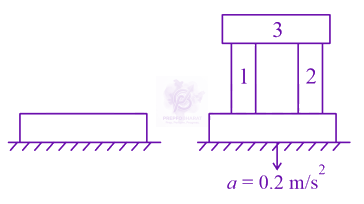
The magnitude of vectors $\vec{\mathrm{OA}},\vec{\mathrm{OB}}$ and $\vec{\mathrm{OC}}$ in the given figure are equal. The direction of $\vec{\mathrm{OA}}+\vec{\mathrm{OB}}-\vec{\mathrm{OC}}$ with $x-$axis will be:<br><img src="https://prepforbharat.s3.ap-south-1.amazonaws.com/exam/615f0e999476412f48314daf/Physics/images/Mathematics_in_Physics/648b5a6b417cc3fb48d673be/question_1__q_648b5a6b417cc3fb48d673be__cdn-question-pool.getmarks.app__f958ec96-79f7-46ca-804b-4243d3868bea-image__8fc9b51105_final_ppt_sync.png" alt="JEE Main 2021 Physics, Mathematics in Physics — question figure">
A block of mass m slides down an inclined plane of inclination θ with uniform speed. The coefficient of friction between the block and the plane is:
A ball is thrown vertically upward with velocity 20 m/s from a tower of height 25 m. The speed with which it hits the ground is (g = 10 m/s²):
An object of mass $m$ is being moved with a constant velocity under the action of an applied force of $2N$ along a frictionless surface with following surface profile. 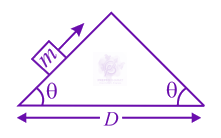 The correct applied force vs distance graph will be :
The angle between vector $(\vec{A})$ and $(\vec{A}-\vec{B})$ is :<br><img src="https://prepforbharat.s3.ap-south-1.amazonaws.com/exam/615f0e999476412f48314daf/Physics/images/Mathematics_in_Physics/648b5a6b417cc3fb48d67413/question_1__q_648b5a6b417cc3fb48d67413__cdn-question-pool.getmarks.app__d50634a7-afb5-4efa-b069-eae20a8bec04-image__3ec37d0b87_final_ppt_sync.png" alt="JEE Main 2021 Physics, Mathematics in Physics — question figure">
If $\vec{P}\times \vec{Q}=\vec{Q}\times \vec{P}$, the angle between $\vec{P}$ and $\vec{Q}$ is $\theta (0^{\circ}<\theta <360^{\circ})$. The value of $\theta$ will be ___$^{\circ}$.
A bullet of mass $0.1\mathrm{kg}$ is fired on a wooden block to pierce through it, but it stops after moving a distance of $50\mathrm{cm}$ into it. If the velocity of the bullet before hitting the wood is $10m{s}^{-1}$ and, it slows down with uniform deceleration, then the magnitude of effective retarding force on the bullet is $xN.$ The value of $x$ to the nearest integer is,
A stone of mass $20g$ is projected from a rubber catapult of length $0.1m$ and area of cross section ${10}^{-6}{m}^{2}$ stretched by an amount $0.04m.$ The velocity of the projected stone is $m{s}^{-1}.$ (Young's modulus of rubber $=0.5\times {10}^{9}N{m}^{-2}$)
Wires ${W}_{1}$ and ${W}_{2}$ are made of same material having the breaking stress of $1.25\times {10}^{9}N{m}^{-2}.{W}_{1}$ and ${W}_{2}$ have cross-sectional area of $8\times {10}^{-7}{m}^{2}$ and $4\times {10}^{-7}{m}^{2}$, respectively. Masses of $20\mathrm{kg}$ and $10\mathrm{kg}$ hang from them as shown in the figure. The maximum mass that can be placed in the pan without breaking the wires is _____$\mathrm{kg}$ (Use $g=10m{s}^{-2})$ 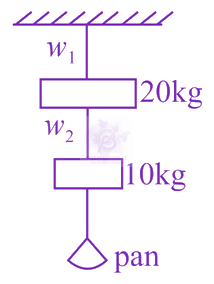
A balloon was moving upwards with a uniform velocity of $10m{s}^{-1}$. An object of finite mass is dropped from the balloon when it was at a height of $75m$ from the ground level. The height of the balloon from the ground when object strikes the ground was around: (takes the value of $g$ as $10m{s}^{-2}$)
The maximum and minimum distances of a comet from the Sun are $1.6\times {10}^{12}m$ and $8.0\times {10}^{10}m$ respectively. If the speed of the comet at the nearest point is $6\times {10}^{4}{ms}^{-1}$, the speed at the farthest point is
If one wants to remove all the mass of the earth to infinity in order to break it up completely. The amount of energy that needs to be supplied will be $\frac{x}{5}\frac{G{M}^{2}}{R}$ where $x$ is ________. (Round off to the Nearest Integer) ($M$ is the mass of earth, $R$ is the radius of earth, $G$ is the gravitational constant)
Angular momentum of a single particle moving with constant speed along circular path :
In Millikan's oil drop experiment, what is viscous force acting on an uncharged drop of radius $2.0\times {10}^{-5}m$ and density $1.2\times {10}^{3}\mathrm{kg}{m}^{-3}$? Take viscosity of liquid $=1.8\times {10}^{-5}Ns{m}^{-2}.$ (Neglect buoyancy due to air).
A triangular plate is shown. A force $\vec{F}=4\hat{i}-3\hat{j}$ is applied at point $P.$ The torque at point $P$ with respect to point $O$ and $Q$ are: 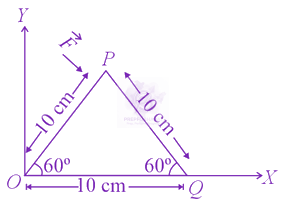
The angular speed of truck wheel is increased from $900\mathrm{rpm}$ to $2460\mathrm{rpm}$ in $26$ seconds. The number of revolutions by the truck engine during this time is ______. (Assuming the acceleration to be uniform).
The coefficient of static friction between two blocks is $0.5$ and the table is smooth. The maximum horizontal force that can be applied to move the blocks together is _______$N$ (take $g=10{ms}^{-2})$ 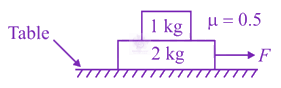
A body of mass $1\mathrm{kg}$ rests on a horizontal floor with which it has a coefficient of static friction $\frac{1}{\sqrt{3}}$. It is desired to make the body move by applying the minimum possible force $FN$. The value of $F$ will be _______.(Round off to the Nearest Integer) [Take $g=10{ms}^{-2}$ ]
A swimmer wants to cross a river from point $A$ to point $B$. Line AB makes an angle of $30^{\circ}$ with the flow of the river. The magnitude of the velocity of the swimmer is the same as that of the river. The angle $\theta$ with the line $AB$ should be _______$^{\circ}$, so that the swimmer reaches point $B$. 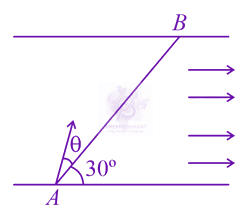
The normal reaction $N$ for a vehicle of $800\mathrm{kg}$ mass, negotiating a turn on a $30^{\circ}$ banked road at maximum possible speed without skidding is ____ $\times {10}^{3}\mathrm{kg}m{s}^{-2}$.
Two masses $A$ and $B$, each of mass $M$ are fixed together by a massless spring, A force acts on the mass $B$ as shown in figure. If the mass $A$ starts moving away from mass $B$ with acceleration $a$, then the acceleration of mass $B$ will be : 
The initial mass of a rocket is $1000\mathrm{kg}$. Calculate at what rate the fuel should be burnt so that the rocket is given an acceleration of, $20{ms}^{-2}$. The gases come out at a relative speed of $500{ms}^{-1}$, with respect to the rocket: $[\text{Use}g=10m{s}^{-2}]$