Mechanics PYQ — Page 13
JEE Main Physics — Mechanics previous year questions with solutions.
All Mechanics Questions (2069)
A 3 m long wire of radius 3 mm shows an extension of 0.1 mm when loaded vertically by a mass of 50 kg in an experiment to determine Young's modulus. The value of Young's modulus of the wire as per this experiment is $\mathrm{P} \times 10^{11} \mathrm{Nm}^{-2}$, where the value of P is: (Take $\left.\mathrm{g}=3 \pi \mathrm{~m} / \mathrm{s}^2\right)$
A balloon and its content having mass $M$ is moving up with an acceleration ' $a$ '. The mass that must be released from the content so that the balloon starts moving up with an acceleration ' $3 a^{\prime}$ will be (Take ' g ' as acceleration due to gravity)
Two cylindrical vessels of equal cross sectional area of $2 \mathrm{~m}^2$ contain water up to height 10 m and 6 m , respectively. If the vessels are connected at their bottom then the work done by the force of gravity is : (Density of water is $10^3 \mathrm{~kg} / \mathrm{m}^3$ and $\mathrm{g}=10 \mathrm{~m} / \mathrm{s}^2$)
A body of mass 2 kg moving with velocity of $\overrightarrow{\mathrm{v}}_{\mathrm{in}}=3 \hat{\mathrm{i}}+4 \hat{\mathrm{j}} \mathrm{ms}^{-1}$ enters into a constant force field of 6 N directed along positive z -axis. If the body remains in the field for a period of $\frac{5}{3}$ seconds, then velocity of the body when it emerges from force field is
An object is kept at rest at a distance of 3 R above the earth's surface where R is earth's radius. The minimum speed with which it must be projected so that it does not return to earth is : (Assume $\mathrm{M}=$ mass of earth, $\mathrm{G}=$ Universal gravitational constant)
The dimension of $\sqrt{\frac{\mu_0}{\epsilon_0}}$ is equal to that of : ( $\mu_0=$ Vacuum permeability and $\epsilon_0=$ Vacuum permittivity)
A satellite is launched into a circular orbit of radius ' R ' around the earth. A second satellite is launched into an orbit of radius 1.03 R . The time period of revolution of the second satellite is larger than the first one approximately by
The moment of inertia of a circular ring of mass $M$ and diameter r about a tangential axis lying in the plane of the ring is :
A block of mass 1 kg , moving along x with speed $\mathrm{v}_{\mathrm{i}}=10 \mathrm{~m} / \mathrm{s}$ enters a rough region ranging from $\mathrm{x}=0.1 \mathrm{~m}$ to $\mathrm{x}=1.9 \mathrm{~m}$. The retarding force acting on the block in this range is $\mathrm{F}_{\mathrm{r}}=-\mathrm{kx} \mathrm{N}$, with $\mathrm{k}=10 \mathrm{~N} / \mathrm{m}$. Then the final speed of the block as it crosses rough region is
The expression given below shows the variation of velocity \((v)\) with time (t), \(v=\mathrm{At}^2+\frac{\mathrm{Bt}}{\mathrm{C}+\mathrm{t}}\). The dimension of ABC is :
A force $\mathrm{F}=\alpha+\beta \mathrm{x}^2$ acts on an object in the x -direction. The work done by the force is 5 J when the object is displaced by 1 m . If the constant $\alpha=1 \mathrm{~N}$ then $\beta$ will be
A car of mass ' $m$ ' moves on a banked road having radius ' $r$ ' and banking angle $\theta$. To avoid slipping from banked road, the maximum permissible speed of the car is $v_0$. The coefficient of friction $\mu$ between the wheels of the car and the banked road is
A circular disk of radius R meter and mass M kg is rotating around the axis perpendicular to the disk. An external torque is applied to the disk such that $\theta(t)=5 t^2-8 t$, where $\theta(t)$ is the angular position of the rotating disc as a function of time $t$. How much power is delivered by the applied torque, when $t=2 \mathrm{~s}$ ?
An object with mass 500 g moves along x -axis with speed $v=4 \sqrt{x} \mathrm{~m} / \mathrm{s}$. The force acting on the object is :
A sportsman runs around a circular track of radius $r$ such that he traverses the path $A B A B$. The distance travelled and displacement, respectively, are 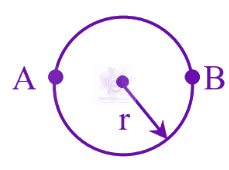
Two projectiles are fired with same initial speed from same point on ground at angles of \(\left(45^{\circ}-\alpha\right)\) and \(\left(45^{\circ}+\alpha\right)\), respectively, with the horizontal direction. The ratio of their maximum heights attained is :
In a hydraulic lift, the surface area of the input piston is \(6 \mathrm{~cm}^2\) and that of the output piston is \(1500 \mathrm{~cm}^2\). If 100 N force is applied to the input piston to raise the output piston by 20 cm, then the work done is _______ kJ.
A block of mass 25 kg is pulled along a horizontal surface by a force at an angle $45^{\circ}$ with the horizontal. The friction coefficient between the block and the surface is 0.25. The displacement of 5 m of the block is:
Two water drops each of radius 'r' coalesce to from a bigger drop. If ' T ' is the surface tension, the surface energy released in this process is :
A vessel with square cross-section and height of 6 m is vertically partitioned. A small window of $100 \mathrm{~cm}^2$ with hinged door is fitted at a depth of 3 m in the partition wall. One part of the vessel is filled completely with water and the other side is filled with the liquid having density $1.5 \times 10^3 \mathrm{~kg} / \mathrm{m}^3$. What force one needs to apply on the hinged door so that it does not get opened ? (Acceleration due to gravity $=10 \mathrm{~m} / \mathrm{s}^2$)
A solid sphere and a hollow sphere of the same mass and of same radius are rolled on an inclined plane. Let the time taken to reach the bottom by the solid sphere and the hollow sphere be $t_1$ and $t_2$, respectively, then
The position of a particle moving on $x$-axis is given by $x(t)=A \sin t+B \cos ^2 t+C t^2+D$, where $t$ is time. The dimension of $\frac{A B C}{D}$ is
The coordinates of a particle with respect to origin in a given reference frame is \((1,1,1)\) meters. If a force of \(\overrightarrow{\mathrm{F}}=\hat{i}-\hat{j}+\hat{k}\) acts on the particle, then the magnitude of torque (with respect to origin) in z-direction is ______.
A thin transparent film with refractive index 1.4 , is held on circular ring of radius 1.8 cm . The fluid in the film evaporates such that transmission through the film at wavelength 560 nm goes to a minimum every 12 seconds. Assuming that the film is flat on its two sides, the rate of evaporation is ____ $\pi \times 10^{-13} \mathrm{~m}^3 / \mathrm{s}$.