CUET UG 2025 — Calculus
Mathematics Calculus questions from CUET UG 2025.
Other Years
523 Calculus Questions from 2025
Match **List-I** with **List-II** | List-I | List-II | |---|---| | **Function** | **Increasing on the interval** | | (A) $f(x) = -x^2 - 2x + 1$ | (I) $(-\infty, -1)$ | | (B) $f(x) = x^2 + 1$ | (II) $(1, \infty)$ | | (C) $f(x) = x^2 - 2x + 3$ | (III) $(-\infty, 0)$ | | (D) $f(x) = -x^2$ | (IV) $(0, \infty)$ | Choose the correct answer from the options given below:
For what value of $\alpha$, the function $f$ defined by $f(x) = \begin{cases} \alpha(x^2 - 2x + 1), & \text{if } x \leq 0 \\ 2x + 1, & \text{if } x > 0 \end{cases}$ is continuous at $x = 0$?
$\int_0^{\pi/2} \sqrt{1 - \sin 2x}\,dx$ is equal to:
The equation of the tangent to the curve $y = \frac{(x - 3)}{(x - 1)(x - 2)}$ at the point, where it cuts x-axis is:
The area (in sq. units) of the region bounded by the curve $y = \sqrt{16-x^2}$ and x-axis is
Match List-I with List-II | List-I | List-II | | --- | --- | | (A) $f(x) = x \sin x$ | (I) is not continuous at $x = -3$ | | (B) $f(x) = \frac{\vert x\vert }{x}, x \neq 0$ and $f(x) = 1 \text{ at } x = 0$ | (II) is continuous everywhere | | (C) $f(x) = x - [x]$, $[x]$ denotes greatest integer function | (III) is not differentiable at $x = 1$ | | (D) $f(x) = e^{\vert x - 1\vert }$ | (IV) is not continuous at $x = 0$ | Choose the correct answer from the options given below:
The value of $\int_{-a}^a f(x)dx$ where $f(x) = \frac{7^x}{1+7^x}$ is:
The rate of change of volume of a sphere with respect to its surface area, when radius is 4 cm, is equal to
$\int \frac{e^{2x} - e^{-2x}}{e^{2x} + e^{-2x}}dx$ is equal to
If the interval in which the function $f(x) = 4x^3 - 6x^2 - 72x + 30$ is strictly decreasing, is (a,b) then a+b is equal to
If the slope of the tangent to the curve $y = y(x)$ at any point $(x, y)$ is $\frac{2x}{y^2}$ and the curve passes through the point $\left(\frac{1}{\sqrt3}, 1\right)$, then equation of curve is
The area (in sq. units) bounded by the curve $y = \cos x$ and x-axis between $x = 0$ and $x = \frac{3\pi}{2}$ is
The general solution of the differential equation $\frac{dy}{dx} + y \tan x = \sec x$
If the function $f(x) = \begin{cases}\frac{\sin 3x}{x}, & \text{if } x \neq 0\\ \frac{3k}{2}, & \text{if } x = 0\end{cases}$ is continuous at $x = 0$, then the value of $k$ is
If $y = (log x)^{(log x)}$, $x > 1$ then $\frac{dy}{dx}$ is equal to
$\int_2^5 |x - 3|dx$ equals
Let $f(x)=\begin{cases}\dfrac{|x|}{x},&x\ne0\\1,&x=0\end{cases}$ and $g(x)=\begin{cases}x\sin\left(\dfrac{1}{x}\right),&x\ne0\\0,&x=0\end{cases}$ Then at the origin, which one of the following is true?
The function $f(x) = \frac{x}{2} + \frac{2}{x}, x \neq 0$ is increasing on (A) $(-\infty, -2)$ (B) $(-2, 2)$ (C) $(2, \infty)$ (D) $(-1, 1)$ Choose the correct answer from the options given below:
If $f(x) = x^2 - 4x + 13, x \in \mathbb{R}$, then which of the following are correct? (A) $x = 2$ is a stationary point of $f(x)$. (B) $f(x)$ is increasing function on $(2, \infty)$ (C) $f(x)$ have maxima at $x = 2$ (D) $f(2) = 9$ Choose the correct answer from the options given below:
If $f(x) = x^3 e^{-x}$, then the value of $f''(1)$ is equal to
The sum of the order and degree of the differential equation representing the family of curves $y = mx + m^4$, where m is arbitrary constant, is
If $y = \sqrt{2024x + 2025}$, then which of the following is correct?
$\int \frac{\log_e x}{(1 + \log_e x)^2} dx$ is equal to
The area (in sq.units) of the region enclosed by the curve $y = \cos x$, $\frac{-\pi}{2} \leq x \leq \frac{\pi}{2}$ and the x - axis is:
$\int_0^2 (|x| + |x - 2|) dx =$
The interval(s), where the function $f(x) = \begin{cases} \frac{1-e^x}{e^{2x}-1} & : x \neq 0 \\ \frac{-1}{2} & : x = 0 \end{cases}$ is increasing, is/ are:
A square board of side 36cm is made into a box without top by cutting a square from each corner and folding up the flaps to form a box then maximum volume of the box is
The general solution of the differential equation $\frac{dy}{dx} = e^{x-y} + x^2e^{-y}$ is equal to:
The radius of spherical balloon is decreasing at the rate of 0.1cm/sec, the rate at which its volume is decreasing, when its radius is 0.5cm is
For $x \neq -1$, if $\int \frac{xe^x dx}{(1+x)^2} = \frac{ae^x}{(1+x)^b} + c$, where a, b are fixed numbers and c is the integration constant, then $a + b$ is equal to
If the function $f(x) = \begin{cases} \frac{k\cos x}{\pi - 2x} & : x \neq \frac{\pi}{2} \\ 3 & : x = \frac{\pi}{2} \end{cases}$ is continuous at $x = \frac{\pi}{2}$, then $k$ is equal to
$\int \frac{e^{7\log_e x} - e^{6\log_e x}}{e^{4\log_e x} - e^{3\log_e x}} dx$ is equal to: (Here, c is an arbitrary constant)
The integrating factor of the differential equation, $x^2 \frac{dy}{dx} + xy = log_e x$ is equal to
$\int (e^{x\log a} + e^{a\log x}) dx$ is equal to (where $a > 1$)
The order of $\sqrt{1 + \left(\frac{dy}{dx}\right)^2} = \left[a \frac{d^2y}{dx^2}\right]^{\frac{1}{2}}$ is
If the function $f(x) = \begin{cases} ax + 2, & x \leq 1 \\ x^2 + 3x + b, & x > 1 \end{cases}$ is differentiable at $x = 1$, then the value of $(2a + b)$ is
If $y = \cos^{-1}\left(\frac{1-x^2}{1+x^2}\right), 0 < x < 1$, then $\frac{dy}{dx}$ is equal to
The semi vertical angle of a right circular cone of maximum volume of a given slant height is
For the function $f(x) = x^x, x > 0$, which of the following are TRUE? (A) $f'(x) = x^x(1 + \log x)$ (B) $x = e$ is the critical point (C) $f$ is increasing in $(\frac{1}{e}, \infty)$ (D) $f$ is increasing in $(0, \infty)$ Choose the *correct* answer from the options given below:
The function $f(x) = \begin{cases} \frac{(\sin 2x)}{x} + \cos x & , if \ x \neq 0 \\ K & , if \ x = 0 \end{cases}$ is continuous at $x = 0$, then the value of K is:
If $f(x) = \begin{cases}\frac{1- \tan x}{4x-\pi}, & x \neq \frac{\pi}{4} \\ k, & x = \frac{\pi}{4}\end{cases}$ is continuous at $x = \frac{\pi}{4}$, then the value of k is
Match List-I with List-II | List-I | List-II | | --- | --- | | (A) Point of minima of $f(x) = \vert x+1\vert $ | (I) 1 | | (B) Minimum value of $f(x) = \vert x\vert $ | (II) -1 | | (C) Maximum value of $f(x) = 1 - x^2$ | (III) 2 | | (D) Minimum value of $f(x) = 2 + \sin^2 x$ | (IV) 0 | Choose the correct answer from the options given below:
A spherical ice ball is melting at the rate of 100 $\pi$ cm³/min. The rate at which its radius is decreasing when its radius is 15 cm, is
Match List-I with List-II | List-I | List-II | | --- | --- | | (A) $\int \dfrac{dx}{x^2 - 16}$ | (I) $\dfrac{1}{8} \log \left\vert \dfrac{4 + x}{4 - x} \right\vert + c$, Where C is an arbitrary constant, | | (B) $\int \dfrac{dx}{x^2 + 16}$ | (II) $\log \left\vert x + \sqrt{x^2 - 16} \right\vert + c$, Where C is an arbitrary constant, | | (C) $\int \dfrac{dx}{16 - x^2}$ | (III) $\dfrac{1}{8} \log \left\vert \dfrac{x - 4}{x + 4} \right\vert + c$, Where C is an arbitrary constant, | | (D) $\int \dfrac{dx}{\sqrt{x^2 - 16}}$ | (IV) $\dfrac{1}{4} \tan^{-1} \left( \dfrac{x}{4} \right) + c$, Where C is an arbitrary constant, | Choose the correct answer from the options given below:
The number of arbitrary constants in the general solution of a differential equation with degree 1 and order 3, is
If $\int \frac{(1 + x \log x)}{xe^{-x}} dx = e^x f(x) + C$, where C is constant of integration, then $f(x)$ is
In which of the following interval, the function $f(x) = \frac{x}{\log x}$ is decreasing?
Match List-I with List-II | List-I | List-II | |---|---| | (A) Degree of the differential equation $\frac{d^2y}{dx^2} = e^{dy/dx}$ is | (I) 2 | | (B) Order of the differential equation $(\frac{dy}{dx})^2 + \frac{d^3y}{dx^3} = 0$ is | (II) not defined | | (C) Degree of the differential equation $\frac{d^2y}{dx^2} + (\frac{dy}{dx})^2 - 5x^2 = 0$ | (III) 3 | | (D) If p is the order and q is the degree of the differential equation $\frac{dy}{dx} + 3y = e^x$, then p + q is | (IV) 1 | Choose the correct answer from the options given below:
Area of the region bounded by the curve $y^2 = 4x$, $y$-axis and the line $y = 3$ is equal to
$\int \frac{dx}{e^x + e^{-x}}$ is equal to
Which of the following functions has a local minima at $x = 0$? (A) $f(x) = x^3$ (B) $f(x) = |x|$ (C) $f(x) = x^2$ (D) $f(x) = x^{-2}$ Choose the correct answer from the options given below:
The two positive numbers whose sum is 16 and the sum of whose squares is minimum then the positive numbers are:
The function $f(x) = 4x^3 - 7x^2$ has point(s) of local minima at
$\int \tan^{-1}\sqrt{x} $ $dx$ equals to: (Here C is an arbitrary constant)
The demand function (in Rs.) for a product is given by $P = 20 - 0.25x$, where P is the price per unit and x is the number of units sold, then the price of one unit, when the revenue is maximized, is:
The area (in sq. units) bounded by the parabola $y^2 = 16x$ and its latus rectum is
Match **List-I** with **List-II** | List-I | List-II | |---|---| | **Differential Equations** | **Order and degree** | | (A) $\frac{dy}{dx} + e^y = 0$ | (I) order 2, degree not defined | | (B) $\frac{d^2y}{dx^2} = \left[1 + \left(\frac{dy}{dx}\right)^2\right]^{3/2}$ | (II) order 2, degree 1 | | (C) $\left(\frac{d^2y}{dx^2}\right)^2 + e^{(\frac{dy}{dx})} = 0$ | (III) order 1, degree 1 | | (D) $\frac{d^2y}{dx^2} + x\frac{dy}{dx} - 2y = logx; x > 0$ | (IV) order 2, degree 2 | Choose the **correct** answer from the options given below:
The marginal cost of production of x units of a commodity is $56 + \frac{3}{2}x$. It is known that fixed costs are Rs.115. Then the total cost of producing 50 units is:-
The greatest possible value of '$a$' such that the function $f(x) = x^2 + a x + 1$ is always decreasing in the interval [1, 2] is:
If $2f(x) + f\left(\frac{1}{x}\right) = x^2 + 1$, then $\int f(x) dx$ is: (Here C is an arbitrary constant)
The sides of an equilateral triangle are increasing at the rate of 2 cm/sec. The rate at which the area increases when the side is 10 cm, is
Match List-I with List-II | List-I | List-II | |---|---| | (A) The degree of differential equation $\frac{d^3y}{dx^3} = e^{\frac{dx}{dy}}$ | (I) 2 | | (B) The order of differential equation $\left(\frac{dy}{dx}\right)^2 + \frac{d^3y}{dx^3} = 0$ | (II) 4 | | (C) The sum of order and degree of differential equation $\frac{d}{dx}\left(\frac{d^2y}{dx^2}\right) + \left(\frac{dy}{dx}\right)^5 = x$ | (III) not defined | | (D) The number of arbitrary constants in the general solution of a differential equation of order 2 | (IV) 3 | Choose the correct answer from the options given below:
The total cost function is given by $c(x) = \frac{1}{3}x^3 - 5x^2 + 30x - 15$ and selling price per unit is Rs.6. The profit is maximum if the value of x is:
Let $y = \cos(\sin x^2)$, then the value of $\frac{dy}{dx}$ at $x = \frac{\sqrt{\pi}}{2}$ is equal to
Match List-I with List-II | List-I | List-II | |---|---| | **Differential Equation** | **Integrating Factor** | | (A) $\frac{dy}{dx} + 2xy = 1$ | (I) $x$ | | (B) $x\frac{dy}{dx} + 2xy = 1$ | (II) $e^{2x}$ | | (C) $x\frac{dy}{dx} + y = 1$ | (III) $x^2$ | | (D) $x\frac{dy}{dx} + 2y = 2$ | (IV) $e^{x^2}$ | Choose the correct answer from the options given below:
If $x\sqrt{1 + y} + y\sqrt{1 + x} = 0$, where $|x| < 1, |y| < 1$ and $x ≠ y$, then
$\int \frac{(x-1)e^x}{x^2} dx, x > 0$ equals (where C is an arbitrary constant)
If the function $f(x) = 2x^3 + 9x^2 + 12x-1$ is given,then $f(x)$ have
The general solution of the differential equation $(x^2 - yx^2)dy + (y^2 + x^2y^2)dx = 0$ is:
Let $y(x) = a(x + 1) \log(x + 1) + bx + 5$ be the solution of the differential equation e$^\frac{dy}{dx} = x + 1_{;}y(0) = 5$, then the value of $(a + b)$ is:
If $e^y(x + 1) = 1$ and $\frac{d^2y}{dx^2} = k(\frac{dy}{dx})^2$, then k is equal to
The function $f: R \rightarrow R$ (where $R$ is set of real numbers) defined as $f(x) = x^2 + 2x$ is
The value of ∫₀¹ x·eˣ dx is:
The solution of the differential equation $\log_e\left(\frac{dy}{dx}\right) = 5x + 2y$ is given by
For $x > 0$, the minimum value of $\frac{x}{\log_e x}$ is
Value of $\int \frac{2}{(x-3)\sqrt{x+1}} dx$ is: (Here C is an arbitrary constant)
If $y = \sqrt{x + \sqrt{x + \sqrt{x + ...\ ...\ ...}}}$, then
$\int (x^4 + x^2 + 1)d(x^2)$ is equal to: (where c is an integration constant)
For $x \in \mathbb{R}$, if $f(x) = -(x-1)^2 + 2$, then (A) $f$ is an increasing function on $(-\infty, 1]$ (B) $f$ has no critical points (C) $f$ has a maximum value at $x = 1$ (D) $f$ has a minimum value at $x = 1$ Choose the correct answer from the options given below:
Match **List-I** with **List-II** | List-I | List-II | |---|---| | **Differential Equation** | **Degree** | | (A) $xy\frac{d^2y}{dx^2} + x\left(\frac{dy}{dx}\right)^2 - y\frac{dy}{dx} = 0$ | (I) 3 | | (B) $\frac{d^2y}{dx^2} + \log\left(\frac{dy}{dx}\right) = 0$ | (II) 1 | | (C) $\left(\frac{d^2y}{dx^2}\right)^2 + \left(\frac{dy}{dx}\right)^3 + \frac{dy}{dx} + 1 = 0$ | (III) not defined | | (D) $2x^2\left(\frac{d^2y}{dx^2}\right)^3 - 5\left(\frac{dy}{dx}\right)^3 + y = 0$ | (IV) 2 | Choose the correct answer from the options given below:
The general solution of differential equation $\frac{dy}{dx} = e^{x+y}$ is
Match List-I with List-II | List-I | List-II | | --- | --- | | Function f(x) | Interval for increasing/decreasing of function f(x) | | --- | --- | | (A) $f(x) = x\vert x\vert $ | (I) Decreases on $(0, \infty)$ | | (B) $f(x) = x^2 + 2x - 5$ | (II) Increases on $(3, \infty)$ | | (C) $f(x) = x^2 - 6x + 9$ | (III) Decreases on $(-\infty, -1)$ | | (D) $f(x) = -x^2$ | (IV) Increases on $(-\infty, \infty)$ | Choose the correct answer from the options given below:
Value of $\int_{\frac{\pi}{6}}^{\frac{\pi}{3}} \log(\tan x)dx$ is
Area (in sq. units) of the region bounded by the curve $y^2 = 4x$, $y$-axis and the line $y = 3$ is
Value of $\int_2^3 \frac{\sqrt{x}}{\sqrt{x} + \sqrt{5-x}}dx$ is
The value of $\int_1^3 \frac{x^2}{x^3+1}dx$
Match List-I with List-II | List-I | List-II | |---|---| | Differential Equations | Order and degree | | (A) $ydx + x\log(y/x)dy - 2xdy = 0$ | (I) Order : 2, degree:1 | | (B) $\left(\frac{d^3y}{dx^3}\right)^2 + 3\frac{d^2y}{dx^2} + 2\left(\frac{dy}{dx}\right)^4 = y^2$ | (II) Order :1, degree:1 | | (C) $\frac{dy}{dx} + \log\left(\frac{dy}{dx}\right) + x = y$ | (III) Order : 3, degree:2 | | (D) $\left(\frac{ds}{dt}\right)^4 + 2s\frac{d^2s}{dt^2} = 0$ | (IV) Order : 1, degree: Not defined | Choose the correct answer from the options given below:
Match List-I with List-II $\begin{array}{|l|l|} \hline \rule{0pt}{2.8ex}\text{List-I} & \text{List-II} \\[1.2ex] \hline \rule{0pt}{2.8ex}\text{(A) The minimum value of } f(x) = (2x - 1)^2 + 3 & \text{(I) } 4 \\[1.2ex] \hline \rule{0pt}{2.8ex}\text{(B) The maximum value of } f(x) = -|x + 1| + 4 & \text{(II) } 10 \\[1.2ex] \hline \rule{0pt}{2.8ex}\text{(C) The minimum value of } f(x) = \sin(2x) + 6 & \text{(III) } 3 \\[1.2ex] \hline \rule{0pt}{2.8ex}\text{(D) The maximum value of } f(x) = -(x - 1)^2 + 10 & \text{(IV) } 5 \\[1.2ex] \hline \end{array}$ Choose the correct answer from the options given below:
The rate of change of area of a circle with respect to its circumference when radius is 4cm, is
$\int \frac{dx}{2\sin^2 x + 5\cos^2 x}$ is equal to
The sum of order and degree of the differential equation $(x^2\frac{d^2y}{dx^2})^{3/4} = 5(\frac{dy}{dx})^2 - 3$ is equal to
If $f(x) = a \log_e|x| + bx^2 + x$ has critical points at $x = -2$ and $x = 1$, then
If $y = \sin^{-1} x + \sin^{-1} \sqrt{1-x^2}, x \in (-1, 0)$, then $\frac{dy}{dx}$ is equal to
Consider the function $f(x) = \sin x$ in the interval $[\pi, 2\pi]$ then which of the following statements are correct? (A) $x = \frac{3\pi}{2}$ is its stationary point. (B) Its maximum value is 1 (C) Its minimum value is -1 (D) It attains its maximum value at $\pi$ and $2\pi$ Choose the **correct** answer from the options given below:
$\int \frac{e^x(1 + x)dx}{\cos^2(e^x x)}$ is equal to
The equation of tangent line to $y = 2x^2 + 7$, which is parallel to the line $4x - y + 3 = 0$ is
The function $f(x) = x^3 + 3x^2 + 4x + 4$, $x \in \mathbb{R}$ (set of real numbers) :
The real valued function $f(x) = 12x^\frac{4}{3} - 6x^\frac{1}{3}, x \in [-8, 8]$ has absolute maximum value equal to
The function $f(x) = [x]$, where $[x]$ denotes the greatest integer function, is continuous at $x =$ (A) 2.9 (B) 5 (C) -3 (D) 6.5 Choose the correct answer from the options given below:
The Value of $\int_1^3 |2x - 1|dx$ equal to
Let $x = t^2, y = t^3$. Then $\frac{d^2y}{dx^2}$ is equal to
$\int \left(\frac{\cos x - \sin x}{1 + \sin 2x}\right) dx$ is equal to
The sides of an equilateral triangle are increasing at the rate of 5 cm/sec. The rate at which the area increases when the side is 20 cm, is
For the differential equation $x\frac{dy}{dx} + 2y = x^2\log_e x$ (A) Integrating factor is $2x$ (B) Integrating factor is $x^2$ (C) General Solution is $y = \frac{x^2}{16}(4\log_e|x| - 1) + Cx^{-2}$ Where C is an arbitrary constant. (D) General Solution is $y = \frac{x^4}{16}(4\log_e|x| - 1) + C$ Where C is an arbitrary constant. Choose the correct answer from the options given below:
$\int \frac{x}{(x-1)(x-2)} dx$ is equal to ( where $C$ is a constant of integration)
If $y = \sin^{-1} \sqrt\frac{x}{x+1} + \sec^{-1}\sqrt{\frac{x+1}{x}}$, then $\frac{dy}{dx}$ is
If $\int \frac{x^4}{x-2}dx = px + qx^2 + rx^3 + sx^4 + t\log |x - 2| + C$, where C is an arbitrary constant and p, q, r, s, t are real numbers, then the correct arrangement of p, q, r, s, t is:
For $|x| < 1$, if $x = \cos\left(\frac{1}{a}\log y\right)$, then
If $y = \log_e(\sec e^{x^2})$ then $\frac{dy}{dx} =$
The solution of the differential equation $log_e\left(\frac{dy}{dx}\right) = 3x + 4y$ is given by
The area of the region $\{(x, y): x^2 + y^2 \leq 1 \leq x + y\}$ is
The area (in sq. units) of the bigger portion of region enclosed by the curves $4x^2 + 9y^2 = 36$ and $2x + 3y = 6$ is
Consider a closed cylinder of radius $r$ with a fixed surface area. The volume of the cylinder is maximum when its height is
The total cost $C(x)$ in Rupees associated with the production of $x$ units of an item is given by $C(x) = 0.007x^3 + 26x^2 + 15x + 400$. The marginal cost when 10 items are produced is:
The interval in which the function $g(x) = x^2 e^{-x}$ is increasing is:
If $y = \sqrt{ax + b}$ then $y\frac{d^2y}{dx^2} + (\frac{dy}{dx})^2 =$
If $f(x) = \sin x - \cos x$, $x \in [0, 2\pi]$ then (A) $f(x)$ is increasing in $(0, \frac{3\pi}{4})$ (B) $f(x)$ is decreasing in $(0, \frac{3\pi}{4})$ (C) $f(x)$ is decreasing in $(\frac{3\pi}{4}, \frac{7\pi}{4})$ (D) $f(x)$ is decreasing in $(\frac{7\pi}{4}, 2\pi)$ Choose the correct answer from the options given below:
$\int_0^1 tan^{-1}\left(\frac{2x-1}{1+x-x^2}\right)dx$ is equal to
Which of the following functions $f(x)$ are differentiable at $x = 0$? (A) $|x|$ (B) $|x - 1|$ (C) $|\sin x|$ (D) $|\cos x|$ (E) $x^2$ Choose the correct answer from the options given below:
The general solution of the differential equation $\log_e\left(\frac{dy}{dx}\right) = ax + by$ is
Differentiation of $\log[\log(\log x^5)]$ with respect to $x$ is
The function $f(x) = x^2e^{-2x}$ increases on
For the function $f(x) = e^{-2x}(2-x)^2$, the point of local maxima is:
If $x = a\cos\alpha + b\sin\alpha$ and $y = a\sin\alpha - b\cos\alpha$, then $\left(x\frac{dy}{dx} - y^2\frac{d^2y}{dx^2}\right)$ is equal to:
The area (in sq. units) of the region bounded by the line $y = x + 2$, $x = 0$, $x = 1$ and $y = 0$ is
If $x = \frac{1-t}{1+t}$ and $y = \frac{3t}{1+t}$, then $\frac{d^2y}{dx^2}$ is equal to
$\int_1^{\sqrt{3}} \frac{1}{1+x^2} dx$ is equal to:
Area of the region bounded by the curve $y = \sin x$ and x-axis between $x = \frac{\pi}{2}$ and $x = \frac{3\pi}{2}$ is
If $y = 3e^{2x} + 2e^{3x}$, then $\frac{d^2y}{dx^2} + 6y$ is equal to
The particular solution of the differential equation $\frac{dy}{dx} = e^{x^2/2} + xy$, when $x = 0$, $y = 1$, is
Consider the function $f(x) = x^3 - 3x$. Then Match List-I with List-II | List-I | List-II | |---|---| | (A) Point of local Maxima | (I) 1 | | (B) Point of local Minima | (II) -1 | | (C) Local maximum value | (III) 2 | | (D) Local minimum value | (IV) -2 | Choose the correct answer from the options given below:
For $y \neq 0$, the particular solution of the differential equation $2ye^{x/y}dx + (y - 2xe^{x/y})dy = 0$ at the point (1, 1) is
The area (in sq. units) of the region bounded by the curve $x^2 = 250y$, $y = 0$ and $x = 50$ is
The function $f(x) = \frac{x}{3} + \frac{3}{x}$ is increasing in the interval:
Match List-I with List-II Consider the function f(x) = 2x³ - 21x² + 36x + 80, x∈[0, 6]. Then | List-I | List-II | |---|---| | (A) one of its critical points is at x = | (I) -28 | | (B) Its absolute maximum value is | (II) -42 | | (C) Its absolute minimum value is | (III) 97 | | (D) Its second derivative at x = 0 is | (IV) 6 | Choose the correct answer from the options given below:
$\int_0^1 \frac{dx}{\sqrt{1+x} - \sqrt{x}}$ is equal to
The general solution of the differential equation $\frac{dy}{dx} = xy + x + y + 1$ is
The integral $\int \frac{2dx}{e^{2x}-1}$ is equal to:
The area of the region bounded by the line $y = 2x$ and the x-axis between $x = -2$ and $x = 2$ is
$\int \frac{f'(x)}{f(x) \log_e[f(x)]} dx$ is equal to
If the function $f(x) = 2x^2 - kx + 7$, is increasing on $[1,2]$, then $k$ lies in the interval
$\int_0^8 (x^{\frac{2}{3}} + 1) dx$ is equal to
If the function defined by $f(x) = \begin{cases} \ kx^2 + 1, & \text{if } x \le 1 \\ 2 , & \text{if } x > 1 \end{cases}$ is continuous at $x = 1$, then k is equal to
If $x = \frac{a}{1 + t}$ and $y = \frac{a}{(1 + t)^2}$ where $a > 0$ , then $\frac{d^2y}{dx^2}$ at $t = 1$ is
The area (in square units) bounded by the curve $y = \cos x$ between $x = 0$ and $x = 2\pi$ in first quadrant is equal to:
For the function $f(x) = 2x^3 - 3x^2 - 12x + 5$, the difference of maximum and minimum value of $f(x)$ is
Match List-I with List-II | List-I | List-II | | --- | --- | | (A) The maximum value of $f(x) = \sin(3x) + 6$ | (I) 2 | | (B) The maximum value of $f(x) = -\vert x + 2\vert + 4$ | (II) 5 | | (C) The minimum value of $f(x) = (3x + 1)^2 + 5$ | (III) 7 | | (D) The minimum value of $f(x) = 2 \cos x + 4$ | (IV) 4 | Choose the correct answer from the options given below:
If $x = 4t$ and $y = \frac{4}{t}$, then $\frac{d^2y}{dx^2}$ is
$\int_{-1}^{1}(x^7 + x^5 + x^3 + x + 1)dx$ is equal to
Match List-I with List-II | List-I | List-II | |---|---| | **Differential Equation** | **Order and Degree** | | (A) $\left(\frac{d^2y}{dx^2}\right)^2 = e^x\left(\frac{dy}{dx}\right)^4 + 1 = 0$ | (I) order = 1 and degree = 2 | | (B) $\left(\frac{dy}{dx}\right)^2 + xy = 0$ | (II) order = 2 and degree = 1 | | (C) $\left(1 + \frac{dy}{dx}\right)^{3/2} = 4\left(\frac{d^2y}{dx^2}\right)^2$ | (III) order = 2 and degree = 2 | | (D) $\sqrt\frac{d^2y}{dx^2} + 1 = \frac{dy}{dx}$ | (IV) order = 2 and degree = 4 | Choose the correct answer from the options given below:
The area of the region bounded by the parabola $y^2 = 8x$ and its latus rectum in the first quadrant, is
The demand function for a commodity is $p = 35 - 2x - x^2$, then the consumer's surplus at equilibrium price $p_0 = 20$ is
The function $f(x) = x + \frac{a^2}{x}$, $a > 0$, $x \neq 0$ has a local maxima at
The area (in sq. units) of the region enclosed by the curve $9x^2 + 4y^2 = 36$ is
If $x = a\sin 2t(1 + \cos 2t)$ and $y = b\cos 2t(1 - \cos 2t)$, then $(\frac{dy}{dx})_{\text{at } x=\frac{\pi}{4}}$ is equal to
If $\int \frac{dx}{(x-1)^3/^4. (x+2)^5/^4} = a[1 - g(x)]^b + c$, where $c$ is a constant of integration, then which of the following are true? (A) $a = \frac{2}{3}$ (B) $\beta = \frac{3}{4}$ (C) $3\alpha + 4\beta = 5$ (D) $g(x) = \frac{3}{(x+2)}$ Choose the **correct** answer from the options given below:
The solution of the differential equation $\frac{dy}{dx} = (1 + x^2)(1 + y^2)$ is (Here C is an arbitrary constant)
The integral $\int e^x\left(\frac{x-1}{2x^2}\right)dx$ is equal to
$\int_0^{\pi/2} \frac{\sin^8 x}{\sin^8 x + \cos^8 x} dx$ is equal to
Consider the region bounded by the lines $y - 1 = x, x = -2, x = 3$ and $x$ - axis. Then (A) The area of the bounded region is given by $\int_{-2}^{3}(x + 1)dx$ (B) The numerical value of the area is $\frac{15}{2}$ sq. units (C) The numerical value of the area is 8 sq. units (D) The numerical value of the area is $\frac{17}{2}$ sq. units Choose the **correct** answer from the options given below:
Let $f(x)=\begin{cases} |x|+3 & \text{if } x\le -3 \\ -2x & \text{if } -3<x<3 \\ 6x+2 & \text{if } x\ge 3 \end{cases}$ Then, which of the following is true?
If the area of an equilateral triangle is increasing at the rate of $4\sqrt{3}$ cm²/sec, then the rate of increase of its perimeter when the side is 4cm, is
The number of arbitrary constants in the general solution of a differential equation of order 4 and degree 1 is
The function $f(x) = \log_e(\sin x), x \in (0, \pi)$ is (A) strictly increasing on $\left(0, \frac{\pi}{2}\right)$ (B) strictly decreasing on $\left(0, \frac{\pi}{2}\right)$ (C) strictly increasing on $\left(\frac{\pi}{2}, \pi\right)$ (D) strictly decreasing on $\left(\frac{\pi}{2}, \pi\right)$ (E) strictly increasing on $(0, \pi)$ Choose the correct answer from the options given below:
Match **List-I** with **List-II** | List-I | List-II | | :--- | :--- | | **Function** | **Points of discontinuity** | | (A) $f(x) = \frac{x^2 + 1}{x}$ | (I) $x = 4$ | | (B) $f(x) = \frac{\vert x - 1 \vert}{x - 1}$ | (II) $x = 2$ | | (C) $f(x) = \begin{cases} x - 1, & x < 2 \\ x + 1, & x \ge 2 \end{cases}$ | (III) $x = 0$ | | (D) $f(x) = \frac{1 - x}{(x - 4)}$ | (IV) $x = 1$ | Choose the **correct** answer from the options given below:
If $y = \left(x + \sqrt{x^2+1}\right)^m$, then $\frac{dy}{dx}$ is
In which of the following intervals, the function $f(x) = -x^2 - 2x + 15$ is decreasing?
The integral I = $\int \frac{e^{5\log_e x} - e^{4\log_e x}}{e^{3\log_e x} - e^{2\log_e x}} dx$ is equal to
Particular solution of the differential equation $x(1 + y^2)dx - y(1 + x^2)dy = 0$, given $y = 0$ when $x = 1$, is
The function $f(x) = 4 - 3x + 3x^2 - x^3$ is (Here $\mathbb{R}$ is set of real numbers)
Value of $\int \left(\frac{1}{logx} - \frac{1}{(logx)^2}\right)dx$ is
The function $f(x) = \frac{x - 2}{x + 1}, x \neq -1$ is increasing when (Where $\mathbb{R}$ is a set of real numbers)
The volume of spherical balloon is increasing at the rate of $4 \text{ cm}^3/ \text{sec}$. The rate of increase of its surface area, when the radius is 3cm will be :-
If $y = \sin^{-1}x$, then $(1-x^2)\frac{d^2y}{dx^2}$ is equal to
$\int \frac{1}{x(x^5-1)} dx$ is equal to
The function $f(x) = x^2 - x + 1$ is
If $I_n = \int_{0}^{\pi/4} \tan^n x dx$ then $I_{2024} + I_{2026}$ is equal to:
The particular solution of the differential equation $\frac{dy}{dx} = 8yx$ when $y = 1$ at $x = 0$
The area (in square units) of the region bounded by the curves $3y^2 = ax$, $y = a$, $a > 0$ and $y$-axis is:
Let $f(x) = 4x^3 - 18x^2 + 27x - 5$, $x \in R$. Then which of the following statements are TRUE? (A) $f''(x) = 24x - 36$ (B) f has local maxima at $x = \frac{3}{2}$ but no minima (C) f has neither maxima nor minima (D) f has both maxima and minima Choose the correct answer from the options given below:
If $y = \left(\log\left(x + \sqrt{x^2+a^2}\right)\right)^2$ and $x \neq \frac{1-a^2}{2}$, then $(x^2+a^2)\frac{d^2y}{dx^2} + x\frac{dy}{dx}$ is equal to:
The point on the curve $y^2 = 8x$ for which the abscissa and ordinate change at the same rate, is
The area of the smaller region of the circle $x^2 + y^2 = 8$ cut off by the line $x = 2$ is
The function $f(x) = 6 - 6x - 2x^2$
If $I = \int \frac{x^4 + x^2 + 1}{x^2 - x + 1} dx = \alpha x + \beta x^2 + \gamma x^3 + \delta$, $\delta$ is constant of integration, then $(\alpha + 2\beta + 3\gamma)$ equals
A boat 10 m high floating at a uniform speed of 13 meters per minute(m/min) away from a lamp post 15 m high. Then the rate at which the length of shadow of the boat increases is:
$\int_{1}^{2} \frac{1}{x(x+1)} dx, x > 0$ equals
For the function, $f(x) = \frac{-3}{4}x^4 - 8x^3 - \frac{45}{2}x^2 - 350$, which of the following statements are correct? (A) $x = -3$ and $x = -5$ are the only critical points of the given function. (B) $x = -3$ is a point of local minimum. (C) The local minimum value at $x = -3$ is 23.1. (D) $x = -5$ is a point of local maximum. Choose the correct answer from the options given below:
Match List-I with List-II | List-I (Curve) | List-II (Slope of tangent at $x = 4$) | |---|---| | (A) $y = \sqrt{x^3}$ | (I) -1 | | (B) $y = \sqrt{x}$ | (II) 1 | | (C) $y = x^3 - 47x$ | (III) 1/4 | | (D) $xy = 16$ | (IV) 3 | Choose the correct answer from the options given below:
$\int_{3\pi/8}^{\pi/8} \frac{ \tan^{2025} x}{ \tan^{2025} x + \cot^{2025} x} dx$ is equal to
The function $f(x) = \frac{-3}{4}x^4 - 8x^3 - \frac{45}{2}x^2 + 163$ has a local maxima at
Area (in sq. units) of the region bounded by the curve $y^2 = 4x$, y-axis and the line $y = 3$ is
$\int_0^1 x e^x dx$ is equal to
If $\int_0^a 3x^2dx = 8$, then the value of $a$ is:
The derivative of $(\log x)^x$ with respect to $\log x$ is
$\int \frac{dx}{(1+5\sin^2 x)}$ is equal to
The equation of the tangent line to the curve $y = x^2 - 2x + 5$ which is parallel to the line $4x - y + 1 = 0$ is
The function $f(x) = x^2 - 4x + 6$ is (A) Strictly decreasing on $(-\infty, 2) \cup (2, \infty)$ (B) Strictly increasing on $(2, \infty)$ (C) Strictly increasing on $(-\infty, \infty)$ (D) Strictly decreasing on $(-\infty, 2)$ Choose the correct answer from the options given below:
Which of the following statements is/are true? (A) $(\tan^{-1} y - x)dy = (1 + y^2)dx$ is a differential equation where variables are separable. (B) $(1 + x^2)dy + 2xydy = \cot x \ dx (x \neq 0)$ is a first order linear differential equation. (C) $(4x + 6y + 5)dy - (3y + 2x + 4)dx = 0$ is not a homogeneous differential equation. (D) $(xy)dx - (x + y^2)dy = 0$ is a homogeneous differential equation. Choose the correct answer from the options given below:
$\int \left(\frac{1}{\log_e x} - \frac{1}{(\log_e x)^2}\right)dx$ is equal to
Match List-I with List-II | List-I | List-II | |---|---| | Differential equation | Integrating factor | | (A) $x\frac{dy}{dx} - y = 2x^2$ | (I) $e^{-y}$ | | (B) $\frac{dy}{dx} + \frac{y}{x} = 2x$ | (II) $\frac{1}{x}$ | | (C) $x\frac{dy}{dx} + 2y = x^2logx$ | (III) $x$ | | (D) $\frac{dx}{dy} - x = y$ | (IV) $x^2$ | Choose the correct answer from the options given below:
The area bounded by $y = 3x + 1$, $x = 0$, $y = 0$ and $x = a$ is 8 Sq.units. Then value of $a$ (where $a > 0$) is
Match List-I with List-II | List-I | List-II | |---|---| | (A) Marginal average cost if cost function $C(x) = \frac{50}{\sqrt{x}}$ | (I) $50\sqrt{x}$ | | (B) Marginal average cost if cost function $C(x) = 50\sqrt{x}$ | (II) $-\frac{75}{x^2\sqrt{x}}$ | | (C) Revenue function if demand function $P=\frac{50}{\sqrt{x}}$ | (III) $\frac{-25}{x\sqrt{x}}$ | | (D) Marginal revenue if demand function $P=50\sqrt{x}$ | (IV) $75\sqrt{x}$ | Choose the **correct** answer from the options given below:
The particular solution of the differential equation $\left[x \sin^2\left(\frac{y}{x}\right) - y\right]dx + xdy = 0$, $y = \frac{\pi}{4}$ when $x = 1$ is
The edge of a cube is increasing at a rate of 7 cm/s. The rate of change of area of the cube when its side is 3 cm is:
If $e^x + e^y = e^{x+y}$, then $\frac{dy}{dx}$ equals
Area (in sq. units) of the region bounded by the curves $y = -1$, $y = 2$, $x = y^3$ and $x = 0$ is
If $f(x)$ and $g(x)$ are continuous functions in [0, a] such that $f(x) = f(a - x)$ and $g(x) + g(a - x) = a$ then $\int_{0}^{a} f(x)g(x)dx =$
A cylindrical drum of radius 7 cm and height 2 m is being kept in a vertical position filled with milk. If the milk is leaking at 14 cm³/sec from its lower base, then the rate of decrease in the level of milk is: [Take $\pi = \frac{22}{7}$]
Which of the following functions $f(x)$ are differentiable at $x = 0$? (A) $|x|$ (B) $|x - 1|$ (C) $[x]$, where $[t]$ denotes the greatest integer $\leq t$ (D) $|x + 1|$ (E) $x^2$ Choose the correct answer from the options given below:
The area of the region bounded by the curves $y = x$ and $y = x^3$ is:
The solution of the differential equation $(x^2 + xy)dy = (x^2 + y^2)dx$ is
The area (in sq. units) of the region enclosed by the ellipse $16x^2 + 25y^2 = 400$ is
If $y = \sqrt{\sin x + \sqrt{\sin x + \sqrt{\sin x + \cdots + \infty}}}$ then $\frac{dy}{dx}$ equals to
If $xy = e^{(x-y)}$, then $\frac{dy}{dx}$ is equal to:
The function $f: \mathbb{R} \to \mathbb{R}$ defined by $f(x) = \begin{cases} x^2, & x \ge 1 \\ x, & x < 1 \end{cases}$ is
$$\frac{d^2}{dx^2} \left\{ \det \begin{bmatrix} x^3 & x \\ 2 & e^x \end{bmatrix} \right\}$$ equals
For the function $f(x) = -2x^3 + 3x^2 + 36x - 10$, which of the following is/are true? (A) $f$ is increasing in $(-\infty, -2)$ (B) $f$ is increasing in $(-2, 3)$ (C) $f$ is decreasing in $(-\infty, -2)$ (D) $f$ is decreasing in $(3, \infty)$ Choose the correct answer from the options given below:
Which of the following are first order linear differential equations? (A) $\frac{dx}{dy} + P_1(y)x = Q_1(y)$ : $P_1(y)$ and $Q_1(y)$ are functions of y or constant functions (B) $\frac{dy}{dx} + P_2(x)y = Q_2(x)$ : $P_2(x)$ and $Q_2(x)$ are functions of x or constant functions (C) $(x + y)\frac{dy}{dx} = x - 2y$ (D) $(1 + x^2)\frac{dy}{dx} - 2xy = x^2 + 3$ Choose the correct answer from the options given below:
A car is moving along the curve $y = x^3 + 12$. The point(s) on the curve at which the rate of change of its y-coordinate at a certain time is 3 times the rate of change of its x-coordinate is/are
Shown below is the graph of parabola $y^2=x$, the area (in sq. units) of the shaded region is: 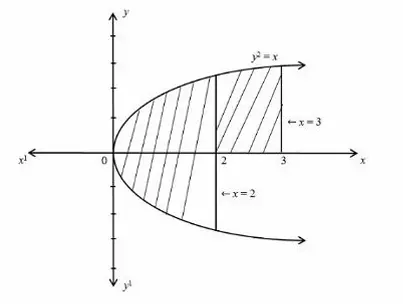
The area (in sq. units) of the region in the first quadrant bounded by $y = 3\sqrt{1-x^2}$, $x \in [0,1]$ and the x-axis is equal to
The rate of change of area of a circle with respect to its circumference when radius in 6 cm, is
For the differential equation $ydx - (x + 3y^2)dy = 0$, which of the following statements are true? (A) It is a linear differential equation (B) It is a homogenous differential equation (C) Its general solution is $x = 3y^2 + Cy$ : $C$ is an arbitrary constant (D) If $y(0) = 1$, then its particular solution is $x = 3y^2 - 1$ Choose the correct answer from the options given below:
Match List-I with List-II | List-I | List-II | |---|---| | (A) $\int_0^1 \frac{x^2}{1 + x^3} dx$ | (I) 0 | | (B) $\int_0^\pi 3\sin x dx$ | (II) $2\log_e\left(\frac{3}{2}\right)$ | | (C) $\int_{-1}^1 \sin^5 x \cos^6 x dx$ | (III) 6 | | (D) $\int_2^3 \frac{4}{x^2 - 1} dx$ | (IV) $\frac{1}{3}\log_e 2$ | Choose the correct answer from the options given below:
The area (in sq.units) of the region bounded by the curve $y = \cos x$ between $x = -\frac{\pi}{2}, x = \frac{\pi}{2}$ and the x-axis is
Area of the region bounded by the curve $y = \sqrt{x}$ and lines $x + y = 2$, $y = 0$ is
The area of region bounded by the curve $y^2 = 4ax$ and the straight line $x = 2a$, $a > 0$ in the first quadrant is:
$\int \frac{\sin 2x \, dx}{\sqrt{9 - \cos^4 x}}$ equals
The area bounded by the x-axis and the parabola $y = 3x-x^2$ is:
If maximum value of $f(x) = 2x^3 + 3x^2 - 6ax + 10$ occurs at $x = -3$, then the value of $\alpha$ is ____
The value of $\int_{-\pi/2}^{\pi/2}(x^5 + x^3\cos x)dx$ is
If $x = -1$ and $x = -2$ are the extreme points of $f(x) = \alpha\log|x| + \beta x^2 + x$ then
The area (in sq.units) of the region bounded by the line $2y + x = 8$, the x-axis and the lines $x = 2$ and $x = 4$ is
The integrating factor of the differential equation $\frac{dy}{dx} = x + xy$ is
The degree of the differential equation $\left(2 + \left(\frac{dy}{dx}\right)^2\right)^{\frac{3}{2}} = a^2 \frac{d^2y}{dx^2}$ is:
If m and n are respectively the order and degree of the differential equation $(\frac{d^2y}{dx^2})^{2} + (\frac{dy}{dx})^3 + y= 4x$, then the value of $m + n$ is:
The particular solution of the differential equation $xdy = (2x^2 + 1)dx, x \neq 0$, given that $y = 1$ when $x = 1$ is:
Match **List-I** with **List-II** | List-I | List-II | |---|---| | **Differential Equation** | **Sum of order and degree** | | (A) $\frac{d^2y}{dx^2} + \frac{dy}{dx} + 3y = \sin x$ | (I) 2 | | (B) $\frac{dy}{dx} = \sin(x + y)$ | (II) 3 | | (C) $\sqrt{1 + (\frac{dy}{dx})^2} = \frac{d^2y}{dx^2}$ | (III) 4 | | (D) $x^2(\frac{d^2y}{dx^2})^3 + y(\frac{dy}{dx})^4 + y^5 = 0$ | (IV) 5 | Choose the **correct** answer from the options given below:
Consider the differential equation $xdy = (y + 2x^3)dx$. Then which of the following are TRUE? (A) It is a homogeneous differential equation. (B) Product of the order and degree of the differential equation in one. (C) Integrating factor is x. (D) General solution of the differential equation is $y = x^3 + Cx$, where C is an arbitary constant. Choose the *correct* answer from the options given below:
Match List-I with List-II Where $\mathbb{R}$ is set of real numbers | List-I | List-II | |---|---| | (A) $\sin x$ is continuous on: | (I) $\mathbb{R} - \{0\}$ | | (B) $ \tan x$ is continuous on: | (II) $\mathbb{R}$ | | (C) $\cot x$ is continuous on: | (III) $\mathbb{R} - \{n\pi: n \in \mathbb{Z}\}$ | | (D) $x^{-n}, n \in \mathbb{N}$ is continuous on: | (IV) $\mathbb{R} - \left\{(2n + 1)\frac{\pi}{2}: n \in \mathbb{Z}\right\}$ | Choose the correct answer from the options given below:
$\int \frac{x^3 - 1}{x^2} dx$ is equal to
The value of the integral $I = \int_0^1 \frac{1}{\sqrt{1+3\sqrt{x}}} dx$ is
Match List-I with List-II | List-I | List-II | |---|---| | (Function) | (Derivative with respect to 'x') | | (A) $f(x) = x^x$ | (I) $ax^{a-1}$ | | (B) $f(x) = a^x$ | (II) 0 | | (C) $f(x) = a^a$ | (III) $a^x log_e a$ | | (D) $f(x) = x^a$ | (IV) $x^x(1 + log_e x)$ | Choose the correct answer from the options given below:
Match **List-I** with **List-II** | List-I | List-II | | :--- | :--- | | **Function** | **Property** | | (A) $f(x) = \begin{cases} \frac{x}{\vert x \vert} & : x \neq 0 \\ 0 & : x = 0 \end{cases}$ | (I) continuous but not differentiable at $x= 0$ | | (B) $f(x) = \vert x \vert$ | (II) continuous but not differentiable at $x=1$ | | (C) $f(x) = \vert x^2 - 1 \vert$ | (III) discontinuous at $x = 0$ | | (D) $f(x) = \vert x - 1 \vert$ | (IV) continuous but not differentiable at $x = 1, -1$ | Choose the **correct** answer from the options given below:
$\int_{\frac{\pi}{6}}^{\frac{\pi}{3}} \frac{dx}{1 + \sqrt{tanx}}$ is equal to
The general solution of the differential equation $ydx - (x + 2y^2)dy = 0$
Function $f(x) = x^x, x > 0$ decreases on the interval
Match List-I with List-II | List-I | List-II | |------------|-------------| | (A) Degree of this differential equation $\frac{d^4y}{dx^4} + 2\log_e\left(\frac{d^3y}{dx^3}\right) = 0$ | (I) 1 | | (B) Order of this differential equation $e^{\left(\frac{dy}{dx}\right)^3} + 3y\left(\frac{d^2y}{dx^2}\right)^3 = 0$ | (II) 4 | | (C) Degree of $\frac{d^4y}{dx^4} + \left(\frac{dy}{dx}\right)^2 = 0$ | (III) not defined | | (D) Order of the differential equation $2\frac{d^4y}{dx^4} + \left(\frac{d^2y}{dx^2}\right)^5 = 0$ | (IV) 2 | Choose the correct answer from the options given below:
The demand for a certain product is represented by the function $p = 150 + 10x - x^2$ (in Rs.) where $x$ is the number of units demanded and $p$ is the price per unit, then the value of marginal revenue, when 10 units are sold is
$\int \frac{\sqrt{16+(\log x)^2}}{x} dx$ is equal to (where C is an arbitrary constant)
If the cost function of a product is given by $C(x) = \frac{3}{4}x^2 - 5x + 21$, then the marginal cost when $x = 10$ is
The demand for a certain product is represented by the function $p = 300 + 25x - x^2$ (in rupees), where x is the number of units demanded and p is the price per unit, then the marginal revenue when 15 units are sold, is
$\int e^x \left(\frac{1-x}{1+x^2}\right)^2 dx$ is equal to
The value of $\int \frac{x^5}{\sqrt{1 + x^3}} dx$ is
If the maximum value of the function $f(x) = \frac{2\log_e x}{x}$, $x > 0$ occurs at $x = e$, then $e^3 f''(e)$ is equal to
The value of $\int_2^4 \frac{x}{x^2 + 1} dx$ is equal to
The value of k for which the function $f(x) = \begin{cases} \frac{1-\cos 8x}{16x^2}, & \text{if } x \neq 0 \\ k, & \text{if } x = 0 \end{cases}$ is continuous at $x = 0$ is:
The number of arbitrary constants in the particular solution of a differential equation of order 4 and degree 3 is
If $\int \sqrt\frac{1-x}{{1+x}} dx = a\sqrt{1-x^2} + \beta \sin^{-1}x + C$, Where C is an arbitrary constant, then which of the following are TRUE? (A) $\alpha = 1$ (B) $\alpha = -1$ (C) $\beta = 1$ (D) $\beta = -1$ Choose the correct answer from the options given below:
The solution of the differential equation $ydx + (x - y^2)dy = 0$ is
$\int \frac{\cos 2x - \cos 2α}{\cos x - \cos α} dx$ is equal to
If $\sin y = x \cos(a + y)$, then $\frac{dy}{dx}$ is equal to
Match List-I with List-II | List-I | List-II | | --- | --- | | Integral | Solution: C is an arbitrary constant | | --- | --- | | (A) $\int \frac{dx}{x^2 + 25}$ | (I) $\frac{1}{10} \log \left\vert \frac{5 + x}{5 - x} \right\vert + C$ | | (B) $\int \frac{dx}{x^2 - 25}$ | (II) $\log \vert x + \sqrt{x^2 - 25}\vert + C$ | | (C) $\int \frac{dx}{25 - x^2}$ | (III) $\frac{1}{5} \tan^{-1} \left( \frac{x}{5} \right) + C$ | | (D) $\int \frac{dx}{\sqrt{x^2 - 25}}$ | (IV) $\frac{1}{10} \log \left\vert \frac{x - 5}{x + 5} \right\vert + C$ | Choose the correct answer from the options given below:
Let $f(x) = x^2 + \frac{250}{x}$ be any function defined on $\mathbb{R} - \{0\}$, where $\mathbb{R}$ is the set of real numbers. Then which of the following are TRUE? (A) $f'(x) = 2x + \frac{250}{x^2}$ (B) $x = 5$ in the only critical point of $f(x)$ (C) minimum value of $f(x)$ is 75 (D) maximum value of $f(x)$ is 50. Choose the **correct** answer from the options given below:
The maximum value of f(x) = $\left(\frac{1}{x}\right)^x$ is
The area (in sq. units) of the region bounded by the lines $y = 2x + 3$, the x – axis and the ordinates $x = -2$ and $x = 2$ is equal to
The area of the region bounded by parabola $x^2 = 4y$, straight line $x = 2$ and $x$-axis, is
If $y = \log_e\left(\frac{e^2}{x^2}\right)$ for $x \neq 0$, then $\frac{d^2y}{dx^2}$ equals
The value of $\int_{-1}^{1}|x|dx$ is
Consider the differential equation $\frac{dy}{dx} + y \tan x = \sec x$, then which of the following statements are correct? (A) It is homogeneous (B) It has $\sec x$ as its integrating factor (C) It's general solution is $y \sec x = \tan x + c$, where c is arbitary constant. (D) It's degree is not defined Choose the correct answer from the options given below:
If $\frac{x^2}{a^2} + \frac{y^2}{b^2} = 1$, then $\frac{d^2y}{dx^2}$ is equal to
The general solution of the differential equation $(1 + e^x)dy + ye^x dx = 0$, where $y > 0$, is
The solution of the differential equation $xdy - ydx = 0$ represents
If $f(x) = \begin{cases} \frac{\tan(\frac{\pi}{4} - x)}{\cot 2x} & , x ≠ \frac{\pi}{4} \\ 2K + 1 & , x = \frac{\pi}{4} \end{cases}$ is continuous at $x = \frac{\pi}{4}$, then the value of K is equal to
Let $y = \sin(\cos x^2)$, then the value of $\frac{dy}{dx}$ at $x = \frac{\sqrt{\pi}}{2}$ is equal to
Match List-I with List-II | List-I | List-II | | --- | --- | | Differential Equation | General solution | | --- | --- | | (A) $\dfrac{dy}{dx} = \dfrac{y}{x}; x \neq 0$ | (I) $y = cx; c \text{ is an arbitrary constant}$ | | (B) $x dx - y dy = 0; y \neq 0, x \neq 0$ | (II) $x^2 - y^2 = c; c \text{ is an arbitrary constant}$ | | (C) $\dfrac{(x^2 - 1)}{y^2 + 1}\dfrac{dx}{dy} = 1$ | (III) $2x + 3y = c; c \text{ is an arbitrary constant}$ | | (D) $2 dx + 3 dy = 0$ | (IV) $(x^3-y^3) = c + 3(x+y); c \text{ is an arbitrary constant}$ | Choose the correct answer from the options given below:
If $f(x) = \begin{cases} ax - 1 & {if } x \ > 1\\ \ 2x + 1 & {if } x < 1 \end{cases}$ is continuous at $x = 1$, then $a$ equals
If $I = \int \frac{x}{x - \sqrt{x^2 - 4}} dx = \alpha x^3 + \beta(x^2 - 4)^{\frac{3}{2}} + \gamma$, where $\gamma$ is constant of integration, then
The nearest integral value of the shaded area shown below is: 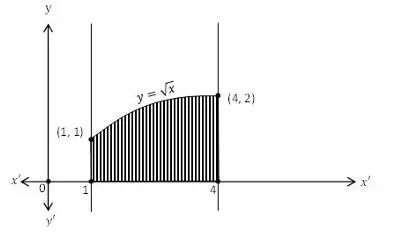
Match List-I with List-II | List-I | List-II | | --- | --- | | Integral | Value | | --- | --- | | (A) $\int_{-1}^{1} (\vert x\vert + 1) dx$ | (I) 0 | | (B) $\int_{-2}^{2} \vert x + 1\vert dx$ | (II) 2 | | (C) $\int_{-1}^{1} 3\vert x^2\vert dx$ | (III) 5 | | (D) $\int_{-1}^{1} x\vert x\vert dx$ | (IV) 3 | Choose the correct answer from the options given below:
If $\frac{d}{dx}[ax^3 + ax^2 + ax + 1] = 9x^2 + 6x + 3$, then $a$ is equal to
The particular solution of the differential equation $e^x\sqrt{1-y^2}dx + \frac{y}{x}dy = 0$, given that $y = 1$, when $x = 0$ is:
Which one of the following equations is a homogeneous differential equation?
Match List-I with List-II (Given that $c$ is an arbitrary constant) | List-I | List-II | | --- | --- | | (A) $\int \frac{dx}{\sqrt{a^2 - x^2}} =$ | (I) $\log_e \vert x + \sqrt{x^2 - a^2}\vert + c$ | | (B) $\int \sqrt{a^2 - x^2} dx =$ | (II) $\sin^{-1} \frac{x}{a} + c$ | | (C) $\int \sqrt{x^2 - a^2} dx =$ | (III) $\frac{x}{2} \sqrt{a^2 - x^2} + \frac{a^2}{2} \sin^{-1} \frac{x}{a} + c$ | | (D) $\int \frac{dx}{\sqrt{x^2 - a^2}} =$ | (IV) $\frac{x}{2} \sqrt{x^2 - a^2} - \frac{a^2}{2} \log_e \vert x + \sqrt{x^2 - a^2}\vert + c$ | Choose the correct answer from the options given below:
If the integral $I = \int \left[log_e(log_e x)^2 + \frac{a}{log_e x}\right] dx = x log_e(log_e x)^2 + C$, where C is constant of integration. Then the value of $a$ is:
The number of tangents to the curve $xy - 3y + 2 = 0$ having slope 2 is:
The area (in sq. units) of the region $\{(x,y): 3x^2 \leq y \leq |x|\}$ is equal to
If $y = 3e^{2x} + 2e^{3x}$, then $\frac{d^2y}{dx^2} + 6y$ is equal to
If the maximum value of the function $f(x) = \frac{\log_ex}{x}$, $x > 0$ occurs at $x = a$, then $a^2f''(a)$ is equal to
$\int_1^4 |x - 2|dx$ is equal to
Which of the following are linear first order differential equations? (A) $\frac{dy}{dx} + P(x)y = Q(x)$ (B) $\frac{dx}{dy} + P(y)x = Q(y)$ (C) $(x - y)\frac{dy}{dx} = x + 2y$ (D) $(1 + x^2)\frac{dy}{dx} + 2xy = 2$ Choose the correct answer from the options given below:
If $e^y = \log x$, then which of the following is true?
Match List-I with List-II $\begin{array}{|l|l|} \hline \rule{0pt}{2.8ex}\text{List-I} & \text{List-II} \\[1.2ex] \hline \rule{0pt}{2.8ex}\text{(A) } f(x) = |x| & \text{(I) Not differentiable at } x=-2 \text{ only} \\[1.2ex] \hline \rule{0pt}{2.8ex}\text{(B) } f(x) = |x+2| & \text{(II) Not differentiable at } x=0 \text{ only} \\[1.2ex] \hline \rule{0pt}{2.8ex}\text{(C) } f(x) = |x^2-4| & \text{(III) Not differentiable at } x=2 \text{ only} \\[1.2ex] \hline \rule{0pt}{2.8ex}\text{(D) } f(x) = |x-2| & \text{(IV) Not differentiable at } x=2,-2 \text{ only} \\[1.2ex] \hline \end{array}$ Choose the correct answer from the options given below:
The function $f(x) = tanx - x$
The integrating factor of the differential equation $(x log_e x)\frac{dy}{dx} + y = 2log_e x$ is
The area (in sq. units) of the region bounded by $y = 2\sqrt{1 - x^2}$, $x \in [0, 1]$ and $x$-axis is equal to
$\int_{\pi/6}^{\pi/3} \frac{tan x}{tan x + cot x} dx$ is equal to
Match **List-I** with **List-II** The function $f(x) = 2x^3 - 15x^2 + 36x + 5$ for $x \in [2,5]$ has | List-I | List-II | |---|---| | (A) absolute maximum value | (I) 5 | | (B) absolute minimum value | (II) 60 | | (C) point of absolute maxima | (III) 3 | | (D) point of absolute minima | (IV) 32 | Choose the **correct** answer from the options given below:
The total cost $c(x)$ associated with the production of $x$ units of an item is given by $c(x) = 0.001x^3 + 0.06x^2 + 20x + 500$. The marginal cost when 10 units are produced is:
General solution of the differential equation $\frac{dy}{dx} = e^{\frac{x^2}{2}} + xy$ is
Match List-I with List-II | List-I | List-II | | --- | --- | | Function | Derivative | | --- | --- | | (A) $y = \sin^{-1} x + \sin^{-1} \sqrt{1 - x^2}; \vert x\vert < 1$ | (I) $\frac{dy}{dx} = \frac{1}{2y-1}$ | | (B) $y = \sqrt{x + y}, x+y > 0 \text{ and } y \neq \frac{1}{2}$ | (II) $\frac{dy}{dx} = 10^x \log_e 10$ | | (C) $y = \log_{10} x, x > 0$ | (III) $\frac{dy}{dx} = 0$ | | (D) $y = 10^x$ | (IV) $\frac{dy}{dx} = \frac{1}{x \log_e 10}$ | Choose the correct answer from the options given below:
Match **List-I** with **List-II**. Here [x] denotes the greatest integer function $\begin{array}{|l|l|} \hline \rule{0pt}{2.8ex}\text{List-I} & \text{List-II} \\[1.2ex] \hline \rule{0pt}{2.8ex}\text{(A) } f(x) = [x] & \text{(I) is continuous everywhere but not differentiable at } x=-1 \\[1.2ex] \hline \rule{0pt}{2.8ex}\text{(B) } f(x) = |x-1| & \text{(II) is continuous everywhere except at all integral values} \\[1.2ex] \hline \rule{0pt}{2.8ex}\text{(C) } f(x) = e^{|x|} & \text{(III) is continuous everywhere but not differentiable at } x=1 \\[1.2ex] \hline \rule{0pt}{2.8ex}\text{(D) } f(x) = |x+1| & \text{(IV) is continuous everywhere but not differentiable at } x=0 \\[1.2ex] \hline \end{array}$ Choose the **correct** answer from the options given below:
$\int_0^2 x(2-x)^n dx$ is equal to
If $f(x) = x^3\log_e x$, Then $f''(e^2)$ is equal to
$\int_0^a \frac{\sqrt{x}}{\sqrt{x} + \sqrt{a-x}} dx$ is equal to
For $x \in \left(0, \frac{\pi}{2}\right)$, $\int \frac{1}{\sin^2 x + \sin 2x} dx$ is equal to
The value of $\int_{-5}^{5} |x + 3| dx$ is
If $e^x + e^y = e^{x+y}$, then $\frac{dy}{dx}$ =
The area (in sq. units) bounded by the parabola $y^2 = 4ax$, its latus rectum and the $x$-axis in the first quadrant is:
The differential equation representing the family of curves $y = Ax + \frac{B}{x}$, $x \neq 0$ where A and B are arbitrary constants, is given by
The general solution of the differential equation $\frac{dy}{dx} = e^{ax+by}$ is: (Here C is an arbitrary constant)
The value of the definite integral $I = \int_0^2 x\sqrt{2-x} dx$ is:
If a revenue function is given by $R(x) = 2027x - 1013x^2 - 675x^3$, then the marginal revenue function (MR) is:
The value of $\int_{-1}^{1} |x^3 - x| dx$ is
The area of the region (in square units) bounded by $x=1, x=2$ and the curve $y^2 = 4x$ in the first quadrant is
The area (in sq. units) of the region bounded by the curve $y = x^5$, the x-axis and the ordinates $x = -1$ and $x = 1$ is equal to
Match List-I with List-II | List-I | List-II | |---|---| | Differential Equation | Integrating Factor | | (A) $y dx + (x - y^3)dy = 0$ | (I) $e^{-x}$ | | (B) $x\frac{dy}{dx} + y = x^2$ | (II) $\frac{1}{x}$ | | (C) $\frac{dy}{dx} - y = e^x$ | (III) $y$ | | (D) $x dy - y dx = x^3 dx$ | (IV) $x$ | Choose the correct answer from the options given below:
The differential equation representing the curve $y = e^{2x}(a + bx)$, where a, b are arbitrary constants is
The point on the curve $\frac{x^2}{4} + \frac{y^2}{9} = 1$ at which the tangent to the curve is parallel to the x-axis is
Match List-I with List-II | List-I | List-II | |---|---| | (A) Maximum value of $f(x) = \sin^2 x - \cos^2 x$, $\forall x \in (\pi, 2\pi)$ is | (I) 0 | | (B) Minimum value of $f(x) = \sin x \cos x$ | (II) 1 | | (C) Point of Minima of $f(x) = x^x$ $(x > 0)$ | (III) $-\frac{1}{2}$ | | (D) Maximum value of $f(x) = -x^{2026}$ | (IV) $\frac{1}{e}$ | Choose the correct answer from the options given below:
The value of $\int_0^{\pi/2} \log_e \left(\frac{5 + 2 \sin x}{5 + 2 \cos x}\right) dx$ is
The general solution of the differential equation $x(1 + y^2)dx + y(1 + x^2)dy = 0$ is
The area (in sq. units) of the region bounded by the curve $y = \sin x, -2\pi \leq x \leq 2\pi$ and $x - axis$ is equal to
The area (in sq. units) of the region bounded by the parabola $y^2 = 8x$ and the line $x = 2$ is
Let the degree and order of the differential equation $2x^3\frac{dy}{dx}-5\left(\frac{d^2y}{dx^2}\right)^2=6\left(\frac{dy}{dx}\right)^3$ be $m$ and $n$ respectively. Then (A) m = 2 (B) n = 3 (C) m = 3 (D) mn = 4 Choose the correct answer from the options given below:
For $x \in \mathbb{R} - \{-1,0,1\}$, $\int \frac{1}{x - x^5}dx$ is equal to
$\int \frac{(x^4 - x)^{1/4}}{x^5} dx$ is equal to
The function $f(x) = x + \frac{1}{x}$ has
The function $f(x) = 2\log_e(x-2) - x^2 + 4x + 1, (x > 2)$ is increasing on the interval:
Consider the differential equation, $x\frac{dy}{dx} = y(\log_e y - \log_e x + 1)$, then which of the following are true? (A) It is a linear differential equation (B) It is a homogenous differential equation (C) Its general solution is $\log_e\left(\frac{y}{x}\right) = Cx$, where C is constant of integration (D) Its general solution is $\log_e\left(\frac{x}{y}\right) = Cy$, where C is constant of integration (E) If $y(1) = 1$, then its particular solution is $y = x$ Choose the correct answer from the options given below:
For the function $f(x) = x^{1/x}$, $x > 0$, which of the following are correct? (A) $x = 0$ is the only point where extremum may occur. (B) The given function is maximum at $x = e$. (C) The function has no extreme value for $x > 0$. (D) The maximum value of the function $f(x)$ is $e^{1/e}$. Choose the correct answer from the options given below:
The slope of the normal to the curve $y = 2x^2$ at $x = 1$ is:
The length of a rectangle is decreasing at the rate of 4 cm/minute and the width is increasing at the rate of 3 cm/minute, then the rate of change of the perimeter is
The differential equation of the family of curves $y = Ae^{3x} + Be^{-3 x}$, where $a$ and $\beta$ are arbitrary constants, is
$\int \frac{\sin x - x\cos x}{x(x + \sin x)}dx =$ (where C is an arbitrary constant)
Consider the differential equation $xdy = (x + y) dx$. Which of the following are true? (A) It is a homogenous differential equation (B) It is a differential equation of order 2 (C) The general solution of the differential equation contains 2 arbitrary constants (D) Integrating factor of differential equation is $\frac{1}{x}$ (E) Degree of the differential equation is not defined Choose the correct answer from the options given below:
Match List-I with List-II | List-I | List-II | |---|---| | Differential Equation | Order and degree of differential equation | | (A) $\frac{d^2y}{dx^2} + 2\left(\frac{dy}{dx}\right)^2 = e^{\frac{dy}{dx}} + 1$ | (I) Order = 1, Degree = 2 | | (B) $\left(\frac{d^2y}{dx^2}\right)^2 + 4\left(\frac{dy}{dx}\right)^3 = e^y - 1$ | (II) Order = 2, Degree = 1 | | (C) $3\left(\frac{dy}{dx}\right) + 4y + e^y = \frac{dx}{dy}$ | (III) Order = 2, Degree = 2 | | (D) $\frac{d^2y}{dx^2} + 3\left(\frac{dy}{dx}\right) = \left(e^y + \frac{dy}{dx}\right)^2$ | (IV) Order = 2, Degree = Not defined | Choose the correct answer from the options given below:
The solution of the differential equation $\frac{dy}{dx} = \frac{x+y}{x-y}$ is
If $y = x\sin y$, then $\frac{dy}{dx}$ is:
Match List-I with List-II | List-I | List-II | | --- | --- | | (A) The value of $\int_{0}^{4} \vert x\vert \, dx$ is | (I) 3 | | (B) The value of $\int_{-2}^{2} \vert x\vert \, dx$ is | (II) -1 | | (C) The value of $\int_{0}^{3} [x] \, dx$ is | (III) 8 | | (D) The value of $\int_{-1}^{1} [x] \, dx$ is | (IV) 4 | Choose the correct answer from the options given below:
Match List-I with List-II | List-I | List-II | |---|---| | (Differential equation) | (Order and Degree) | | (A) $\frac{d^3y}{dx^3} + y^2 + e^{dy/dx} = 0$ | (I) order = 3, degree = 1 | | (B) $\left(\frac{d^2y}{dx^2}\right)^3 + \left(\frac{dy}{dx}\right)^2 + \frac{dy}{dx} + 1 = 0$ | (II) order = 3, degree not defined | | (C) $2x^2\frac{d^2y}{dx^2} - 3\left(\frac{dy}{dx}\right)^2 + y = 0$ | (III) order = 2, degree = 3 | | (D) $\frac{d^3y}{dx^3} + 2\left(\frac{dy}{dx}\right)^2 + \frac{dy}{dx} = 0$ | (IV) order = 2, degree = 1 | Choose the correct answer from the options given below:
Consider the curve which is represented by the differential equation $\frac{dy}{dx} = 1 + x + y + xy$. If it passes through the point $(0,0)$, then which of the following is/are true? (A) it is a straight line. (B) it is a parabola. (C) it also passes through the point $(-1, \frac{1}{\sqrt{e}} - 1)$ (D) Its equation is $xy(x + 1)\left(y - \frac{1}{\sqrt{e}} + 1\right) = 0$ Choose the **correct** answer from the options given below:
Which of the following are correct? (A) The function $f(x) = 3x+12$ is increasing on R. (B) The function $f(x) = e^{2x}$ is decreasing on R. (C) The function $f(x) = x^2-x-1$ is neither increasing nor decreasing on (-1, 1). (D) The function $f(x) = x^3-3x^2+4x$ is increasing on R. Choose the correct answer from the options given below:
If $\int e^x\left(\frac{x-1}{(x+1)^3}\right)dx = \frac{Ae^x}{(x+1)^B} + C$, where C is constant of integration then which of the following are correct? (A) $A = -1$ (B) $A = 1$ (C) $B = 3$ (D) $B = 2$ Choose the correct answer from the options given below:
Which of the following functions are increasing on $x \in \left(0, \frac{\pi}{2}\right)$? (A) $f(x) = \sin x$ (B) $f(x) = \cos x$ (C) $f(x) = \tan x$ (D) $f(x) = \cos 3x$ Choose the correct answer from the options given below:
Match List-I with List-II | List-I | List-II | | :--- | :--- | | **Differential equation** | **Order and degree** | | (A) $(y'')^3 + (y')^4 - 6 = (y''')^2$ | (I) Order = 1, Degree = 2 | | (B) $\sqrt{(y')^2 + 5} = y''$ | (II) Order = 2, Degree = 3 | | (C) $(y')^2 = (2 + y'')^{3/2}$ | (III) Order = 2, Degree = 2 | | (D) $y = xy' + \sqrt{a^2(y')^2 + b^2}$ | (IV) Order = 3, Degree = 2 | Choose the correct answer from the options given below:
The value of the definite integral $I = \int_{-1}^{1} \frac{1}{1 + \sqrt{e^x}} dx$ is:
If $e^y(x + 1) = 1$, then
Match List-I with List-II [.] denotes the greatest integer function. | List-I | List-II | |---|---| | (A) $\int_0^3 [x]dx$ | (I) $\frac{1}{2}$ | | (B) $\int_0^1 [2x]dx$ | (II) 1 | | (C) $\int_0^1 [3x]dx$ | (III) $\frac{3}{2}$ | | (D) $\int_0^1 [4x]dx$ | (IV) 3 | Choose the correct answer from the options given below:
The general solution of the differential equation $\frac{xdy}{dx} + 4y = x^3, (x \neq 0)$ is:
For $x > 1$, $\int \frac{e^{7\log x} - e^{5\log x}}{e^{5\log x} - e^{4\log x}} dx$ equals.
The interval on which the function $f(x) = x^4 - \frac{x^3}{3}$ is strictly decreasing, is:
If the integral $I = \int \frac{x^2}{\sqrt{1+x}} dx = \frac{1}{\alpha} (1+x)^\alpha - \frac{8\alpha}{15} (1+x)^{\alpha-1} + 2(1+x)^{\alpha-2} + C$, $C$ is constant of integration, then the value of $\alpha$ is:
Match List-I with List-II | List-I | List-II | |---|---| | (Parametric equations) | $\left(\frac{dy}{dx}\right)$ | | (A) $x = \frac{2}{t}, y = 2t$ | (I) $4t^2$ | | (B) $x = t^3, y = 3t + 2$ | (II) $2(t+1)$ | | (C) $x = \log t, y = 2t^2$ | (III) $-t^2$ | | (D) $x = e^t, y = 2te^t$ | (IV) $t^{-2}$ | Choose the correct answer from the options given below:
The particular solution of the differential equation x(1 + y²)dx - y(1 + x²)dy = 0, y(0) = 1, is:
If the interval in which the function f(x) = $\frac{x}{x^2+1}$ is strictly increasing is (-a, a), then a is equal to
Given differential equation, (1 + y²)dx = (tan⁻¹y - x)dy, then which of the following is/are true? (A) Integrating factor = tan⁻¹x (B) Integrating factor = tan⁻¹y (C) Integrating factor = $e^{tan⁻¹y}$ (D) Degree = 1 Choose the correct answer from the options given below:
The greatest integer function $f(x) = [x]$ is differentiable for all values of
$\int \frac{dx}{x^3\sqrt{(1 + x^4)}} =$
$\int \frac{(x-3)e^x}{(x-1)^3} dx$ is equal to
Match List-I with List-II | List-I | List-II | | --- | --- | | Function f(x) | Points of Non-Differentiability | | --- | --- | | (A) $f(x) = \vert x\vert + 1$ | (I) Not differentiable at $x = 3$ only | | (B) $f(x) = \vert x - 3\vert $ | (II) Not differentiable at $x = -3$ only | | (C) $f(x) = \vert x + 3\vert $ | (III) Not differentiable at $x = 3, -3$ only | | (D) $f(x) = \vert x^2 - 9\vert $ | (IV) Not differentiable at $x = 0$ only | Choose the correct answer from the options given below:
The value of $\int_{-\frac{\pi}{2}}^{\frac{\pi}{2}} (\sin|x| + \cos|x|)dx$, is equal to:
The real valued function $f(x) = x^{15} + 5x^9 + 10$ is increasing for___________.
A integrating factor of the differential equation $\frac{dy}{dx} + \frac{y}{x} = \frac{1}{x^2}$, $(x > 0)$ is equal to
The area of the region bounded by the curves $y = x^2 + 2$ and $x$-axis, between $x = 0$ and $x = 3$ in the first quadrant is:
Match List-I with List-II | List-I | List-II | | --- | --- | | Functions | Integrals | | --- | --- | | (A) $\int \frac{dx}{x^2 - 4}, x \neq \pm 2$ | (I) $\log \vert x + \sqrt{4 + x^2}\vert + C$, where $C$ is an arbitrary constant | | (B) $\int \frac{1}{\sqrt{16 - x^2}} dx; \vert x\vert < 4$ | (II) $\sin^{-1} \left( \frac{x}{4} \right) + C$, where $C$ is an arbitrary constant | | (C) $\int \frac{1}{16 + x^2} dx$ | (III) $\frac{1}{4} \log \left\vert \frac{x-2}{x+2} \right\vert + C$, where $C$ is an arbitrary constant | | (D) $\int \frac{1}{\sqrt{4 + x^2}} dx$ | (IV) $\frac{1}{4} \tan^{-1} \left( \frac{x}{4} \right) + C$, where $C$ is an arbitrary constant | Choose the correct answer from the options given below:
If $x$ is real, the minimum value of $x^2 - 8x + 20$ is
The maximum value of $\left(\frac{1}{x}\right)^x$ for $x > 0$ is
$\int_{-\frac{5}{2}}^{\frac{5}{2}} |x| dx$ is equal to
The particular solution of the differential equation $\frac{dy}{dx} + \frac{3y}{x} = 0$, $y(1) = 1$ is
$\int \left(\frac{1}{log_e t} - \frac{1}{(log_e t)^2}\right) dt$ is equal to
For $x \in \left(0, \frac{\pi}{2}\right)$, $\int \frac{\sin x + \cos x}{\sqrt{\sin 2x}} dx$ is equal to
The area of the region bounded by the parabola $y^2 = x$ and the straight line $2y = x$ is
If $y = t - \frac{1}{t}$ and $x = t + \frac{1}{t}$, then $\frac{dy}{dx}$ is equal to
The curve $x = y^2$ and $xy = k$ cut orthogonally, then $k^2$ is equal to:
If $x^m y^n = (x + y)^{m+n}$, then $\frac{d^2y}{dx^2}$ is equal to:
The area bounded by the curve $y = 4 + 3x - x^2$ and $x$-axis is equal to
Match List-I with List-II: | List-I | List-II | | --- | --- | | **Differential Equations** | **Degree/Order** | | (A) Degree of the differential equation $\frac{d^3y}{dx^3} + 2 \log x.y = 0$ | (I) 3 | | (B) Order of the differential equation $\frac{d^4y}{dx^4} + \left(\frac{dy}{dx}\right)^4 + xy = 0$ | (II) 2 | | (C) Degree of the differential equation $\left(\frac{d^4y}{dx^4}\right)^2 + \left(\frac{dy}{dx}\right)^3 + x^2y = 0$ | (III) 1 | | (D) Order of the differential equation $\frac{d^3y}{dx^3} + y\left(\frac{dy}{dx}\right)^3 = 0$ | (IV) 4 |
If $f(x) = |x| + |x - 5|$, then which of the following statements are TRUE? (A) f is a continuous function every where (B) f is a continuous function except $x = 5$ and $x = 0$ (C) f is a continuous function except $x = 0$ but not differentiable at $x = 5$ (D) f is a continuous function everywhere but not differentiable at $x = 0$ and $x = 5$ Choose the correct answer from the options given below:
The area (in square units) of the region enclosed between the lines $x + y = 2$, $x = 0$, $x = 3$ and $x$-axis is equal to
The area of the region bounded by the curve $y = x + 1$, $x = axis$ and the lines $x = 2$ and $x = 3$ is
If $x = at^2, y = 2at$; then $\frac{d^2y}{dx^2}$ is equal to
For the differential equation $(x + y)dy + (x - y)dx = 0$, which of the following is/are correct? (A) Differential equation is homogeneous (B) Order of differential equation is 1 (C) Integrating factor of differential equation is $e^x$ (D) Degree of the equation is not defined Choose the **correct** answer from the options given below:
Interval in which the function $f$ given by $f(x) = \tan x - 4x$, $x \in (0, \frac{\pi}{2})$ is strictly decreasing is
The value of $\int \frac{(x^4 - x)^{1/4}}{x^5} dx$ is equal to (where C is an arbitrary constant)
The particular solution of the differential equation $\log\left(\frac{dy}{dx}\right)= 3x + 4y$ satisfying $y = 0$ when $x = 0$ is:
The area (in Sq. units) of the region bounded by $y = -2$, $y = 2$, $x = y^3$ and $x = 0$ is equal to
The rate of change of the area of a circle with respect to its radius $r$, when $r = 3$cm, is:
If the area above x-axis, bounded by the curves $y = 3^{\beta x}$, $x = 0$ and $x = 3$ is $\frac{26}{\log_e 3}$, then the value of $\beta$ is:
If $y^{1/m} + y^{-1/m} = 2x$, then the value of $(x^2 - 1)\frac{d^2y}{dx^2} + x\frac{dy}{dx}$ is:
Derivative of $x^x$ with respect to $x\log x$ is
The area of the region bounded by the curves $y = x^2 + 2$, $y = x$, $x = 0$ and $x = 2$ is
If $f(a-x) = f(x)$, then $\int_0^a xf(x)dx$ is equal to
$\int \left(\frac{\cos 2x - \cos 2\alpha}{\cos x - \cos \alpha}\right) dx =$ (Given that $c$ is an arbitrary constant)
If $y = \frac{1}{1+x^{b-a}+x^{c-a}} + \frac{1}{1+x^{c-b}+x^{a-b}} + \frac{1}{1+x^{a-c}+x^{b-c}}$ then $\frac{d^2y}{dx^2}$ is
Area of the region bounded by $y = x^2$ and the line $y = 16$ is
The value of $\int_{0}^{\pi/2} \frac{\tan^7 x}{\cot^7 x + \tan^7 x} dx$ is
The area (in sq. units) of the region bounded by the curve $y = 2x^3$, $x$ - axis and ordinates $x = -1$ and $x = 1$ is:
The point of local maxima of the function $f(x) = (x - 2)^5(x + 2)^2$ is
The maximum value of the function $f(x) = x^2(60 - x)$ in [20, 80] is:
Let $e^{\alpha y} + e^{\beta y} + \gamma x^2 + \delta \log|x| + C = 0$, where $C \in \mathbb{R}$ be a particular solution of the differential equation $x(e^{2y} - 1)dy + (x^2 - 1)e^ydx = 0$ and passes through the point $(1, 1)$. The value of $(\alpha + \beta + \gamma + \delta - C)$ is
The general solution of the differential equation $\frac{dy}{dx} = -4xy^2$ is given by
If $xy + \frac{x^2}{y} = x^3y + y$, then $\frac{dy}{dx}$ is equal to
Match List-I with List-II | List-I | List-II | |---|---| | (A) $\int_{-a}^a f(x) dx = 0$ | (I) 0 | | (B) $\int_0^{2a} f(x) dx = 2\int_0^a f(x) dx$ | (II) 1 | | (C) $\int_{-\pi}^{\pi} \cos x dx$ | (III) $f$ is an odd function | | (D) $\int_{-1}^1 x^{101} dx + 1$ | (IV) $f(2a-x) = f(x)$ | Choose the correct answer from the options given below:
If $x^2 - y^2 = t - \frac{1}{t}$, and $x^4 + y^4 = t^2 + \frac{1}{t^2}$, then which of the following is correct?
The largest interval, in which the function $f(x) = x^3 + 2x^2 - 1$ is increasing, is:
If $x = a\sec^3 \theta$, $y = a \tan^3 \theta$, then $\frac{d^2y}{dx^2}$ equals.
The interval in which the function $f(x) = 2x^3 + 3x^2 - 12x + 1$ is strictly increasing, is
The function, $f(x) = x - \frac{1}{x}$ is
For the differential equation $x\frac{dy}{dx} + 3y = x^2\log_e x$, which of the following statements are TRUE? (A) Product of order and degree is 1 (B) Integrating factor is $x^3$ (C) Integrating factor is $3x$ (D) General solution is $y = \frac{x^3}{36}(6\log_e|x| - 1) + Cx^{-3}$, C is an arbitrary constant. Choose the correct answer from the options given below:
The function $f(x) = \sin 3x$, $x \in \left[0, \frac{\pi}{2}\right]$ (A) is increasing on $\left[0, \frac{\pi}{6}\right]$ (B) is decreasing on $\left[\frac{\pi}{6}, \frac{\pi}{2}\right]$ (C) is increasing on $\left[0, \frac{\pi}{2}\right]$ (D) is decreasing on $\left[0, \frac{\pi}{2}\right]$ Choose the correct answer from the options given below:
The sum of two positive numbers is 60. If the sum of their squares in minimum, then the absolute value of the difference of their cubes is
For x ∈ ℝ - {0}, the function f(x) = $\frac{3}{x}$ + 7 is decreasing when
The edge of a cube is increasing at a rate of 7cm/s. The rate of change of area of the cube when edge of the cube is 3cm is:
$\int\limits_{\sqrt{log_e 2}}^{\sqrt{log_e 4}} xe^{x^2} dx$ is equal to
Match List-I with List-II | List-I | List-II | |---|---| | Definite integral | Value | | (A) $\int_0^1 \frac{2x}{1 + x^2} dx$ | (I) 2 | | (B) $\int_{-1}^1 sin^3 x \cos^4 x dx$ | (II) $log_e\left(\frac{3}{2}\right)$ | | (C) $\int_0^{\pi} \sin x dx$ | (III) $log_e 2$ | | (D) $\int_2^3 \frac{2}{x^2 - 1} dx$ | (IV) 0 | Choose the correct answer from the options given below:
The absolute maximum value of the function $f(x) = 4x - \frac{1}{2}x^2$ in the interval $\left[-2, \frac{9}{2}\right]$ is
The rate of change of volume of a sphere with respect to its surface area, when the radius is 6cm is:
If $x = t^3$, $y = t^2$ then $\frac{d^2y}{dx^2}$ is equal to:
$\int e^{(x \log 5)}e^x dx$, is: Where $C$ is the constant of integration.
The area (sq.units) bounded by the curve y = sinx, π ≤ x ≤ 2π and the x-axis is
$\int_{-\pi}^{\pi} \frac{e^{\sin x}}{e^{\sin x} + e^{-\sin x}}dx$ is equal to
The interval on which the function $f(x) = x^3 + 2x^2 - 1$ is decreasing, is
If $y = e^{acos^{-1}x}, -1 < x < 1$, then $(1-x^2)\frac{d^2y}{dx^2} - x\frac{dy}{dx}$ is equal to
If $x = t^{1/2}$, $y = t^{3/2}$, then $\frac{dy}{dx}$ =
Let $f(x) = \log_e(\sin x), x \in (0, \pi)$, then which of the following statements is/are TRUE? (A) $f(x)$ is increasing on $(0, \pi/2)$ (B) $f(x)$ is decreasing on $(\pi/2, \pi)$ (C) $f(x)$ is increasing on $(0, \pi)$ (D) $f(x)$ is decreasing on $(0, \pi)$ Choose the correct answer from the options given below:
If $\int_0^1 \frac{e^x}{1 + x} dx = m$, then the value of $\int_0^1 \frac{e^x}{(1 + x)^2} dx$ is:
$\int \sin x \sin 2x \sin 3x dx$ is equal to
The sum of order and degree of the differential equation $y = x\frac{dy}{dx} + 2\sqrt{1 + \left(\frac{dy}{dx}\right)^2}$ is
The solution of the differential equation $(x + 1)\frac{dy}{dx} + 1 - 2e^{-y} = 0$, $y(0) = 0$ is
If $x^2 - y^2 = 1$, then which of the following is correct? (A) $(x^2 - 1)\left(\frac{dy}{dx}\right)^2 = x^2$ (B) $(x^2 - 1)\left(\frac{d^2y}{dx^2}\right)^2 = x^2$ (C) $(x^2 - 1)^3\left(\frac{d^2y}{dx^2}\right)^2 = x^2$ (D) $(x^2 - 1)^3\left(\frac{d^2y}{dx^2}\right)^2 = 1$ Choose the correct answer from the options given below:
The solution of the differential equation $\frac{dy}{dx} = \frac{ax + c}{by + d}$ represents a circle when
If $x = e^{\cos 2t}$, $y = e^{\sin 2t}$, then $\frac{dy}{dx}$ equals to
Match List-I with List-II | List-I | List-II | |---|---| | (A) The degree of the differential equation $\left(\frac{d^2y}{dx^2}\right)^2 + \left(\frac{dy}{dx}\right)^2 = x\sin\left(\frac{dy}{dx}\right)$ | (I) 4 | | (B) The degree of differential equation $\frac{d^2y}{dx^2} + \left(\frac{dy}{dx}\right)^{1/4} + x^{1/5} = 0$ | (II) 1 | | (C) The degree of differential equation $\frac{d^2y}{dx^2} + \left(\frac{dy}{dx}\right)^3 + 6y^5 = 0$ | (III) Not defined | | (D) The degree of differential equation $1 + \left(\frac{dy}{dx}\right)^4 = 7\left(\frac{d^2y}{dx^2}\right)^3$ | (IV) 3 | Choose the correct answer from the options given below:
If $x = e^t$ and $y = e^{2t}$ then $\frac{d^2y}{dx^2} =$
The value of which of the following integrals is zero? (A) $\int_0^1 x dx$ (B) $\int_{-1}^1 x dx$ (C) $\int_{-1}^1 x^2 dx$ (D) $\int_0^1 \log\left(\frac{x}{1-x}\right) dx$ Choose the correct answer from the options given below:
If $y = (x+1)(x^2+1)(x^4+1)(x^8+1)$ then $\frac{dy}{dx}$ at $x = -1$ is
The area (in square units) of the region bounded by the curve $x^2 = y$ and the straight line $y = 4$ in the first quadrant is equal to
The value of k for which the function, defined by, $f(x) = \begin{cases} \frac{3x + 4 \tan x}{x} & : x \neq 0 \\ k & : x = 0 \end{cases}$ is continuous at $x = 0$, is
The value of $\int_{-\frac{\pi}{2}}^{\frac{\pi}{2}} (\sin|x| + \cos|x|) dx$ is
Let $e^y(x+1) = 1$. Then which of the following are TRUE? (A) $\frac{d^2y}{dx^2} = -\frac{1}{(x+1)^2}$ (B) $\frac{d^2y}{dx^2} = \left(\frac{dy}{dx}\right)^2$ (C) $\left.\frac{d^2y}{dx^2}\right|_{x=0} = -1$ (D) $\left.\frac{d^2y}{dx^2}\right|_{x=0} = 1$ (E) $\left.\frac{d^2y}{dx^2}\right|_{x=1} = \frac{1}{4}$ Choose the correct answer from the options given below:
The area (in sq. units) of the region bounded by the parabola $y^2 = 4x$ and the line $x = 1$ is
Area of region bounded by the curves $x = y^3$, $x = 0$ between $y = -1$ and $y = 2$ is:
If $x = a\left(\cos t + \log \tan\frac{t}{2}\right), y = a\sin t$, then value of $\frac{dy}{dx}$ at $t = \frac{\pi}{4}$ is
If $g(x) = \begin{cases} \frac{αx}{|x|}, & \text{if } x < 0 \\ 5, & \text{if } x ≥ 0 \end{cases}$ is continuous at x = 0, then the value of α is
Solution of the differential equation $y\log_e y dx - x dy = 0$ is (Where c is an arbitrary constant)
$\int_{1}^{2} \frac{\sqrt{x}}{\sqrt{3 - x} + \sqrt{x}} dx$ is equal to
For the function $f(x) = sinx + cosx, x \in [0, \pi]$, which one of the following is correct?
Which of the following statements are true? (A) The function $f(x) = \frac{x^4}{4} - \frac{4}{3}x^3 + \frac{x^2}{2} + 6x$ has 3 critical points. (B) The function $f(x) = |x| + 3$ has no minimum value. (C) A local maximum value is always the absolute maximum value. (D) $f(x) = x^2$ has minima at $x=0$. Choose the **correct** answer from the options given below:
Solution of the differential equation $\frac{dy}{dx} = \sqrt{1 + x^2 + y^2 + x^2y^2}$ is : (Here $C$ is an arbitrary constant)
The general solution of the differential equation $e^x dy + (y e^x + 2x)dx = 0$ is
$\int \frac{dx}{9x^2 - 16}$ is equal to
Area (in sq. units) of the region bounded by curves $y^2 = x$ and $x = 4$ is
Match List-I with List-II The function $f(x) = (x - 1)(x + 1)^2$ has | List-I | List-II | |---|---| | (A) A local maxima at $x = $ ____ | (I) $\frac{1}{3}$ | | (B) A local minima at $x = $ ____ | (II) 0 | | (C) The local minimum value of $f(x) = $ ____ | (III) -1 | | (D) The local maximum value of $f(x) = $ ____ | (IV) $-\frac{32}{27}$ | Choose the correct answer from the options given below:
Match List-I with List-II | List-I | List-II | |---|---| | (A) Integrating factor of $xdy - (y + x^2)dx = 0$ | (I) $x^2$ | | (B) Integrating factor of $xdy + (2y + x^2)dx = 0$ | (II) $x^3$ | | (C) Integrating factor of $(3y - x^2)dx + xdy = 0$ | (III) $x$ | | (D) Integrating factor of $(y + 3x^2)dx + xdy = 0$ | (IV) $\frac{1}{x}$ | Choose the correct answer from the options given below:
If $f(x) = 2x^3 - 15x^2 + 36x + 1$, $x \in [1, 5]$, then the absolute minimum value of $f(x)$ is:
If $f(x) = \begin{cases} mx + 1,\ x \geq \pi/2 \\sin x + n, x \leq \pi/2, & \end{cases}$ is continuous at $x = \pi/2$, where $m \in \mathbb{Z}$ (set of integers), then $\sin 2n =$
Function $f(x) = x^3 - 3x + 3$ is (A) Increasing in the interval $(-1, 1)$ (B) Increasing in the interval $(1, \infty)$ (C) Decreasing in the interval $(-1, 1)$ (D) Increasing in the interval $(-\infty, -1) \cup (1, \infty)$ Choose the correct answer from the options given below:
In which of the following interval the function $f(x) = x^x, x > 0$ is strictly increasing?
Area of the bounded region between the curve $y = |x - 2|$ and the line $y = 2$ is:
The area enclosed between the graph of y = x³ and the lines x = 0, y = 1, y = 8 is
If it is given that at $x = 1$, the function $f(x) = x^4 - 62x^2 + 2ax + b$ attains its maximum value on the interval [0, 2], then the value of a is:
If $y = 3^x + e^x + x^x + x^3$, then the value of $\frac{dy}{dx}$ at $x = 3$ is
The solution of the differential equation $\frac{dr}{dt} = -rt, r(0) = r_0$ is
The value of $\int \left\{ \frac{1}{\log_e x} - \frac{1}{(\log_e x)^2} \right\} dx$ is
The largest open interval, in which the function $f(x) = \frac{x}{x^2 + 1}$ increases, is
The value of derivative of the function $\cot^{-1}\{(\cos 2x)^{1/2}\}$ at $x = \frac{\pi}{6}$ is
If $y = 5e^{2x} + 4e^{3x}$, then $\frac{d^2y}{dx^2}$ equals:
The area of the smaller region bounded by the ellipse $\frac{x^2}{16} + \frac{y^2}{9} = 1$ and the straight line $3x + 4y = 12$ is:
The maximum value of $f(x) = \frac{1}{4x^2 + 2x + 1}$ is
If under pure competition demand and supply functions are given by $p = \sqrt{10 - x}$ and $p = \frac{1}{2}(x-2)$ respectively, where $p$ is price per unit and $x$ is quantity, then the consumer surplus is:
The interval, on which the function $f(x) = x^2e^{-x}$ is increasing, is equal to
The value of $\int_0^1 \log_e\left(\frac{1}{x} - 1\right)dx$ is:
Let $f(x) = x^3 - 6x^2 + 9x - 8$ be a function, then which of the following statements are TRUE? (A) $f'(x) = 3(x - 1)(x - 3)$ (B) The critical points of the function are $x = 1$ and $x = 3$ (C) $x = 1$ is the point of local minimum (D) The local maximum value is $-4$ Choose the correct answer from the options given below:
The area (in sq.units) of region bounded by $y^2 = 9x$, $x = 2$, $x = 4$ and the $x$-axis in the first quadrant is
For $x > e$, $\int \frac{dx}{x - \sqrt{x}}$ is equal to
The area of the region bounded by y² = 9x, x = 2, x = 4 and the x-axis in the first quadrant, is
The area of the region bounded by $y = -1$, $y = 2$, $x = y^3$ and $x = 0$ is $\frac{m}{n}$ sq. units, where $\gcd(m, n) = 1$, then $m - n$ is equal to:
If the minimum value of $a$ is $-\frac{k}{2}$ such that the function $f(x) = x^2 + ax + 5$ is increasing in [1, 2]. Then value of $k$ is
The largest open interval in which the function $f(x) = 4x^3 - 5x^2 - 8x + 12$ increases, is:
The value of $\int_0^1 x e^x dx$ is:
In the following differential equation $\frac{d^2y}{dx^2} + \left(\frac{dy}{dx}\right)^2 = 2x^2 \log\left(\frac{d^2y}{dx^2}\right)$ order and degree is:
$\int e^{2x}(\sin x + \frac{1}{2}\cos x) dx$ is equal to
$\int \sqrt{1 + \frac{x^2}{9}} dx$ is equal to (Where C is an arbitrary constant)
The point on the curve y = (x - 2)² at which the tangent is parallel to the chord joining the points (2, 0) and (4, 4) is:
$\int \frac{1}{(x + 1)(x + 2)} dx$ is equal to
Let f be a function defined by $f(x) = 2x^3 - 3x^2 - 36x + 2$, then which of the following are correct? (A) The critical points of f(x) are -2 and 3. (B) The function f(x) increases in the interval $(3, \infty)$ (C) The function f(x) decreases in the interval (-2,3) (D) The function f(x) increases in the interval (-2,3) Choose the **correct** answer from the options given below:
$\int_{-1}^1 \frac{x^3 + |x| + 1}{x^2 + 2|x| + 1}dx$ is equal to
If the interval in which f(x) = $\frac{x}{4}$ + $\frac{4}{x}$, x ≠ 0 is strictly increasing is (-∞, a) ∪ (b, ∞), then
The marginal cost (MC) and marginal revenue (MR) functions of a product are $MC = 20 + \frac{x}{20}$ and $MR = 30$ respectively. If the fixed cost is 200, then the maximum value of the profit is:
$\int \frac{e^{2x} - 1}{e^{2x} + 1} dx =$
Match List-I with List-II (where $c$ is an arbitrary constant) | List-I | List-II | | --- | --- | | (A) $\int \tan x \, dx$ | (I) $\log\vert \sec x + \tan x\vert + c$ | | (B) $\int \cot x \, dx$ | (II) $\log\vert \sec x\vert + c$ | | (C) $\int \sec x \, dx$ | (III) $\log\vert \sin x\vert + c$ | | (D) $\int \cosec x \, dx$ | (IV) $\log\vert \cosec x - \cot x\vert + c$ | Choose the correct answer from the options given below:
The product of order and degree of the differential equation $\left(\frac{d^3y}{dx^3}\right)^2 + x^2y\left(\frac{d^2y}{dx^2}\right)^3 = 2x^5$ is:
The integral I = $\int e^x\left(\frac{x - 1}{3x^2}\right) dx$ is equal to
The value of the integral $I = \int_0^1 \frac{1}{\sqrt{x^2 + 2x + 3}} dx$ is:
The minimum value of the function $f(x) = x^3 + (10-x)^3$ occurs at:
The value of the definite integral $\int_0^1 e^x \frac{(1-x)^2}{(1+x^2)^2}dx$ is:
If $\int \frac{2x - 5}{(2x - 3)^3} e^{2x} dx = \frac{\lambda e^{2x}}{(2x - 3)^2} + C$, where $C$ is an arbitrary constant then the value of $\lambda$ is
The area bounded by the curve $y = \log x, y = 0$ and $x = e$, is
Showing 500 of 523 questions.