CUET UG 2023 — Calculus
Mathematics Calculus questions from CUET UG 2023.
Other Years
106 Calculus Questions from 2023
If f(x) = x³ - 3x² + 3x - 1, then f'(1) is:
The area enclosed between the curve $x^2 + y^2 = 16$ and the coordinate axes in the first quadrant is :
Calculate the shaded area as given below : 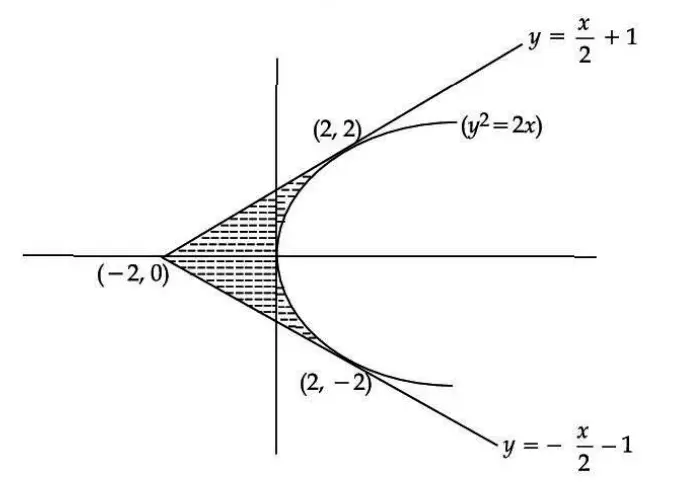
If $y = \sin^{-1}\left(\frac{1-x^2}{1+x^2}\right)$ then $\frac{dy}{dx} =$
If the rate of change of area of a circle is equal to the rate of change of its diameter, then its radius is equal to :
The area enclosed between $y^2 = 4x$, $x = 1$, $x = 4$ in first quadrant is :
If $f(x) = \begin{cases} \frac{k\cos x}{\pi - 2x}, & x \neq \frac{\pi}{2} \\ 3, & x = \frac{\pi}{2} \end{cases}$ is continuous at $x = \frac{\pi}{2}$, then k is :
$\int \left(\frac{1+x+x^2}{1+x^2}\right) e^{\tan^{-1} x} dx =$
The differential equation of the family of curves $y = a \sin(bx + c)$, a and c are parameters, is :
If $y = \frac{1}{x+1}$, then $\frac{d^2y}{dx^2}$ at $x = 2$ is:
If the function $f(x) = x^4 - 62x^2 + ax + 9$ attains its local maximum value at $x = 1$, then a is equal to :
The slope of the normal to the curve $y = 2x^2 - 4$ at P (1, -2) is :
The area enclosed by the ellipse $\frac{x^2}{9^2} + \frac{y^2}{6^2} = 1$ is:
The sum of order and degree of the differential equation $\frac{\left\{1+\left(\frac{dy}{dx}\right)^2\right\}^{\frac{5}{2}}}{\frac{d^2y}{dx^2}} = p$ is :
The points of discontinuity of the function f defined by $f(x) = \begin{cases} x+2 & x \leq 1 \\ x-2 & 1 < x < 2 \\ 0 & x \geq 2 \end{cases}$ are :
The area of the shaded portion 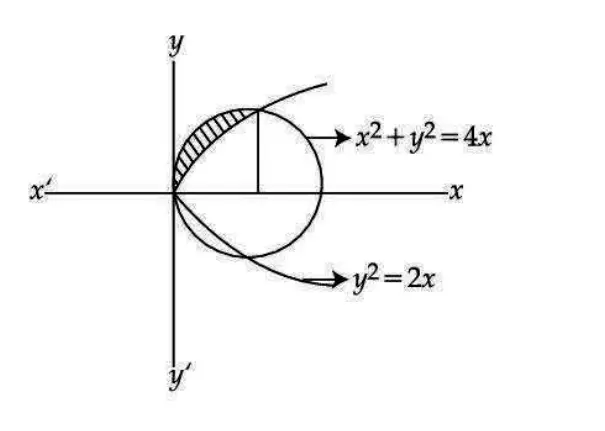 is :
The interval in which the function $f(x) = 10 - 6x - 2x^2$ is decreasing is :
In the context of differential equation Match List I with List II | LIST I | LIST II | |---|---| | A. $\frac{dy}{dx} = \frac{1+y^2}{1+x^2}$ | I. Not a differential equation | | B. $x^2 \frac{dy}{dx} = x^2 - 2y^2 + xy$ | II. Linear first order | | C. $\sin x + y = \cos(x+y)$ | III. Variable separable | | D. $(x+y)\frac{dy}{dx} = 1$ | IV. Homogenous | Choose the correct answer from the options given below:
If $y = x^{(x \sin x)}$ then $\frac{dy}{dx} = ?$
The equation of curve whose slope is given by $\frac{dy}{dx} = x$ and which passes through $\left(1, \frac{5}{2}\right)$ is :
Match List I with List II | LIST I | LIST II | |---|---| | A. $\int \frac{\sin x}{1 + \cos x} \, dx$ | I. $e^{\tan^{-1} x} + C$ | | B. $\int \frac{1}{1 - \tan x} \, dx$ | II. $\log(\log x + 1) + C$ | | C. $\int \frac{e^{\tan^{-1} x}}{1 + x^2} \, dx$ | III. $-\log\lvert 1+\cos x \rvert + C$ | | D. $\int \frac{1}{x + x \log x} \, dx$ | IV. $\frac{x}{2} - \frac{1}{2}\log\lvert \cos x - \sin x \rvert + C$ | Choose the correct answer from the options given below:
If $f(x) = \begin{cases} ax^2 + b, & x < -1 \\ bx^2 + ax + 4, & x \geq -1 \end{cases}$ is everywhere differentiable, then :
The value of the integral $\int_{2}^{4} \frac{x}{x^2+1} dx$ is :
If $f(x) = \frac{1}{1-x}$, then for $x > 1, f(x)$ is:
The general solution of $\frac{dy}{dx} = 1 + x^2 + y^2 + x^2y^2$ is: (given that $C$ is the constant of integration)
The volume of a cube is increasing at the rate of 27 cm$^3$/s. How fast is the surface area increasing when the length of the cube is 12 cm.
The minimum value of $f(x) = |2x - 1|$ is
The given function $f(x) = [x]$ is discontinuous at :
Which of the following statements are correct ? (A) If $f : R \to R$ then $f(x) = |x|$ is continuous everywhere. (B) If $f : R \to R$ then $f(x) = |x|$ is continuous everywhere but not differentiable at $x = 0$. (C) Let $f : R - \{0\} \to R$ then $f(x) = \frac{1}{x}$ is continuous everywhere. (D) Let $f : R \to R$ then $f(x) = |x - 1| + |x - 2|$ is continuous everywhere but not differentiable at exactly 2 points. (E) If $f : R \to R$ then $f(x) = \cot x$ is continuous everywhere. Choose the correct answer from the options given below :
Area of the region bounded by the curve $|x| + |y| = 1$ and x-axis is :
Integerating factor of $(x \log_e x) \frac{dy}{dx} + y = 2 \log_e x$ is :
The equation of tangent to the curve $x = a \cos^3 t, y = a \sin^3 t$ at t is :
The degree of the differential equation $\left(1 + \frac{dy}{dx}\right)^4 = \left(\frac{d^2y}{dx^2}\right)^2$ is:
Solution of $\frac{dy}{dx} = (1+x^2)(1+y^2)$ is:
Particular solution of the differential equation $\log\left(\frac{dy}{dx}\right) = x + y$, given that when $x = 0, y = 0$ is:
The area of the region bounded by the parabola $y^2 = 4ax$ and its latus rectum is:
If $\sqrt{1-x^2} + \sqrt{1-y^2} = a(x-y)$, then $\frac{dy}{dx} =$
The maximum slope of the curve $y = -x^3 + 3x^2 + 9x - 27$ is:
The area enclosed between the curves $y = x^2$ and $x = y^2$ is
The value of $\int \left(\sqrt{x} + \frac{1}{\sqrt{x}}\right)^2 dx$ is:
The differential equation $\frac{dy}{dx} + \frac{x}{y} = 0$, represents the family of curves:
Solution of differential equation $x dy - y dx = 0$ respresents :
The value of integral $\int \sqrt{4x^2 + 9}\, dx$ is
Match **List - I** with **List - II**. | | List - I | | List - II | |---|---|---|---| | (A) | $x = 2at^2, y = at^4$ | (I) | Inverse trignometric function | | (B) | $f(x) = (2x + 3)^3$ | (II) | Implicit function | | (C) | $xy + y^2 = \tan(x + y)$ | (III) | Parametric function | | (D) | $y = \tan^{-1}\left(\frac{3x - x^3}{1 - 3x^2}\right), -\frac{1}{\sqrt{3}} < x < \frac{1}{\sqrt{3}}$ | (IV) | Composite function | Choose the **correct** answer from the options given below :
$\int_0^{\pi/2} \sqrt{1 - \sin 2x} \, dx$ is equal to :
Points of discontinuity of the greatest integer function $f(x) = [x]$, where $[x]$ denotes integer less than or equal to $x$, are
The rate of change of the area of a circular disc with respect to its circumference when radius is 3 is :
The function $f(x) = \frac{x-1}{x(x^2-1)}, x \neq 1, f(1) = 1$, is discontinuous at
The value of $\int_{0}^{3} |2x - 6| dx$ is :
The derivative of $\sec(\tan \sqrt{x})$ with respect to x is :
The area of the region $\{(x, y) : y \geq x^2 \text{ and } y \leq |x|\}$ is
The slope of the tangent to the curve $x = at^2$, $y = 2at$ at 't' is :
If m and n are respectively the order and degree of the differential equation : $\left(\frac{d^2 y}{dx^2}\right)^5 + 6 \frac{\left(\frac{d^2 y}{dx^2}\right)^3}{\frac{d^3 y}{dx^3}} + \frac{d^3 y}{dx^3} = x^2 + 5$, then :
The interval in which the function $f(x) = 2x^3 - 3x^2 - 36x + 7$ is strictly decreasing is :
$\int \frac{\sqrt{\tan x}}{\sin x \cos x} dx$ equals :
$\int e^x \sec x (1 + \tan x) dx$ equals :
The rate of change in area of a triangle having sides 10 cm and 12 cm when the variable angle between them is $\theta = 60°$, is :
Which of the following regions will represent the shaded area in the given figure ?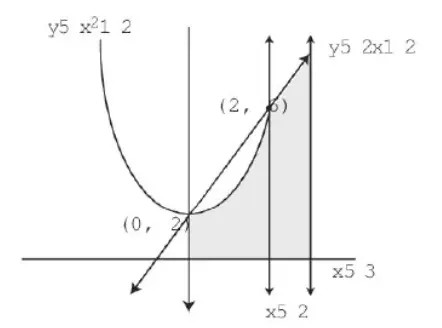
The angle of intersection between the curves $y = 4 - x^2$ and $y = x^2$ is :
Area of the region bounded by the curve $y = \cos x$ and x-axis between $x = 0$ and $x = \pi$ is :
The equation of the tangent, to the curve $y = x^2 - 2x - 3$ which is perpendicular to the line $x + 2y + 3 = 0$, is
$\int e^x (\tan x + \log_e \sec x) \, dx =$
Match **List - I** with **List - II**. | | List - I | | List - II | |---|---|---|---| | (A) | $y = \log(\sin x)$ | (I) | $\frac{d^2y}{dx^2} = -\frac{1}{x^2}$ | | (B) | $y = e^{(1 + \log x)}$ | (II) | $\frac{d^2y}{dx^2} = 2$ | | (C) | $y = \log\lvert x \rvert$ | (III) | $\frac{d^2y}{dx^2} = 0$ | | (D) | $y = x^2 + 4x - 1$ | (IV) | $\frac{d^2y}{dx^2} = -\csc^2 x$ | Choose the **correct** answer from the options given below :
The critical points of $f(x) = x^3 + x^2 + x + 1$ are
If $y = x^x$, $\frac{dy}{dx}$ will be:
The solution of the differentiable equation $2x\frac{dy}{dx} + y = 14x^3, x > 0$, is
$\int_1^2 \frac{x \, dx}{(x+1)(x+2)} =$
Interval in which the function $f(x) = 2x^3 - 3x^2 - 12x + 10$ is decreasing is :
$\int \left(x + \frac{1}{x}\right)^2 dx$ equals :
Angle between tangents to the curve $y = x^2 - 5x + 6$ at the points (2, 0) and (3, 0) is :
The interval in which the $f(x) = \sin x - \cos x$, $0 \leq x \leq 2\pi$ is strictly decreasing is :
Which of the following differential equation represents the family of circles touching the x-axis at the origin ?
If $y = \log\left[\frac{x^2}{e^2}\right]$ then value of $\frac{d^2y}{dx^2}$ is :
The equation of tangent to the curve given by $x = a\sin^3 t$, $y = b\cos^3 t$ at a point where $t = \frac{\pi}{2}$ is :
Match List - I with List - II. Match the integrating factors : | List - I (Differential Equation) | List - II (Integrating factor) | |---|---| | (A) $\frac{dy}{dx} + 3y = e^{-2x}$ | (I) $\frac{1}{x}$ | | (B) $x\frac{dy}{dx} + y = 3x^2$ | (II) $e^{-x}$ | | (C) $x\frac{dy}{dx} - y = 3x^2$ | (III) $x$ | | (D) $\frac{dy}{dx} - y = x$ | (IV) $e^{3x}$ | Choose the correct answer from the options given below :
The area enclosed by the ellipse $\frac{x^2}{16} + \frac{y^2}{9} = 1$ is given by :
The two curves $x^3 - 3xy^2 + 15 = 0$ and $3x^2 y - y^3 + 17 = 0$ :
$\int e^x \left(\frac{1-x}{1+x^2}\right)^2 dx =$
If $f(x) = 2x$ and $g(x) = \frac{x^2}{2} + 1$, then which of the following can be a discontinuous function ?
$\int_{\frac{\pi}{6}}^{\frac{\pi}{3}} \frac{dx}{1 + \sqrt{\tan x}}$ is equal to :
The differential equation whose solution is $Ax^2 + By^2 = 1$ where A and B are arbitrary constant is of : (A) first order and first degree (B) second order and first degree (C) second order and second degree (D) second order Choose the correct answer from the options given below :
The condition on a and b, such that for $y = \frac{a}{x} - \frac{b}{x^2}$, $\frac{dy}{dx} = 0$ at $x=1$ is :
The derivative of $\sin(\tan^{-1} e^{2x})$ with respect to $x$ is:
The maximum value of $2x^3 - 24x + 107$ in the interval $[1, 3]$ is :
The area enclosed between the curve $y = x^2 + 2$ and x-axis between $x = 0$ and $x = 3$ is :
Integrating factor of the differential equation $(1 - y^2)\frac{dx}{dy} + xy = ay$ is :
If $x = a\left(t - \frac{1}{t}\right)$, $y = b\left(t + \frac{1}{t}\right)$, then $\frac{dy}{dx} =$
If $\cos y = x\cos(a+y)$, then $\frac{dy}{dx} = $
Match List I with List II | LIST I | LIST II | |---|---| | A. Maximum value of $f(x) = -\lvert x+1 \rvert + 3$ | I. 6 | | B. Minimum value of $f(x) = (2x-1)^2 + 5$ | II. 5 | | C. Maximum value of $f(x) = 6 - x^2$ | III. no maximum value | | D. Maximum value of $f(x) = x^3 + 1$ | IV. 3 | Choose the correct answer from the options given below:
The integral $\int_{0}^{1} x(1-x)^n dx$ is equal to :
Let $y = \log_e \left(\frac{a + b \sin x}{a - b \sin x}\right)$, then value of $\frac{dy}{dx}$ is :
The intervals for which $f(x) = x^4 - 2x^2$ is increasing are :
The solution of $y' - y'' = 2x$ is: A. $y = x^2 + 2x + 2$ B. $y = x^2 + 2x + 1$ C. $y = x + 2$ D. $y = x^2 - 2x + 1$ Choose the correct answer from the options given below:
Area of the region bounded by $y = -1$, $y = 2$, $x = y^3$ and $x = 0$ is :
The degree of the differential equation $\left[1 + \left(\frac{dy}{dx}\right)\right]^3 = \left(\frac{d^2 y}{dx^2}\right)^2$ is :
The value of C which satisfies Rolle's Theorem for $f(x) = \sin^4 x + \cos^4 x$ in $\left[0, \frac{\pi}{2}\right]$. Then C is :
The value of C, in Rolle's theorem for the function $f(x) = e^x \sin x$, when $x \in [0, \pi]$ is :
The approximate volume of a cube of side a meters on increasing the side by 4% is:
The integral $\int e^x \left(\frac{x-1}{2x^2}\right) dx$ is equal to:
$\int_{0}^{1.5} [x] dx$, where $[x]$ denotes the greatest integer function $\leq x$, is equal to :
The appropriate change in the volume V of a cube of side $x$ metres caused by increasing the side by 2% is :
The differential equation $y = xp + \sqrt{x^2 p^3 + 4}$ where $p = \frac{dy}{dx}$ is : (A) of order 1 (B) of degree 1 (C) of order 2 (D) of degree 3 Choose the **correct** answer from the options given below :
The solution of the differential equation $\frac{dy}{dx} = \frac{6}{x^2}$; $y(1) = 3$ is :
The area of the region bounded by the lines $x = 2y + 3, x = 0, y = 1$ and $y = -1$ is:
The integral $\int \frac{dx}{x^2(x^4+1)^{\frac{3}{4}}}$ equals __________.
If $f(x) = \begin{cases} \frac{x^2 - 9}{x - 3}, & x \neq 3 \\ 5, & x = 3 \end{cases}$ then $f(x)$ :