Waves & Oscillations PYQ — Page 3
NEET UG Physics — Waves & Oscillations previous year questions with solutions.
All Waves & Oscillations Questions (108)
If ${n}_{1}, {n}_{2}$ and ${n}_{3}$ are the fundamental frequencies of three segments into which a string is divided, then the original fundamental frequency $n$ of the string is given by:
A source of unknown frequency gives 4 beats/s when sounded with a source of known frequency $250 \mathrm{~Hz}$. The second harmonic of the source of unknown frequency gives five beats per second when sounded with a source of frequency $513 \mathrm{~Hz}$. The unknown frequency is
Two source $\mathrm{P}$ and $\mathrm{Q}$ produce notes of frequency $660 \mathrm{~Hz}$ each. A listener moves from $\mathrm{P}$ to $\mathrm{Q}$ with a speed of $1 \mathrm{~ms}^{-1}$. If the speed of sound is $330 \mathrm{~m} / \mathrm{s}$, then the number of beats heard by the listener per second will be:
The length of the wire between two ends of sonometer is $100 \mathrm{~cm}$. What should be the positions of two bridges below the wire so that the three segments of the wire have their fundamental frequencies in the ratio $1: 3: 5$.
A wave travelling in the positive $x$-direction having displacement along $y$-direction as $1 \mathrm{~m}$, wavelength $2 \pi \mathrm{m}$ and frequency of $\frac{1}{\pi} \mathrm{Hz}$ is represented by
A particle of mass $m$ oscillates along $x$-axis according to equation $x=a$ sin $\omega t$. The nature of the graph between momentum and displacement of the particle is:
If we study the vibration of a pipe open at both ends, then the following statements is not true
Two sources of sound placed close to each other, are emitting progressive waves given by $y_1=4 \sin 600 \pi t \text { and } y_2=5 \sin 608 \pi t$ An observer located near these two sources of sound will hear
The equation of a simple harmonic wave is given by $$ y=3 \sin \frac{\pi}{2}(50 t-x) $$ where $x$ and $y$ are in metres and $t$ is in seconds. The ratio of maximum particle velocity to the wave velocity is
When a string is divided into three segments of lengths $l_1, l_2$ and $l_3$, the fundamental frequencies of these three segments are $v_1$, $v_2$ and $v_3$ respectively. The original fundamental frequency $(v)$ of the string is
Two waves are represented by the equations $y_1=a \sin (\omega t+k x+0.57) \mathrm{m}$ and $y_2=a \cos (\omega t+k x) \mathrm{m}$, where $x$ is in metre and $t$ in second. The phase difference between them is
Two particle are oscillating along two close parallel straight lines side by side, with the same frequency and amplitudes. They pass each other, moving in opposite directions when their displacement is half of the amplitude. The mean positions of the two particles lie on a straight line perpendicular to the paths of the two particles. The phase difference is
Sound waves travel at $350 \mathrm{~m} / \mathrm{s}$ through a warm air and at $3500 \mathrm{~m} / \mathrm{s}$ through brass. The wavelength of a $700 \mathrm{~Hz}$ acoustic wave as it enters brass from warm air
A particle of mass $m$ is released from rest and follows a parabolic path as shown. Assuming that the displacement of the mass from the origin is small, which graph correctly depicts the position of the particle as a function of time? 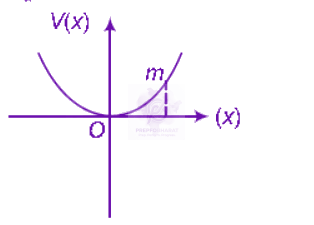
Two identical piano wires kept under the same tension $T$ have a fundamental frequency of $600 \mathrm{~Hz}$. The fractional increase in the tension of one of the wires which will lead to occurrence of 6 beat/s when both the wires oscillate together would be
Out of the following functions representing motion of a particle which represents SHM I. $y=\sin \omega t-\cos \omega t$ II. $y=\sin ^3 \omega t$ III. $y=5 \cos \left(\frac{3 \pi}{4}-3 \omega t\right)$ IV. $y=1+\omega t+\omega^2 t^2$
A transverse wave is represented by $y=A \sin (\omega t-k x)$. For what value of the wavelength is the wave velocity equal to the maximum particle velocity?
A particle moves in $x-y$ plane according to rule $\mathrm{x}=\mathrm{a} \sin \omega \mathrm{t}$ and $\mathrm{y}=\mathrm{a} \cos \omega \mathrm{t}$. The particle follows
The period of oscillation of a mass $M$ suspended from a spring of negligible mass is $\mathrm{T}$. If along with it another mass $M$ is also suspended, the period of oscillation will now be
The displacement of a particle along the $x$ axis is given by $\mathrm{x}=\mathrm{a} \sin ^2 \omega \mathrm{t}$. The motion of the particle corresponds to
A tuning fork of frequency $512 \mathrm{~Hz}$ makes 4 beats/seconds with the vibrating string of a piano. The beat frequency decreases to 2 beats/s when the tension in the piano string is slightly increased. The frequency of the piano string before increasing the tension was
A wave in a string has an amplitude of $2 \mathrm{~cm}$. The wave travels in the +ve direction of $x$ axis with a speed of $128 \mathrm{~ms}^{-1}$ and it is noted that 5 complete waves fit in $4 \mathrm{~m}$ length of the string. The equation describing the wave is
A simple pendulum performs simple harmonic motion about $\mathrm{x}=0$ with an amplitude a and time period $T$. The speed of the pendulum at $\mathrm{x}=\frac{\mathrm{a}}{2}$ will be
Each of the two strings of length $51.6 \mathrm{~cm}$ and $49.1 \mathrm{~cm}$ are tensioned separately by $20 \mathrm{~N}$ force. Mass per unit length of both the strings is same and equal to $1 \mathrm{~g} / \mathrm{m}$. When both the strings vibrate simultaneously the number of beats is :