Waves & Oscillations PYQ — Page 2
NEET UG Physics — Waves & Oscillations previous year questions with solutions.
All Waves & Oscillations Questions (108)
The radius of circle, the period of revolution, initial position and sense of revolution are indicated in the figure. 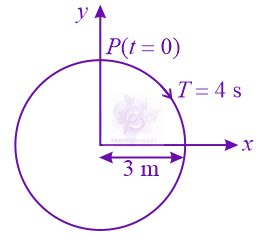 $y$-projection of the radius vector of rotating particle $P$ is
The displacement of a particle executing simple harmonic motion is given by, $y={A}_{0}+Asin\omega t+Bcos\omega t.$ Then, the amplitude of its oscillation is given by
Average velocity of a particle executing SHM in one complete vibration is
The distance covered by a particle undergoing SHM in one time period is ( amplitude $=\mathrm{A}$ )
A mass falls from a height ' $h$ ' and its time of fall ' $t$ ' is recorded in terms of time period $T$ of a simple pendulum. On the surface of earth it is found that $t=2 \mathrm{~T}$. The entire set $u$ is taken on the surface of another planet whose mass is half of earth and radius the same. Same experiment is repeated and corresponding times noted as $\mathrm{t}^{\prime}$ and $\mathrm{T}^{\prime}$.
A tuning fork with frequency $800 \mathrm{~Hz}$ produces resonance in a resonance column tube with upper end open and lower end closed by water surface. Successive resonance are observed at length $9.75 \mathrm{~cm}, 31.25 \mathrm{~cm}$ and $52.75 \mathrm{~cm}$. The speed of sound in air is
A truck is stationary and has a bob suspended by a light string, in a frame attached to the truck. The truck, suddenly moves to the right with an acceleration of a. The pendulum will tilt
A pendulum is hung from the roof of a sufficiently high building and is moving freely to and fro like a simple harmonic oscillator. The acceleration of the bob of the pendulum is $20m{s}^{-2}$ at a distance of $5m$ from mean position. The time period of oscillation is
The fundamental frequency in an open organ pipe is equal to the third harmonic of closed organ pipe. If the length of the closed organ pipe is 20 cm, the length of the open organ pipe is
A tuning fork is used to produce resonance in glass tube. The length of the air column in this tube can be adjusted by a variable piston. At room temperature of ${27}^{ o}C$ two successive resonances are produced at $20\mathrm{cm}$ and $73\mathrm{cm}$ of column length. If the frequency of the tuning fork is $320\mathrm{Hz}$, the velocity of sound in air at ${27}^{ o}C$ is
The two nearest harmonics of a tube closed at one end and open at other end are 220 Hz and 260 Hz. What is the fundamental frequency of the system?
A particle executes linear simple harmonic motion with an amplitude of 3 cm. When the particle is at 2 cm from the mean position, the magnitude of its velocity is equal to that of its acceleration. Then its time period in seconds is
A uniform rope of length $L$ and mass ${m}_{1}$, hangs vertically from a rigid support. A block of mass ${m}_{2}$ is attached to the free end of the rope. A transverse pulse of wavelength ${\lambda }_{1}$ is produced at the lower end of the rope. The wavelength of the pulse when it reaches the top of the rope is ${\lambda }_{2}$. The ratio $\frac{{\lambda }_{2}}{{\lambda }_{1}}$ is:
The second overtone of an open organ pipe has the same frequency as the first overtone of a closed pipe which is $L$ meter long. The length of the open pipe will be
A body of mass, $m$ is attached to the lower end of a spring whose upper end is fixed. The spring has negligible mass. When the mass $m$ is slightly pulled down and released, it oscillates with a time period of $3s$. When the mass $m$ is increased by $1\mathrm{kg}$, the time period of oscillations becomes $5s$. The value of $m$ in $\mathrm{kg}$ is
Three sound waves of equal amplitudes have frequencies, $(n – 1), n, (n + 1)$. They superimpose to give beats. The number of beats produced per second will be
An air column, closed at one end and open at the other, resonates with a tuning fork when the smallest length of the column is $50 \text{cm}$. The next larger length of the column resonating with the same tuning fork is:
A particle is executing SHM along a straight line. Its velocities at distances ${x}_{1}$ and ${x}_{2}$ from the mean position are ${V}_{1}$ and ${V}_{2}$ respectively. Its time period is:
A string is stretched between fixed points separated by 75.0 cm. It is observed to have resonant frequencies of 420 Hz and 315 Hz. There are no other resonant frequencier between these two. The lowest resonant frequency for this string is:
A particle is executing a simple harmonic motion. Its maximum acceleration is $\alpha$ and maximum velocity is $\beta$. Then, its time period of vibration will be:
When two displacements represented by ${y}_{1}=a sin(\omega t)$ and ${y}_{2}=b\mathrm{cos}(\omega t)$ are superimposed the motion is:
The fundamental frequency of a closed organ pipe of length $20\mathrm{cm}$ is equal to the second overtone of an organ pipe open at both the ends. The length of the organ pipe open at both the ends is
The oscillation of a body on a smooth horizontal surface is represented by the equation, $X=A\mathrm{cos}(\omega t)$, where $X=$ displacement at time $t$, $\omega =$ frequency of oscillation, $a=$ acceleration at time $t$ and $T=$ time period. Which one of the following graph shows correctly the variation $a$ with $t$ ?
The number of possible natural oscillations of air column in a pipe closed at one end of length $85 cm$ whose frequencies lies below $1250 Hz$ are: (velocity of sound $=340 {ms}^{-1}$)