Waves & Oscillations PYQ — Page 5
NEET UG Physics — Waves & Oscillations previous year questions with solutions.
All Waves & Oscillations Questions (108)
Two vibrating tuning forks produce progressive waves given $Y_1=4 \sin 500$ $\pi \mathrm{t}$ and $Y_2=2 \sin 506 \pi \mathrm{t}$. Number of beats produced per minute is:
A particle executing simple harmonic motion of amplitude $5 \mathrm{~cm}$ has maximum speed of $31.4 \mathrm{~cm} / \mathrm{s}$. The frequency of its oscillation is:
Which one of the following statements is true for the speed $v$ and the acceleration $a$ of particle executing simple harmonic motion?
The phase difference between two waves represented by $\begin{aligned} & y_1=10^{-6} \sin [100 t+(x / 50)+0.5] \mathrm{m} \\ & y_1=10^{-6} \cos [100 t+(x / 50)] \mathrm{m} \end{aligned}$ where $x$ is expressed in metres and $t$ is expressed in seconds is approximately
The time period of mass suspended from a spring is $T$. If the spring is cut into four equal parts and the same mass is suspended from one of the parts, then the new time period will be:
A particle of mass $m$ oscillates with simple harmonic motion between points $x_1$ and $x_2$, the equilibrium position being $\mathrm{O}$. Its potential energy is plotted. It will be as given below in the graph:
The potential energy of a simple harmonic oscillator when the particle is half way to its end point is: where $E$ energy is the total energy
In case of a forced vibration, the resonance peak becomes very sharp when the:
A wave travelling in the positive $x$-direction with amplitude $\mathrm{A}=0.2 \mathrm{~m}$, velocity $v=360 \mathrm{~ms}^{-1}$ and wavelength $\lambda$ $=60 \mathrm{~m}$, then the correct expression for the wave is:
Displacement between the maximum potential energy (P.E.) position and the maximum energy (K.E.) position for a particle executing simple harmonic motion is:
When a oscillator completes 100 oscillations its amplitude reduces to $\frac{1}{3}$ of the initial value. What will be its amplitude when it completes 200 oscillations?
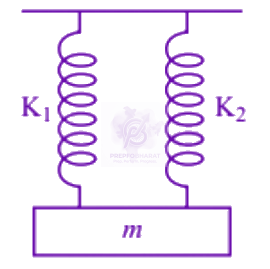
A mass is suspended separately by two different springs in successive order, then the time period is $T_1$ and $T_2$, respectively. If it is connected by both spring as shown in figure, then the time period $T_0$, so the correct reaction is: