Waves & Oscillations PYQ — Page 4
NEET UG Physics — Waves & Oscillations previous year questions with solutions.
All Waves & Oscillations Questions (108)
Each of the two strings of length $51.6 \mathrm{~cm}$ and $49.1 \mathrm{~cm}$ are tensioned separately by $20 \mathrm{~N}$ force. Mass per unit length of both the strings is same and equal to $1 \mathrm{gm}^{-1}$. When both the strings vibrate simultaneously the number of beats is
A simple pendulum performs simple harmonic motion about $\mathrm{x}=0$ with an amplitude a and time period T. The speed of the pendulum at $\mathrm{x}=\mathrm{a} / 2$ will be :
Which one of the following equations of motion represents simple harmonic motion? Where $\mathrm{k}, \mathrm{k}_0, \mathrm{k}_1$ and $\mathrm{a}$ are all positive
Which one of the following equations of motion represents simple harmonic motion?
A wave in a string has an amplitude of $2 \mathrm{~cm}$. The wave travels in the +ve direction of $\mathrm{x}$-axis with a speed of $128 \mathrm{~m} / \mathrm{s}$ and it is noted that 5 complete waves fit in $4 \mathrm{~m}$ length of the string. The equation describing the wave is
A point performs simple harmonic oscillation of period $T$ and the equation of motion is given by $x=a \sin (\omega t+ \frac{\pi}{6})$. After the elapse of what fraction of the time period the velocity of the point will be equal to half of its maximum velocity?
Two points are located at a distance of $10 \mathrm{~m}$ and $15 \mathrm{~m}$ from the source of oscillation. The period of oscillation is $0.05 \mathrm{~s}$ and the velocity of the wave is $300 \mathrm{~m} / \mathrm{s}$. What is the phase difference between the oscillations of two points?
The wave described by $y=0.25 \sin (10 \pi x-2 \pi t)$, where $x$ and $y$ are in metre and $t$ in second, is a wave travelling along the
Two periodic waves of intensities $I_1$ and $I_2$ pass through a region at the same time in the same direction. The sum of the maximum and minimum intensities is
The wave described by $y=0.25 \sin (10 \pi x-2 \pi t)$, where $\mathrm{x}$ and $\mathrm{y}$ are in meters and $\mathrm{t}$ in seconds, is a wave travelling along the
A point performs simple harmonic oscillation of period $\mathrm{T}$ and the equation of motion is given by $x=a \sin (w t+\pi / 6)$. After the elapse of what fraction of the time period the velocity of the point will be equal to half of its maximum velocity?
Two periodic waves of intensities $I_1$ and $I_2$ pass through a region at the same time in the same direction. The sum of the maximum and minimum intensities is
. Two points are located at a distance of $10 \mathrm{~m}$ and $15 \mathrm{~m}$ from the source of oscillation. The period of oscillation is $0.05 \mathrm{sec}$ and the velocity of the wave is $300 \mathrm{~m} / \mathrm{sec}$. What is the phase difference between the oscillations of two points?
Two simple harmonic motions of angular frequency 100 rad/s and 1000 rad/s have the same displacement amplitude. The ratio of their maximum acceleration is
Two Simple Harmonic Motions of angular frequency 100 and $1000 \mathrm{rad} \mathrm{s}^{-1}$ have the same displacement amplitude. The ratio of their maximum accelerations is
The particle executing simple harmonic motion has a kinetic energy $K_0 \cos ^2$ $\omega t$. The maximum values of the potential energy and the total energy are respectively.
A particle executes simple harmonic oscillation with an amplitude $a$. The period of oscillation is $T$. The minimum time taken by the particle to travel half of the amplitude from the equilibrium position is:
The phase difference between the instantaneous velocity and acceleration of a particle executing simple harmonic motion is :
A mass of $2.0 \mathrm{~kg}$ is put on a flat pan attached to a vertical spring fixed on the ground as shown in the figure. The mass of the spring and the pan is negligible. When pressed slightly and released the mass executes a simple harmonic motion. The spring constant is $200 \mathrm{~N} / \mathrm{m}$. What should be the minimum amplitude of the motion so that the mass gets detached from the pan (take $g=10 \mathrm{~m} / \mathrm{s}^2$ ). 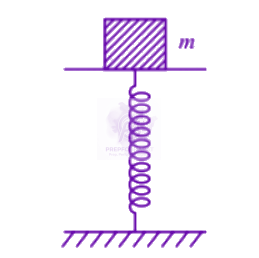
Two sound waves with wavelengths 5.0 $\mathrm{m}$ and $5.5 \mathrm{~m}$ respectively, each propagate in a gas with velocity $330 \mathrm{~m} / \mathrm{s}$. We expect the following number of beats per second:
The time of reverberation of a room $\mathrm{A}$ is one second. What will be the time (in seconds) of reverberation of a room, having all the dimensions double of those of room $\mathrm{A}$ ?
Which one of the following statements is true?
A transverse wave propagating along $x$-axis is represented by $y(x, t)=8.0$ $\sin (0.5 \pi x-4 \pi t-\pi / 4)$ where $x$ is in metres and $t$ is in seconds. The speed of the wave is:
A point source emits sound equally in all directions in a non-absorbing medium. Two points $\mathrm{P}$ and $\mathrm{Q}$ are at distances of 2 $\mathrm{m}$ and $3 \mathrm{~m}$ respectively from the source. The ratio of the intensities of the wave at $P$ and $Q$ is: