For given condition mg⇒a=mω2a=Ka=kmg=2002×10=0.1=10 cm
A mass of 2.0 ~kg is put on a flat pan attached to a vertical spring fixed on the ground as shown in the figure. The mass of the spring and the pan…
NEET UG 2007 — Physics Waves & Oscillations
2007mcqhard
A mass of 2.0 kg is put on a flat pan attached to a vertical spring fixed on the ground as shown in the figure. The mass of the spring and the pan is negligible. When pressed slightly and released the mass executes a simple harmonic motion. The spring constant is 200 N/m. What should be the minimum amplitude of the motion so that the mass gets detached from the pan (take g=10 m/s2 ). 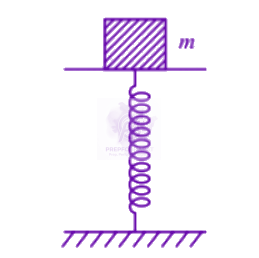
Official previous-year question
Held on 30 Apr 2007 · Verified 9 Jul 2026.
Options
- A
10.0 cm
- B
any value less than 12.0 cm
- C
4.0 cm
- D
8.0 cm
Did you get this right?
Sign in to track your attempts and accuracy.
Your note
Sign in to keep a private note on this question. Nothing you write is ever public.
NEET UG Waves & Oscillations in other years
Waves & Oscillations 2025Waves & Oscillations 2024Waves & Oscillations 2023Waves & Oscillations 2022Waves & Oscillations 2021Waves & Oscillations 2020Waves & Oscillations 2019Waves & Oscillations 2018Waves & Oscillations 2017Waves & Oscillations 2016Waves & Oscillations 2015Waves & Oscillations 2014
More NEET UG Waves & Oscillations questions
In an oscillating spring mass system, a spring is connected to a box filled with sand. As the box oscillates, sand leaks slowly out of the box vertically so that the average frequency $\omega(t)$ and average amplitude $A(t)$ of the system change with time $t$. Which one of the following options schematically depicts these changes correctly?
2025medium
Two identical point masses P and Q , suspended from two separate massless springs of spring constants $\mathrm{k}_1$ and $\mathrm{k}_2$, respectively, oscillate vertically. If their maximum speeds are the same, the ratio $\left(A_Q / A_P\right)$ of the amplitude $A_Q$ of mass $Q$ to the amplitude $A_P$ of mass $P$ is :
2025medium
A pipe open at both ends has a fundamental frequency $f$ in air. The pipe is now dipped vertically in a water drum to half of its length. The fundamental frequency of the air column is now equal to :
2025medium
If $x=5 \sin \left(\pi t+\frac{\pi}{3}\right) \mathrm{m}$ represents the motion of a particle executing simple harmonic motion, the amplitude and time period of motion, respectively, are
2024easy
Let $\omega_1, \omega_2$ and $\omega_3$ be the angular speed of the second hand, minute hand and hour hand of a smoothly running analog clock, respectively. If $x_1, x_2$ and $x_3$ are their respective angular distances in 1 minute then the factor which remains constant $(k)$ is
2024medium
Other Physics topics for NEET UG
Keep practicing Waves & Oscillations
Work through every NEET UG Waves & Oscillations PYQ, year by year.