NEET UG 2007 — Waves & Oscillations
Physics Waves & Oscillations questions from NEET UG 2007.
Other Years
4 Waves & Oscillations Questions from 2007
The particle executing simple harmonic motion has a kinetic energy $K_0 \cos ^2$ $\omega t$. The maximum values of the potential energy and the total energy are respectively.
A particle executes simple harmonic oscillation with an amplitude $a$. The period of oscillation is $T$. The minimum time taken by the particle to travel half of the amplitude from the equilibrium position is:
The phase difference between the instantaneous velocity and acceleration of a particle executing simple harmonic motion is :
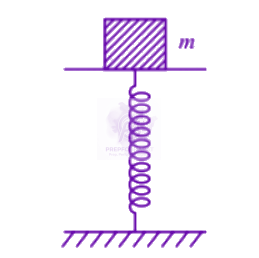
A mass of $2.0 \mathrm{~kg}$ is put on a flat pan attached to a vertical spring fixed on the ground as shown in the figure. The mass of the spring and the pan is negligible. When pressed slightly and released the mass executes a simple harmonic motion. The spring constant is $200 \mathrm{~N} / \mathrm{m}$. What should be the minimum amplitude of the motion so that the mass gets detached from the pan (take $g=10 \mathrm{~m} / \mathrm{s}^2$ ).