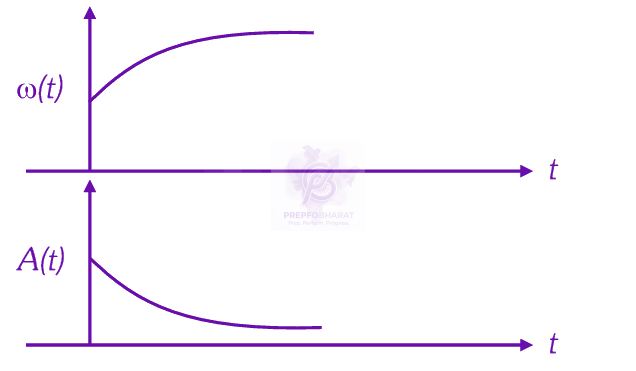
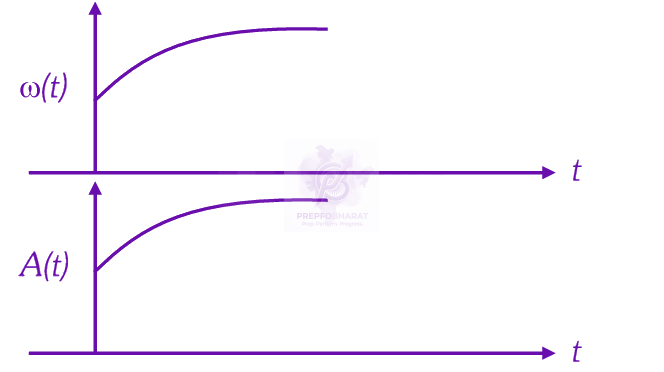
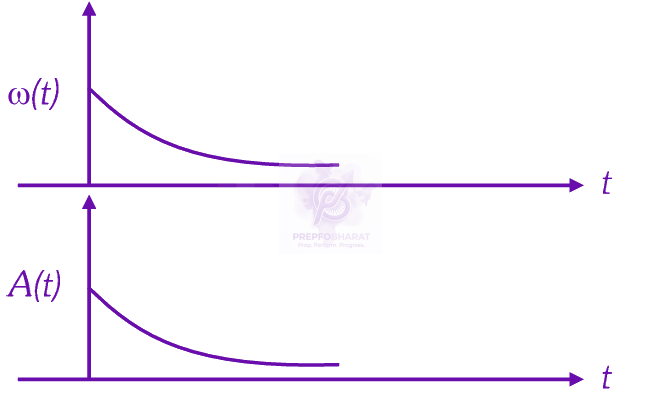
ω=mk∵m↓⇒ω↑ 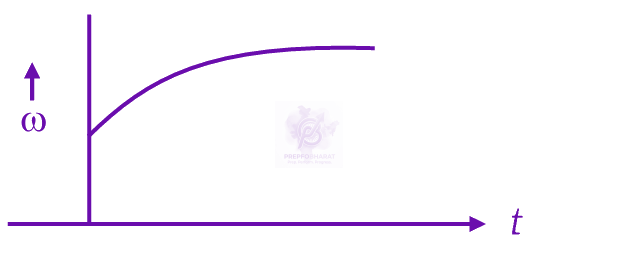
∵E=21kA2 The part of sand being removed takes away a part of energy. ∴ Total energy decreases. ∴ Energy of SHM decreases As a result Amplitude also decreases.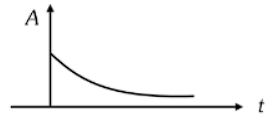
NEET UG 2025 — Physics Waves & Oscillations
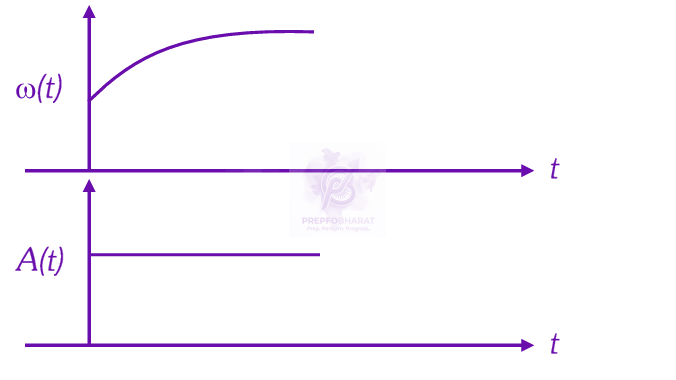
In an oscillating spring mass system, a spring is connected to a box filled with sand. As the box oscillates, sand leaks slowly out of the box vertically so that the average frequency ω(t) and average amplitude A(t) of the system change with time t. Which one of the following options schematically depicts these changes correctly?
Held on 30 Apr 2025 · Verified 9 Jul 2026.
Sign in to track your attempts and accuracy.
Sign in to keep a private note on this question. Nothing you write is ever public.
Two identical point masses P and Q , suspended from two separate massless springs of spring constants $\mathrm{k}_1$ and $\mathrm{k}_2$, respectively, oscillate vertically. If their maximum speeds are the same, the ratio $\left(A_Q / A_P\right)$ of the amplitude $A_Q$ of mass $Q$ to the amplitude $A_P$ of mass $P$ is :
A pipe open at both ends has a fundamental frequency $f$ in air. The pipe is now dipped vertically in a water drum to half of its length. The fundamental frequency of the air column is now equal to :
If $x=5 \sin \left(\pi t+\frac{\pi}{3}\right) \mathrm{m}$ represents the motion of a particle executing simple harmonic motion, the amplitude and time period of motion, respectively, are
Let $\omega_1, \omega_2$ and $\omega_3$ be the angular speed of the second hand, minute hand and hour hand of a smoothly running analog clock, respectively. If $x_1, x_2$ and $x_3$ are their respective angular distances in 1 minute then the factor which remains constant $(k)$ is
A particle executing simple harmonic motion with amplitude $A$ has the same potential and kinetic energies at the displacement
Work through every NEET UG Waves & Oscillations PYQ, year by year.