NEET UG 2004 — Mechanics
Physics Mechanics questions from NEET UG 2004.
Other Years
16 Mechanics Questions from 2004
The density of a newly discovered plant is twice that of earth. The acceleration due to gravity at the surface of the planet is equal to that at the surface of the earth. If the radius of the earth $R$, the radius of the planet would be:
A mass of $0.5 \mathrm{~kg}$ moving with a speed of $1.5 \mathrm{~m} / \mathrm{s}$ on a horizontal smooth surface, collides with a nearly weightless spring of force constant $k=50 \mathrm{~N} / \mathrm{m}$. The maximum compression of the spring would be: 
A block mass $m$ is placed on a smooth wedge of inclination $\theta$. The whole system is accelerated horizontally so that the block does not slip on the wedge. The force exerted by the wedge on the block ( $g$ is acceleration due to gravity) will be:
The coefficient of static friction $\mu_8$, between block $A$ of mass $2 \mathrm{~kg}$ and the table as shown in the figure is 0.2 . What would be the maximum mass value of block B so that the two blocks do not move? The string and the pulley are assumed to be smooth and massless $(g$ $\left.=10 \mathrm{~m} / \mathrm{s}^2\right)$ 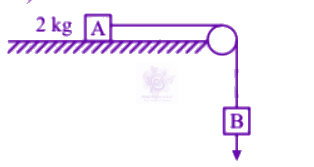
Two springs of spring constant $k_1$ and $k_2$ are joined in series. The effective spring constant of the combination is given by:
The ratio of the radii of gyration of a circular disc about a tangential axis in the plane of the disc and of a circular ring of the same radius about a tangential axis in the plane of the ring is:
A ball of mass $2 \mathrm{~kg}$ and another of mass $4 \mathrm{~kg}$ are dropped together from a 60 feet tall building. After a fall of 30 feet each towards earth, their respective kinetic energies will be in the ratio of:
Three particles, each of mass $m$ gram, are situated at the vertices of an equilateral triangle $\mathrm{ABC}$ side $l \mathrm{~cm}$ (as shown in the figure). The moment of inertia of the system about a line $\mathrm{AX}$ perpendicular to $A B$ and in the plane of $A B C$, in gram $\mathrm{cm}^2$ units will be: 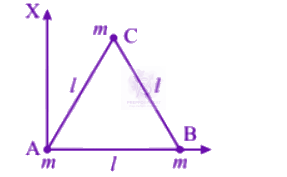
Consider a system of two particle having masses $m_1$ and $m_2$. If the particle of mas $m_1$ is pushed towards the mass centre of particle through a distance $d$, by what distance would the particle of mass $m_2$ move so as to keep the mass centre of particles at the original position?
A wheel having moment of inertia $2 \mathrm{~kg}$ $\mathrm{m}^2$ about its vertical axis, rotates at the rate of $60 \mathrm{rpm}$ about the axis. The torque which can stop the wheel's rotation in one minute would be:
The dimensions of universal gravitational constant are:
A stone is tied to a string of length ' $l$ ' and is whirled in a vertical circle with the other end of the string as the centre. At a certain instant of time, the stone is at its lowest position and has a speed ' $u$ '. The magnitude of change in velocity as it reaches a position where the string is horizontal ( $g$ being acceleration due to gravity)is:
If $|\vec{A} \times \vec{B}|=\sqrt{3} \vec{A} \cdot \vec{B}$ then the value of $|\vec{A} + \vec{B}|$ is:
An round disc of moment of inertia $I_2$ about its axis perpendicular to its plane and passing through its centre is placed over another disc of moment of inertia $\mathrm{I}_1$ rotating with an angular velocity $\omega$ about the same axis. The final angular velocity of the combination of discs is:
The unit of permittivity of free space $\varepsilon_0$, is:
A particle of mass $m_1$ is moving with a velocity $v_1$ and another particle of mass $m_2$ is moving with a velocity $v_2$. Both of them have the same momentum but their different kinetic energies are $E_1$ and $E_2$ respectively. If $m_1>m_2$ then: