NEET UG 2019 — Physical Chemistry
Chemistry Physical Chemistry questions from NEET UG 2019.
Other Years
29 Physical Chemistry Questions from 2019
Which of the following statements is correct regarding a solution of two compounds A and $\mathrm{B}$ exhibiting positive deviation from ideal behaviour?
The molar solubility of $\mathrm{CaF}_2$ $\left(\mathrm{K}_{\mathrm{sp}}=5.3 \times 10^{-11}\right)$ in $0.1 \mathrm{M}$ solution of $\mathrm{NaF}$ will be
An ideal gas expands isothermally from $10^{-3} \mathrm{~m}^3$ to $10^{-2} \mathrm{~m}^3$ at $300 \mathrm{~K}$ against a constant pressure of $10^5 \mathrm{Nm}^{-2}$. The work done on the gas is
Following limiting molar conductivities are given as given as $$ \begin{aligned} & \lambda_{\mathrm{m}\left(\mathrm{H}_2 \mathrm{SO}_4\right)}^0=\mathrm{x} \mathrm{S} \mathrm{cm}{ }^2 \mathrm{~mol}^{-1} \\ & \lambda_{\mathrm{m}\left(\mathrm{K}_2 \mathrm{SO}_4\right)}^0=\mathrm{y} \mathrm{S} \mathrm{cm}{ }^2 \mathrm{~mol}^{-1} \\ & \end{aligned} $$ $\lambda_{\mathrm{m}\left(\mathrm{CH}_2 \mathrm{COOK}\right)}^0=\mathrm{Z} \mathrm{S} \mathrm{cm}{ }^2 \mathrm{~mol}^{-1}$
Which of the following cannot act both as Bronsted acid and as Bronsted base?
For the cell reaction $2F{e}^{3+}(aq)+2{I}^{-}(aq)\rightarrow 2F{e}^{2+}(aq)+{I}_{2}(aq)$ ${E}_{cell}^{0}=0.24 V$ at $298 K.$ The standard Gibbs energy $({\Delta }_{r}{G}^{-})$ of the cell reaction is: [Given that Faraday constant $F=96500 Cmo{l}^{-1}$ ]
In water saturated air the mole fraction of water vapour is 0.02 . If the total pressure of the saturated air is $1.2 \mathrm{~atm}$, the partial pressure of dry air is
A first order reaction has a rate constant of $2.303 \times 10^{-3} \mathrm{~s}^{-1}$. The time required for $40 \mathrm{~g}$ of this reactant to reduce to $10 \mathrm{~g}$ will be [Given that $\log _{10} 2=0.3010$ ]
Orbital having 3 angular nodes and 3 total nodes is
Under the isothermal condition, a gas at $300 K$ expands from $0.1 L$ to $0.25 L$ against a constant external pressure of $2$ bar. The work done by the gas is (Given that $1 L$ bar$=100 J$)
Conjugate base for Bronsted acids ${\text{H}}_{2} \text{O}$ and $\text{HF}$ are:
If the rate constant for a first order reaction is $k$, the time $(t)$ required for the completion of $99%$ of the reaction is given by
The standard electrode potential $\left(\mathrm{E}^{-}\right)$values of $\left(\mathrm{Al}^{3+} / \mathrm{Al}, \mathrm{Ag}^{+} / \mathrm{Ag}, \mathrm{K}^{+} / \mathrm{K}\right.$ and $\mathrm{Cr}^{3+} / \mathrm{Cr}$ are $-1.66 \mathrm{~V}, 0.80 \mathrm{~V}, 2.93 \mathrm{~V}$ and $-0.74 \mathrm{~V}$, respectively. The correct decreasing order of reducing power of the metal is
Which of the following series of transitions in the spectrum of hydrogen atom falls in visible region?
For the chemical reaction ${N}_{2}(g)+3{H}_{2}(g)\rightleftharpoons 2N{H}_{3}(g)$, the correct option is:
$4d, 5p, 5f$ and $6p$ orbitals are arranged in the order of decreasing energy. The correct option is:
In hydrogen atom, the de-Broglie wavelength of an electron in the second Bohr orbit is [Given that, Bohr radius, $\mathrm{a}_0=52.9 \mathrm{pm}$ ]
The mixture that forms maximum boiling azeotrope is
pH of a saturated solution of $Ca{(OH)}_{2}$ is $9$ . The solubility product $({K}_{sp})$ of $Ca{(OH)}_{2}$ is:
Reversible expansion of an ideal gas under isothermal and adiabatic conditions are as shown in the figure. 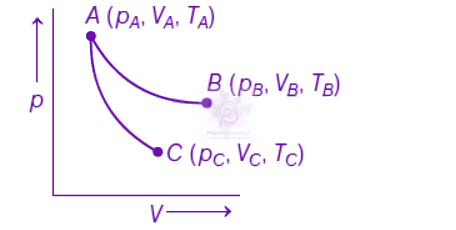 $A B \rightarrow$ Isothermal expansion $A C \rightarrow$ Adiabatic expansion Which of the following option is not correct?
Which will make basic buffer?
The density of $2 \mathrm{M}$ aqueous solution of $\mathrm{NaOH}$ is $1.28 \mathrm{~g} / \mathrm{cm}^3$. The molality of the solution is [Given that molecular mass of $\left.\mathrm{NaOH}=40 \mathrm{~g} \mathrm{~mol}^{-1}\right]$
The $\mathrm{pH}$ of $0.01 \mathrm{M} \mathrm{NaOH}(a q)$ solution will be
The oxidation state of $\mathrm{Cr}$ in $\mathrm{CrO}_5$ is
For an ideal solution, the correct option is:
For a cell involving one electron ${E}_{cell}^{\circleddash }=0.59 V$ at $298 K$, the equilibrium constant for the cell reaction is: $[Given that \frac{2.303 RT}{F}=0.059 V at T=298 K]$
In which case change in entropy is negative?
Which of the following reactions are disproportionation reaction? $(a)$ $2C{u}^{+}\rightarrow C{u}^{2+}+C{u}^{0}$ $(b)$ $3Mn{O}_{4}^{2-}+4{H}^{+}\rightarrow 2Mn{O}_{4}^{-}+Mn{O}_{2}+2{H}_{2}O$ $(c)$ $2KMn{O}_{4}\overset{\Delta }{\rightarrow }{K}_{2}Mn{O}_{4}+Mn{O}_{2}+{O}_{2}$ $(d)$ $2Mn{O}_{4}^{-}+3M{n}^{2+}+2{H}_{2}O\rightarrow 5Mn{O}_{2}+4{H}^{\oplus }$ Select the correct option from the following:
For a reaction, activation energy $\mathrm{E}_{\mathrm{a}}=0$ and the rate constant at $200 \mathrm{~K}$ is $1.6 \times 10^6 \mathrm{~s}^{-1}$. The rate constant at $400 \mathrm{~K}$ will be [Given that gas constant $\mathrm{R}=8.314 \mathrm{JK}^{-1} \mathrm{~mol}^{-1}$ ]