NEET UG 2024 — Physical Chemistry
Chemistry Physical Chemistry questions from NEET UG 2024.
Other Years
39 Physical Chemistry Questions from 2024
The ratio of solubility of AgCl in 0.1 M KCl solution to the solubility of AgCl in water is: (Given : Solubility product of $\mathrm{AgCl}=10^{-10}$ )
Choose the correct statement for the work done in the expansion and heat absorbed or released when 5 litres of an ideal gas at 10 atmospheric pressure isothermally expands into vacuum until volume is 15 litres:
The quantum numbers of four electrons are given below : I. $n=4 ; I=2 ; m_1=-2 ; s=-\frac{1}{2}$ II. $n=3 ; I=2 ; m_1=1 ; s=+\frac{1}{2}$ III. $n=4 ; I=1 ; m_1=0 ; s=+\frac{1}{2}$ IV. $n=3 ; I=1 ; m_1=-1 ; s=+\frac{1}{2}$ The correct decreasing order of energy of these electrons is
Following data is for a reaction between reactants A and B : 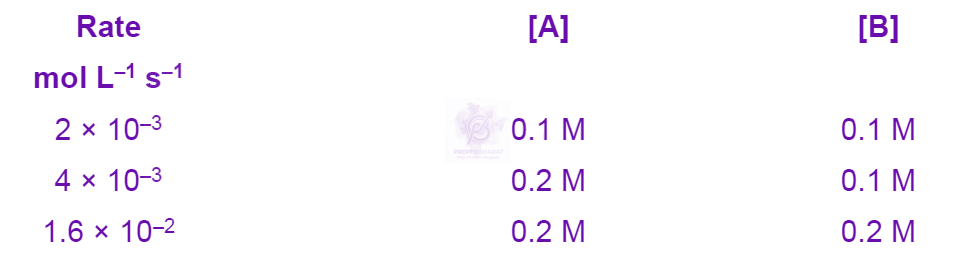 The order of the reaction with respect to $A$ and $B$, respectively, are
Match List I with List II. 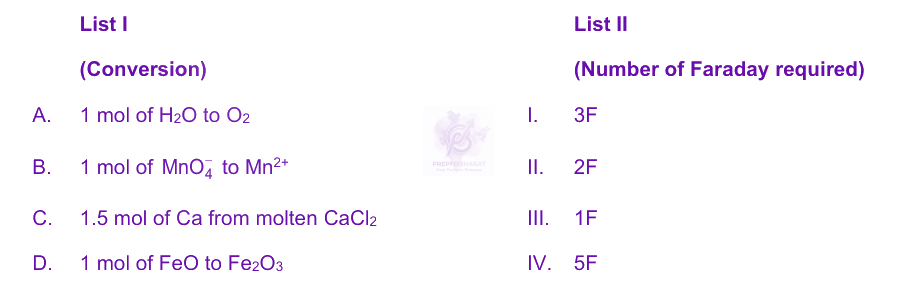 Choose the correct answer from the options given below:
For the following reaction at 300 K $\mathrm{A}_2(\mathrm{~g})+3 \mathrm{~B}_2(\mathrm{~g}) \rightarrow 2 \mathrm{AB}_3(\mathrm{~g})$ the enthalpy change is +15 kJ then the internal energy change is:
The standard cell potential of the following cell $\mathrm{Zn}\left|\mathrm{Zn}^{2+}(\mathrm{aq})\right| \mathrm{Fe}^{2+}(\mathrm{aq}) \mid \mathrm{Fe}$ is 0.32 V . Calculate the standard Gibbs energy change for the reaction : $\mathrm{Zn}(\mathrm{s})+\mathrm{Fe}^{2+}(\mathrm{aq}) \rightarrow \mathrm{Zn}^{2+}(\mathrm{aq})+\mathrm{Fe}(\mathrm{s})$ (Given : $1 \mathrm{~F}=96487 \mathrm{C}$ )
Match List-I with List-II: 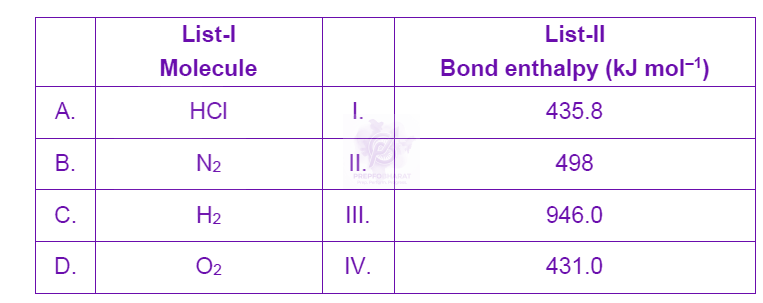 Choose the correct answer from the options given below:
The pH of a solution is defined as:
For the reaction $2 \mathrm{~A} \rightleftharpoons \mathrm{B}+\mathrm{C}, \mathrm{K}_{\mathrm{C}}=4 \times 10^{-3}$. At a given time, the composition of reaction mixture is: $[\mathrm{A}]=[\mathrm{B}]=[\mathrm{C}]=2 \times 10^{-3} \mathrm{M}$. Then, which of the following is correct?
A compound $X$ contains $32 \%$ of $A, 20 \%$ of $B$ and remaining percentage of $C$. Then, the empirical formula of X is : (Given atomic masses of $A=64 ; B=40 ; C=32 u$)
The rate of a reaction quadruples when temperature changes from $27^{\circ} \mathrm{C}$ to $57^{\circ} \mathrm{C}$. Calculate the energy o activation. Given $\mathrm{R}=8.314 \mathrm{~J} \mathrm{~K}^{-1} \mathrm{~mol}^{-1}, \log 4=0.6021$
For an endothermic reaction: (A) $\mathrm{qp}_{\mathrm{p}}$ is negative. (B) $\Delta_r H$ is positive. (C) $\Delta_r \mathrm{H}$ is negative. (D) $\mathrm{q}_{\mathrm{p}}$ is positive. Choose the correct answer from the options given below:
Rate constants of a reaction at 500 K and $700 \mid \mathrm{K}$ are $0.04 \mathrm{~s}^{-1}$ and $0.14 \mathrm{~s}^{-1}$, respectively; then, activation energy of the reaction is : (Given: $\log 3.5=0.5441, \mathrm{R}=8.31 \mathrm{~J} \mathrm{~K}^{-1} \mathrm{~mol}^{-1}$
Which indicator is used in the titration of sodium hydroxide against oxalic acid and what is the colour change at the end point?
The highest number of helium atoms is in
Which of the following plot represents the variation of $\ln \mathrm{k}$ versus $\frac{1}{T}$ in accordance with Arrhenius equation?
The work done during reversible isothermal expansion of one mole of hydrogen gas at $25^{\circ} \mathrm{C}$ from pressure of 20 atmosphere to 10 atmosphere is (Given $\mathrm{R}=2.0 \mathrm{cal} \mathrm{K}^{-1} \mathrm{~mol}^{-1}$ )
Which reaction is NOT a redox reaction?
Match List I with List II. 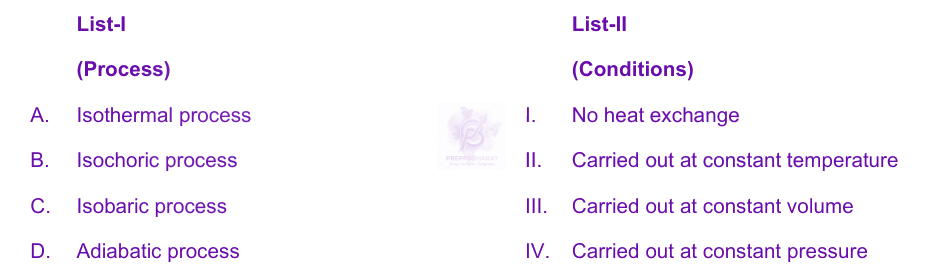 Choose the correct answer from the options given below:
1.0 g of $\mathrm{H}_2$ has same number of molecules as in:
Activation energy of any chemical reaction can be calculated if one knows the value of
Consider the following reaction in a sealed vessel at equilibrium with concentrations of $\mathrm{N}_2=3.0 \times 10^{-3} \mathrm{M}, \mathrm{O}_2=4.2 \times 10^{-3} \mathrm{M}$ and $\mathrm{NO}=2.8 \times 10^{-3} \mathrm{M}$. $2 \mathrm{NO}_{(\mathrm{g})} \rightleftharpoons \mathrm{N}_{2(\mathrm{~g})}+\mathrm{O}_{2(\mathrm{~g})}$ If 0.1 mol $\mathrm{L}^{-1}$ of $\mathrm{NO}_{(\mathrm{g})}$ is taken in a closed vessel, what will be degree of dissociation ( $\alpha$ ) of $\mathrm{NO}_{(\mathrm{g})}$ at equilibrium?
Which of the following pairs of ions will have same spin only magnetic moment values within the pair? A. $\mathrm{Zn}^{2+}, \mathrm{Ti}^{2+}$ B. $\mathrm{Cr}^{2+}, \mathrm{Fe}^{2+}$ C. $\mathrm{Ti}^{3+}, \mathrm{Cu}^{2+}$ D. $\mathrm{V}^{2+}, \mathrm{Cu}^{+}$ Choose the correct answer from the options given below
Mass in grams of copper deposited by passing 9.6487 A current through a voltmeter containing copper sulphate solution for 100 seconds is (Given : Molar mass of $\mathrm{Cu}: 63 \mathrm{~g} \mathrm{~mol}^{-1}, 1 \mathrm{~F}=96487 \mathrm{C}$ )
Match List I with List II 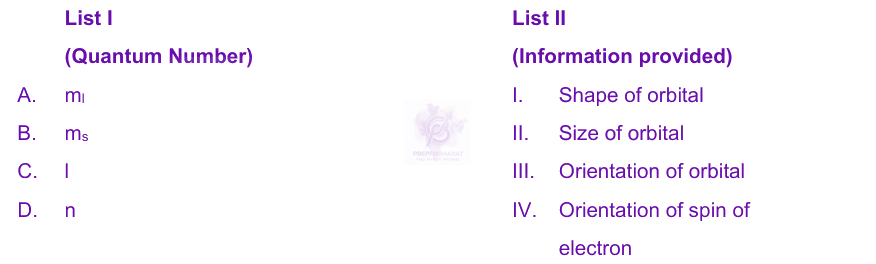 Choose the correct answer from the options given below :
At a given temperature and pressure, the equilibrium constant values for the equilibria are given below: $3 \mathrm{~A}_2+\mathrm{B}_2 \rightleftharpoons 2 \mathrm{~A}_3 \mathrm{~B}, \mathrm{~K}_1$ $\mathrm{A}_3 \mathrm{~B} \rightleftharpoons \frac{3}{2} \mathrm{~A}_2+\frac{1}{2} \mathrm{~B}_2, \mathrm{~K}_2$ The relation between $\mathrm{K}_1$ and $\mathrm{K}_2$ is :
From the following select the one which is not an example of corrosion.
The Henry's law constant $\left(\mathrm{K}_H\right)$ values of three gases $(\mathrm{A}, \mathrm{B}, \mathrm{C})$ in water are $145,2 \times 10^{-5}$ and 35 kbar , respectively. The solubility of these gases in water follow the order:
In which of the following equilibria, $\mathrm{K}_{\mathrm{p}}$ and $\mathrm{K}_{\mathrm{c}}$ are NOT equal?
In which of the following processes entropy increases? A. A liquid evaporates to vapour. B. Temperature of a crystalline solid lowered from 130 K to 0 K . C. $2 \mathrm{NaHCO}_{3(\mathrm{~s})} \rightarrow \mathrm{Na}_2 \mathrm{CO}_{3(\mathrm{~s})}+\mathrm{CO}_{2(\mathrm{~g})}+\mathrm{H}_2 \mathrm{O}_{(\mathrm{g})}$ D. $\mathrm{Cl}_{2(\mathrm{~g})} \rightarrow 2 \mathrm{Cl}_{(\mathrm{g})}$ Choose the correct answer from the options given below:
The energy of an electron in the ground state $(n=1)$ for $\mathrm{He}^{+}$ion is $-x J$, then that for an electron in $n=2$ state for $\mathrm{Be}^{3+}$ ion in J is
Which plot of $\ln k$ vs $\frac{1}{\mathrm{~T}}$ is consistent with Arrhenius equation?
For the reaction in equilibrium $\mathrm{N}_2(\mathrm{~g})+3 \mathrm{H}_2(\mathrm{~g}) \rightleftharpoons 2 \mathrm{NH}_3(\mathrm{~g}), \Delta \mathrm{H}=-\mathrm{Q}$ Reaction is favoured in forward direction by:
The amount of glucose required to prepare 250 mL of $\frac{\mathrm{M}}{20}$ aquepus solution is : (Molar mass of glucose : $180 \mathrm{~g} \mathrm{~mol}^{-1}$ )
The plot of osmotic pressure $(\Pi)$ vs concentration ( $\mathrm{mol} \mathrm{L}^{-1}$ ) for a solution gives a straight line with slope 25.73 $\mathrm{L}^{\text {bar mol-1}}$. The temperature at which the osmotic pressure measurement is done is
Mass of glucose $\left(\mathrm{C}_6 \mathrm{H}_{12} \mathrm{O}_6\right)$ required to be dissolved to prepare one litre of its solution which is isotonic with $15 \mathrm{~g} \mathrm{~L}^{-1}$ solution of urea $\left(\mathrm{NH}_3 \mathrm{CONH}_2\right)$ is (Given: Molar mass in $\mathrm{g} \mathrm{mol}{ }^{-1} \mathrm{C}: 12, \mathrm{H}: 1, \mathrm{O}: 16, \mathrm{~N}: 14$ )
1 gram of sodium hydroxide was treated with 25 mL of 0.75 M HCl solution, the mass of sodium hydroxide left unreacted is equal to
Given below are two statements: Statement I: The Balmer spectral line for $H$ atom with lowest energy is locateld at $\frac{5}{36} R_H \mathrm{~cm}^{-1}$. $\left(\mathrm{R}_{\mathrm{H}}=\right.$ Rydberg constant $)$ Statement II: When the temperature of blackbody increases, the maxima of the curve (intensity and wavelength) shifts to shorter wavelength. In the light of the above statements, choose the correct answer from the options given below: