NEET UG 2020 — Physical Chemistry
Chemistry Physical Chemistry questions from NEET UG 2020.
Other Years
29 Physical Chemistry Questions from 2020
An increase in the concentration of the reactants of a reaction leads to change in
Hydrolysis of sucrose is given by the following reaction. Sucrose $+{H}_{2}O\rightleftharpoons$ Glucose $+$ Fructose If the equilibrium constant $({K}_{C})$ is $2\times {10}^{13}$ at $300 K$, the value of ${\Delta }_{r}{G}^{\ominus }$ at the same temperature will be:
At standard conditions, if the change in the enthalpy for the following reaction is $-109{\mathrm{kJmol}}^{-1}$ ${H}_{2(g)}+{\mathrm{Br}}_{2(g)}\rightarrow 2{\mathrm{HBr}}_{(g)}$ Given that bond energy of ${H}_{2}$ and ${\mathrm{Br}}_{2}$ is $435{\mathrm{kJmol}}^{-1}$ and $192{\mathrm{kJmol}}^{-1}$, respectively, what is the bond energy (in $\mathrm{kJ}{\mathrm{mol}}^{-1}$) of $\mathrm{HBr}?$
The mixture which shows positive deviation from Raoult’s law is
The number of Faradays(F) required to produce $20 g$ of calcium from molten ${\mathrm{CaCl}}_{2}$ (Atomic mass of $\mathrm{Ca}=40 g{\mathrm{mol}}^{–1}$) is
The solubility product for a salt of the type $\mathrm{AB}$ is $4\times {10}^{-8}.$ What is the molarity of its saturated solution?
$\mathrm{HCl}$ was passed through a solution of ${\mathrm{CaCl}}_{2}$, ${\mathrm{MgCl}}_{2}$ and $\mathrm{NaCl}$. Which of the following compound(s) crystallise(s)?
Find out the solubility of $\mathrm{Ni}{(\mathrm{OH})}_{2}$ in $0.1 M\mathrm{NaOH}$. Given that the ionic product of $\mathrm{Ni}{(\mathrm{OH})}_{2}$ is $2\times {10}^{–15}$.
Isotonic solutions have same
The potential energy $(y)$ curve for ${H}_{2}$ formation as a function of internuclear distance $(x)$ of the $H$ atoms is shown below. 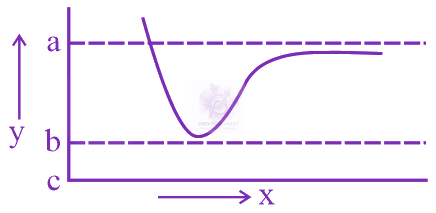 The bond energy of ${H}_{2}$ is :
The half-life for a zero order reaction having $0.02M$ initial concentration of reactant is $100s$. The rate constant (in $\mathrm{mol}{L}^{-1}{s}^{-1}$) for the reaction is
Which one of the followings has maximum number of atoms?
One mole of carbon atom weighs $12g$, the number of atoms in it is equal to, (Mass of carbon $-12$ is $1.9926\times {10}^{-23}g)$
If for a certain reaction ${\Delta }_{r}H$ is $30{\mathrm{kJmol}}^{-1}$ at $450K,$ the value of ${\Delta }_{r}S$ (in ${\mathrm{JK}}^{-1}{\mathrm{mol}}^{-1}$) for which the same reaction will be spontaneous at the same temperature is
The freezing point depression constant $({K}_{f})$ of benzene is $5.12 K \mathrm{kg} {\mathrm{mol}}^{–1}$. The freezing point depression for the solution of molality $0.078 m$ containing a non-electrolyte solute in benzene is (rounded off upto two decimal places):
The number of protons, neutrons and electrons in ${}_{71}^{175}\mathrm{Lu}$, respectively, are
In a typical fuel cell, the reactants (R) and product (P) are :-
What is the change in oxidation number of carbon in the following reaction? ${\mathrm{CH}}_{4}(g)+4{\mathrm{Cl}}_{2}(g)\rightarrow {\mathrm{CCl}}_{4}+4\mathrm{HCl}(g)$
The oxidation number of the underlined atom in the following species (Identify the incorrect statement)
Identify the reaction from following having top position in EMF series (Std.red. potential) according to their electrode potential at $298K.$
The calculated spin only magnetic moment of ${\mathrm{Cr}}^{2+}$ ion is
Which one of the following reactions does not come under hydrolysis type reaction?
The correct option for free expansion of an ideal gas under adiabatic condition is
For the reaction, $2\mathrm{Cl}(g)\rightarrow {\mathrm{Cl}}_{2}(g)$, the correct option is
In collision theory of chemical reaction, ${Z}_{\mathrm{AB}}$ represents
The number of angular nodes and radial nodes in $3s$ orbital are
If $8g$ of a non-electrolyte solute is dissolved in $114g$ of $n-$octane to reduce its vapour pressure to $80%,$ the molar mass (in $g{\mathrm{mol}}^{-1}$) of the solute is [Given that molar mass of n-octane is $114g{\mathrm{mol}}^{-1}$]
Which among the following salt solutions is basic in nature?
The rate constant for a first order reaction is $4.606\times {10}^{–3} {s}^{–1}$. The time required to reduce $2.0 g$ of the reactant to $0.2 g$ is :