From first law of thermodynamics, ΔU=q+W In adiabatic expansion, q=0 ∴ΔU=W During expansion of a gas w is negative i.e w<0 or ΔU<0. We know that, ΔU=nCVΔT ∴∴nCVΔT<0TC−TA<0 or or ΔT<0TC<TA Thus, option (4) is incorrect while the remaining options are correct.
Reversible expansion of an ideal gas under isothermal and adiabatic conditions are as shown in the figure. NEET 2019 Chemistry, Thermodynamics (C) —…
NEET UG 2019 — Chemistry Physical Chemistry
2019mcqhard
Reversible expansion of an ideal gas under isothermal and adiabatic conditions are as shown in the figure. 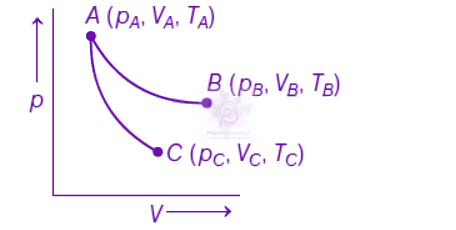
AB→ Isothermal expansion AC→ Adiabatic expansion Which of the following option is not correct?
Official previous-year question
Held on 30 Apr 2019 · Verified 9 Jul 2026.
Options
- A
ΔSisothermal >ΔSadiabatic
- B
TA=TB
- C
Wisothermal >Wadiabatic
- D
Tc>TA
Did you get this right?
Sign in to track your attempts and accuracy.
Your note
Sign in to keep a private note on this question. Nothing you write is ever public.
NEET UG Physical Chemistry in other years
More NEET UG Physical Chemistry questions
For the reaction 2SO₂(g) + O₂(g) ⇌ 2SO₃(g), ΔH = -198 kJ. Which condition favours forward reaction?
2026medium
The unit of rate constant for a first-order reaction is:
2026easy
Among the following choose the ones with equal number of atoms. A. 212 g of $\mathrm{Na}_2 \mathrm{CO}_3(\mathrm{~s})$ [molar mass $=106 \mathrm{~g}$ ] B. 248 g of $\mathrm{Na}_2 \mathrm{O}$ (s) [molar mass $=62 \mathrm{~g}$ ] C. 240 g of $\mathrm{NaOH}(\mathrm{s})$ [molar mass $=40 \mathrm{~g}]$ D. 12 g of $\mathrm{H}_2(\mathrm{~g})$ [molar mass $=2 \mathrm{~g}$ ] E. 220 q of $\mathrm{CO}_2(\mathrm{q})$ [molar mass $\left.=44 \mathrm{~g}\right]$ Choose the correct answer from the options given below:
2025medium
For the reaction $\mathrm{A}(\mathrm{g}) \rightleftharpoons 2 \mathrm{~B}(\mathrm{~g})$, the backward reaction rate constant is higher than the forward reaction rate constant by a factor of 2500 , at 1000 K . [Given : $\mathrm{R}=0.0831 \mathrm{~L} \mathrm{~atm} \mathrm{~mol}^{-1} \mathrm{~K}^{-1}$ ] $\mathrm{K}_{\mathrm{p}}$ for the reaction at 1000 K is
2025medium
The standard heat of formation, in $\mathrm{kcal} / \mathrm{mol}^{\text {of }} \mathrm{Ba}^{2+}$ is : [Given : standard heat of formation of $\mathrm{SO}_4^{2-}$ ion (aq) $=-216 \mathrm{kcal} / \mathrm{mol}$, Standard heat of crystallisation of $\mathrm{BaSO}_4(\mathrm{~s})=-4.5 \mathrm{kcal} / \mathrm{mol}$, standard heat of formation of $\left.\mathrm{BaSO}_4(\mathrm{~s})=-349 \mathrm{kcal} / \mathrm{mol}\right]$
2025medium
Other Chemistry topics for NEET UG
Keep practicing Physical Chemistry
Work through every NEET UG Physical Chemistry PYQ, year by year.