Inorganic Chemistry PYQ
NEET UG Chemistry — Inorganic Chemistry previous year questions with solutions.
Browse by Year
Inorganic Chemistry at a glance
Questions per year
441 across 25 yearsDifficulty mix
441 total- easy207 · 47%
- medium191 · 43%
- hard43 · 10%
Subtopic-wise weightage
Breakdown of the 437 Inorganic Chemistry questions tagged to a subtopic, by year — darker cells mean more questions.
| Subtopic | Weightage | Total | 2025 | 2024 | 2023 | 2022 | 2021 | 2020 | 2019 | 2018 | 2017 | 2016 | 2015 | 2014 | 2013 | 2012 | 2011 | 2010 | 2009 | 2008 | 2007 | 2006 | 2005 | 2004 | 2003 | 2002 |
|---|---|---|---|---|---|---|---|---|---|---|---|---|---|---|---|---|---|---|---|---|---|---|---|---|---|---|
| Chemical Bonding | 30.4% | 133 | 2 | 7 | 6 | 8 | 4 | 5 | 9 | 5 | 4 | 7 | 8 | 3 | 11 | 7 | 7 | 7 | 6 | 6 | 2 | 7 | 4 | 5 | 1 | 2 |
| Coordination Compounds | 21.3% | 93 | 4 | 6 | 6 | 5 | 2 | 3 | 4 | 4 | 4 | 3 | 6 | 2 | 5 | 3 | 5 | 2 | 4 | 5 | 2 | 3 | 2 | 6 | 4 | 3 |
| p-Block Elements | 19.5% | 85 | 2 | 5 | 3 | 7 | 3 | 5 | 8 | 3 | 1 | 8 | 5 | 2 | 5 | 3 | 2 | 4 | 2 | 4 | 3 | 3 | 4 | 2 | 1 | |
| d- & f-Block Elements | 16.2% | 71 | 1 | 8 | 4 | 3 | 2 | 4 | 2 | 1 | 4 | 3 | 3 | 3 | 5 | 5 | 2 | 3 | 3 | 2 | 2 | 2 | 3 | 3 | 3 | |
| Periodic Table & Periodicity | 10.1% | 44 | 2 | 5 | 3 | 3 | 3 | 2 | 1 | 1 | 2 | 2 | 1 | 2 | 2 | 2 | 3 | 2 | 3 | 2 | 1 | 2 | ||||
| Qualitative Analysis | 1.1% | 5 | 1 | 3 | 1 | |||||||||||||||||||||
| Hydrogen & s-Block | 0.9% | 4 | 4 | |||||||||||||||||||||||
| Metallurgy | 0.5% | 2 | 2 | |||||||||||||||||||||||
| All subtopics | 437 | 12 | 34 | 22 | 26 | 11 | 20 | 25 | 14 | 14 | 23 | 24 | 11 | 28 | 18 | 20 | 22 | 18 | 17 | 12 | 15 | 14 | 17 | 9 | 11 |
All Inorganic Chemistry Questions (441)
Which of the following is the most electronegative element?
Which among the following electronic configurations belong to main group elements? A. $[\mathrm{Ne}] 3 \mathrm{~s}^1$ B. $[\operatorname{Ar}] 3 \mathrm{~d}^3 4 \mathrm{~s}^2$ C. $[\mathrm{Kr}] 4 d^{10} 5 s^2 5 p^5$ D. $[\mathrm{Ar}] 3 \mathrm{~d}^{10} 4 \mathrm{~s}^1$ E. $[R n] 5 f^0 6 d^2 7 s^2$ Choose the correct answer from the option given below:
Out of the following complex compounds, which of the compound will be having the minimum conductance in solution?
Match List-I with List-II $\begin{array}{|l|l|l|l|}\hline & \text{List - I} & & \text{List - II} \\\hline \text{A}. & \text{Haber process} & \text{(i)} & \text {Fe catalyst} \\\hline \text{B.} & \text{Wacker oxidation} & \text{(ii)} & \mathrm{PdCl}_2 \\\hline \text{C.} & \text{Wilkinson catalyst} & \text{(iii)} & \left[\left(\mathrm{PPh}_3\right)_3 \mathrm{RhCl}\right] \\\hline \text{D.} & \text{Ziegler catalyst} & \text{(iv)} & \mathrm{TiCl}_4 \text{ with } \mathrm{Al}\left(\mathrm{CH}_3\right)_3 \\\hline\end{array}$ Choose the correct answer from the options given below :
Identify the correct orders against the property mentioned (A) $\mathrm{H}_2 \mathrm{O}\gt\mathrm{NH}_3\gt\mathrm{CHCl}_3$ - dipole moment (B) $\mathrm{XeF}_4\gt\mathrm{XeO}_3\gt\mathrm{XeF}_2-$ number of lone pairs on central atom (C) $\mathrm{O}-\mathrm{H}\gt\mathrm{C}-\mathrm{H}\gt\mathrm{N}-\mathrm{O}-$ bond length (D) $\mathrm{N}_2\gt\mathrm{O}_2\gt\mathrm{H}_2$ - bond enthalpy Choose the correct answer from the options given below :
Match List - I with List - II $\begin{array}{llll} & \text{List-I} & & \text{List-II} \\A. & \mathrm{XeO}_3 & I. & \mathrm{sp}^3 \mathrm{~d}, \text{linear} \\B. & \mathrm{XeF}_2 & II. & \mathrm{sp}^3 ; \text{pyramidal} \\C. & \mathrm{XeOF}_4 & III. & \mathrm{sp}^3 \mathrm{~d}^3 ; \text{distorted octahedral} \\D. & \mathrm{XeF}_6 & IV. & \mathrm{sp}^3 \mathrm{~d}^2 ; \text{square pyramidal}\end{array}$ Choose the correct answer from the options given below:
Match List I with List II: $\begin{array}{|l|l|l|l|}\hline & \text{List - I (Ion)} & & \text{List - II (Group Number in Cation Analysis)} \\\hline \text{A}. & \mathrm{Co}^{2+} & \text{(i)} & \text{Group-I} \\\hline \text{B.} & \mathrm{Mg}^{2+} & \text{(ii)} & \text{Group-III} \\\hline \text{C.} & \mathrm{Pb}^{2+} & \text{(iii)} & \text{Group-IV} \\\hline \text{D.} & \mathrm{Al}^{3+} & \text{(iv)} & \text{Group-VI} \\\hline\end{array}$ Choose the correct answer from the option given below :
Given below are two statements : Statement I : A hypothetical diatomic molecule with bond order zero is quite stable. Statement II : As bond order increases, the bond length increase. In the light of the above statements, choose the most appropriate answer from the options given below :
The correct order of the wavelength of light absorbed by the following complexes is, A. $\left[\mathrm{Co}\left(\mathrm{NH}_3\right)_6\right]^{3+}$ B. $\left[\mathrm{Co}(\mathrm{CN})_6\right]^{3-}$ C. $\left[\mathrm{Cu}\left(\mathrm{H}_2 \mathrm{O}\right)_4\right]^{2+}$ D. $\left[\mathrm{Ti}\left(\mathrm{H}_2 \mathrm{O}\right)_6\right]^{3+}$ Choose the correct answer from the options given below:
Given below are two statements : Statement I : Ferromagnetism is considered as an extreme form of paramagnetism. Statement II : The number of unpaired electrons in a $\mathrm{Cr}^{2+}$ ion $(\mathrm{Z}=24)$ is the same as that of a $\mathrm{Nd}^{3+}$ ion $(Z=60)$. In the light of the above statements, choose the correct answer from the options given below :
Which of the following statements are true? A. Unlike Ga that has a very high melting point, Cs has a very low melting point. B. On Pauling scale, the electronegativity values of N and Cl are not the same. C. $\mathrm{Ar}, \mathrm{K}^{+}, \mathrm{Cl}^{-}, \mathrm{Ca}^{2+}$, and $\mathrm{S}^{2-}$ are all isoelectronic species. D. The correct order of the first ionization enthalpies of $\mathrm{Na}, \mathrm{Mg}, \mathrm{Al}$, and Si is $\mathrm{Si}\gt\mathrm{Al}\gt\mathrm{Mg}\gt\mathrm{Na}$. E. The atomic radius of Cs is greater than that of Li and Rb . Choose the correct answer from the options given below
Given below are two statements: Statement I : Like nitrogen that can form ammonia, arsenic can form arsine. Statement II : Antimony cannot form antimony pentoxide. In the light of the above statements, choose the most appropriate answer from the options given below:
Which of the following are paramagnetic? A. $\left[\mathrm{NiCl}_4\right]^{2-}$ B. $\mathrm{Ni}(\mathrm{CO})_4$ C. $\left[\mathrm{Ni}(\mathrm{CN})_4\right]^{2-}$ D. $\left[\mathrm{Ni}\left(\mathrm{H}_2 \mathrm{O}\right)_6\right]^{2+}$ E. $\mathrm{Ni}\left(\mathrm{PPh}_3\right)_4$ Choose the correct answer from the options given below :
$\left[\mathrm{Mn}_2(\mathrm{CO})_{10}\right]$ and $\left[\mathrm{Co}_2(\mathrm{CO})_8\right]$ structures have A. Metal-Metal linkage B. Terminal CO groups C. Bridging CO groups D. Metal in zero oxidation state Choose the correct answer from the options given below
The $\mathrm{E}^{\circ}$ value for the $\mathrm{Mn}^{3+} / \mathrm{Mn}^{2+}$ couple is more positive than that of $\mathrm{Cr}^{3+} / \mathrm{Cr}^{2+}$ or $\mathrm{Fe}^{3+} / \mathrm{Fe}^{2+}$ due to change of
Match List-I will List-II: 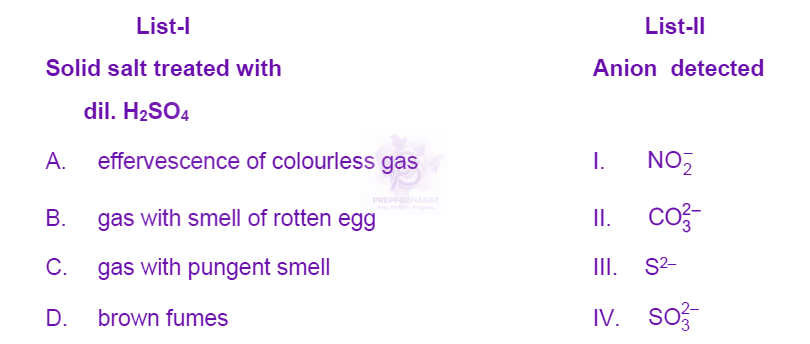 Choose the correct answer from the options given below:
The products A and B obtained in the following reactions, respectively, are $\begin{aligned} & 3 \mathrm{ROH}+\mathrm{PCl}_3 \rightarrow 3 \mathrm{RCl}+\mathrm{A} \\ & \mathrm{ROH}+\mathrm{PCl}_5 \rightarrow \mathrm{RCl}+\mathrm{HCl}+\mathrm{B} \end{aligned}$
Arrange the following compounds in increasing order of their solubilities in chloroform: $\mathrm{NaCl}, \mathrm{CH}_3 \mathrm{OH}$, cyclohexane, $\mathrm{CH}_3 \mathrm{CN}$
Among Group 16 elements, which one does NOT show -2 oxidation state?
Arrange the following elements in increasing order of electronegativity: $\mathrm{N}, \mathrm{O}, \mathrm{F}, \mathrm{C}, \mathrm{Si}$ Choose the correct answer from the options given below:
Given below are certain cations. Using inorganic qualitative analysis, arrange them in increasing group number from 0 to VI . A. $\mathrm{Al}^{3+}$ B. $\mathrm{Cu}^{2+}$ C. $\mathrm{Ba}^{2+}$ D. $\mathrm{Co}^{2+}$ E. $\mathrm{Mg}^{2+}$ Choose the correct answer from the options given below.
Which of the following set of ions act as oxidising agents?
Match List I with List II.  Choose the correct answer from the options given below:
Match List I with List II. 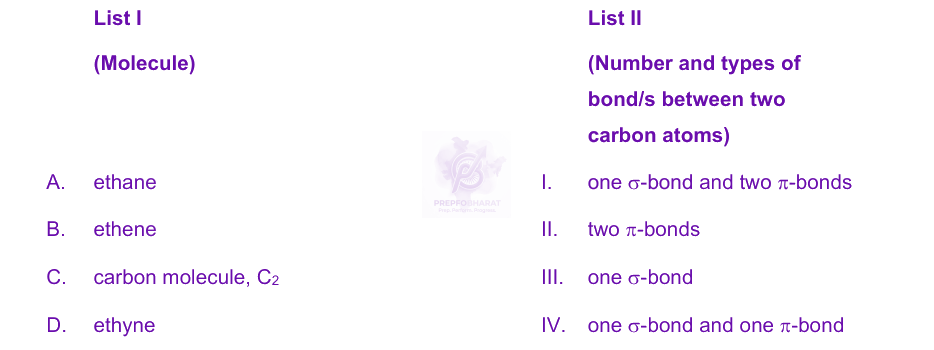 Choose the correct answer from the options given below: