NEET UG 2009 — Inorganic Chemistry
Chemistry Inorganic Chemistry questions from NEET UG 2009.
Other Years
18 Inorganic Chemistry Questions from 2009
What is the dominant intermolecular force or bond that must be overcome in converting liquid $\mathrm{CH}_3 \mathrm{OH}$ to a gas -
Amongst the elements with following electronic configurations, which one of them may have the highest ionisation energy ?
Out of $\mathrm{TiF}_6^{2-}$ and $\mathrm{CoF}_6^{3-}, \mathrm{Cu}_2 \mathrm{Cl}_2$ and $\mathrm{NiCl}_4^{2-}$ ( $\mathrm{Z}$ of $\mathrm{Ti}=22, \mathrm{Co}=27, \mathrm{Cu}=29, \mathrm{Ni}=28)$ the colourless species are :
In which of the following molecules / ions $\mathrm{BF}_3$, $\mathrm{NO}_2^{-}, \mathrm{NH}_2^{-}$and $\mathrm{H}_2 \mathrm{O}$, the central atom is $\mathrm{sp}^2$ hybridized?
In which of the following molecules/ions $\mathrm{BF}_3, \mathrm{NO}_2^{-}, \mathrm{NH}_2^{-}$and $\mathrm{H}_2 \mathrm{O}$, the central atom is $\mathrm{sp}^2$ hybridised ?
The state of hybridisation of $\mathrm{C}_2, \mathrm{C}_3, \mathrm{C}_5$ and $\mathrm{C}_6$ of the hydrocarbon, 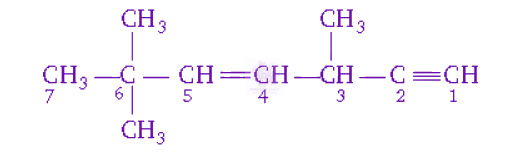 is in the following sequence
The straight chain polymer is formed by
According to MO theory which of the following lists ranks the nitrogen species in terms of increasing bond order ?
Which of the following molecules acts as a Lewis acid ?
Which of the following complex ions is expected to absorb visible light ? (At. no. $\mathrm{Zn}=30, \mathrm{Sc}=21, \mathrm{Ti}=22, \mathrm{Cr}=24$ )
Among the following which is the strongest oxidising agent?
Which of the following does not show optical isomerism - (en = Ethylenediamine)
Which of the following does not show optical isomerism? (en = ethylenediamine)
Which of the following complex ions is expected to absorb visible light ? (At no. $\mathrm{Zn}=30, \mathrm{Sc}=21, \mathrm{Ti}=22, \mathrm{Cr}=24$ )
Which one of the elements with the following outer orbital configurations may exhibit the largest number of oxidation states ?
The stability of +1 oxidation state increases in the sequence
Out of $\mathrm{TiF}_6^{2-}, \mathrm{CoF}_6^{3-}, \mathrm{Cu}_2 \mathrm{Cl}_2$ and $\mathrm{NiCl}_4^{2-}$ ( $\mathrm{Z}$ of $\mathrm{Ti}=22, \mathrm{Co}=27, \mathrm{Cu}=29, \mathrm{Ni}=28$ ) the colourless species are
What is the dominant intermolecular force or bond that must be overcome in converting liquid $\mathrm{CH}_3 \mathrm{OH}$ to a gas ?