NEET UG 2020 — Inorganic Chemistry
Chemistry Inorganic Chemistry questions from NEET UG 2020.
Other Years
20 Inorganic Chemistry Questions from 2020
Identify the correct statements from the following: (a) ${\mathrm{CO}}_{2}(g)$ is used as a refrigerant for ice cream and frozen food. (b) The structure of ${C}_{60}$ contains twelve six-membered carbon rings and twenty-five membered carbon rings. (c) $\mathrm{ZSM}-5$, a type of zeolite, is used to convert alcohols into gasoline. (d) $\mathrm{CO}$ is a colourless and odourless gas.
Match the compounds of Xe in column I with the molecular structure in column II. <table class="pyq-table"><tbody><tr><td></td><td>Column-I</td><td></td><td>Column-II</td></tr><tr><td>(a)</td><td>${\mathrm{XeF}}_{2}$</td><td>(p)</td><td>Square planar</td></tr><tr><td>(b)</td><td>${\mathrm{XeF}}_{4}$</td><td>(q)</td><td>Linear</td></tr><tr><td>(c)</td><td>${\mathrm{XeO}}_{3}$</td><td>(r)</td><td>Square pyramidal</td></tr><tr><td>(d)</td><td>${\mathrm{XeOF}}_{4}$</td><td>(s)</td><td>Pyramidal</td></tr></tbody></table>
Identify the wrongly matched pair:
Which of the following oxide is amphoteric in nature?
Match the coordination number and type of hybridisation with distribution of hybrid orbitals in space based on Valence bond theory. <table class="pyq-table"><tbody><tr><td></td><td>Coordination number and type of hybridisation</td><td></td><td>Distribution of hybrid orbitals in space</td></tr><tr><td>(a)</td><td>$4,{\mathrm{sp}}^{3}$</td><td>(p)</td><td>trigonal bipyramidal</td></tr><tr><td>(b)</td><td>$4,{\mathrm{dsp}}^{2}$</td><td>(q)</td><td>octahedral</td></tr><tr><td>(c)</td><td>$5,{\mathrm{sp}}^{3}d$</td><td>(r)</td><td>tetrahedral</td></tr><tr><td>(d)</td><td>$6,{d}^{2}{\mathrm{sp}}^{3}$</td><td>(s)</td><td>square planar</td></tr></tbody></table>Select the correct option:
Identify the incorrect match. <table class="pyq-table"><tbody><tr><td>Name IUPAC</td><td>Official Name</td></tr><tr><td>(a) Unnilunium</td><td>(i) Mendelevium</td></tr><tr><td>(b) Unniltrium</td><td>(ii) Lawrencium</td></tr><tr><td>(c) Unnilhexium</td><td>(iii) Seaborgium</td></tr><tr><td>(d) Unununium</td><td>(iv) Darmstadtium</td></tr></tbody></table>
Identify the incorrect statement.
Match the element in column I with that in column II. <table class="pyq-table"><tbody><tr><td></td><td>Column-I</td><td></td><td>Column-II</td></tr><tr><td>(a)</td><td>Copper</td><td>(p)</td><td>Non-metal</td></tr><tr><td>(b)</td><td>Fluorine</td><td>(q)</td><td>Transition metal</td></tr><tr><td>(c)</td><td>Silicon</td><td>(r)</td><td>Lanthanoid</td></tr><tr><td>(d)</td><td>Cerium</td><td>(s)</td><td>Metalloid</td></tr></tbody></table>Identify the correct match :
How many (i) ${\mathrm{sp}}^{2}$ hybridised carbon atoms and (ii) $\pi$ bonds are present in the following compound? 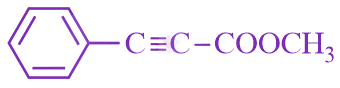
Which of the following is the correct order of increasing field strength of ligands to form coordination compounds?
Among the compounds shown below which one revealed a linear structure?
Match the following aspects with the respective metal. <table class="pyq-table"><tbody><tr><td></td><td>Aspects</td><td></td><td>Metal</td></tr><tr><td>(a)</td><td>The metal which reveals a maximum number of oxidation states</td><td>(p)</td><td>Scandium</td></tr><tr><td>(b)</td><td>The metal although placed in $3d$ block is considered not as a transition element</td><td>(q)</td><td>Copper</td></tr><tr><td>(c)</td><td>The metal which does not exhibit variable oxidation states</td><td>(r)</td><td>Manganese</td></tr><tr><td>(d)</td><td>The metal which in $+1$oxidation state in aqueous solution undergoes disproportionation</td><td>(s)</td><td>Zinc</td></tr></tbody></table>
Match the following : <table class="pyq-table"><tbody><tr><td>Oxide</td><td>Nature</td></tr><tr><td>(a) $\mathrm{CO}$</td><td>(i) Basic</td></tr><tr><td>(b) $\mathrm{BaO}$</td><td>(ii) Neutral</td></tr><tr><td>(c) ${\mathrm{Al}}_{2}{O}_{3}$</td><td>(iii) Acidic</td></tr><tr><td>(d) ${\mathrm{Cl}}_{2}{O}_{7}$</td><td>(iv) Amphoteric</td></tr></tbody></table> Which of the following is correct option?
Identify the incorrect statement from the following:
Identify a molecule which does not exist.
Match the following and identify the correct option. <table class="pyq-table"><tbody><tr><td>(a) $\mathrm{CO}(g)+{H}_{2}(g)$</td><td>(i) $\mathrm{Mg}{({\mathrm{HCO}}_{3})}_{2}+\mathrm{Ca}{({\mathrm{HCO}}_{3})}_{2}$</td></tr><tr><td>(b) Temporary hardness of water</td><td>(ii) An electron deficient hydride</td></tr><tr><td>(c) ${B}_{2}{H}_{6}$</td><td>(iii) Synthesis gas</td></tr><tr><td>(d) ${H}_{2}{O}_{2}$</td><td>(iv) Non-planar structure</td></tr></tbody></table>
On electrolysis of dil. sulphuric acid using Platinum $(\mathrm{Pt})$ electrode, the product obtained at anode will be
Which of the following set of molecules will have zero dipole moment?
Which of the following oxoacid of sulphur has $–O–O–$ linkage?
Urea reacts with water to form $A$ which will decompose to form $B$. $B$ when passed through ${\mathrm{Cu}}^{2+}(\mathrm{aq})$, deep blue colour solution $C$ is formed. What is the formula of $C$ from the following?