NEET UG 2024 — Inorganic Chemistry
Chemistry Inorganic Chemistry questions from NEET UG 2024.
Other Years
34 Inorganic Chemistry Questions from 2024
Among Group 16 elements, which one does NOT show -2 oxidation state?
Arrange the following elements in increasing order of electronegativity: $\mathrm{N}, \mathrm{O}, \mathrm{F}, \mathrm{C}, \mathrm{Si}$ Choose the correct answer from the options given below:
Given below are certain cations. Using inorganic qualitative analysis, arrange them in increasing group number from 0 to VI . A. $\mathrm{Al}^{3+}$ B. $\mathrm{Cu}^{2+}$ C. $\mathrm{Ba}^{2+}$ D. $\mathrm{Co}^{2+}$ E. $\mathrm{Mg}^{2+}$ Choose the correct answer from the options given below.
Which of the following set of ions act as oxidising agents?
Match List I with List II.  Choose the correct answer from the options given below:
Match List I with List II. 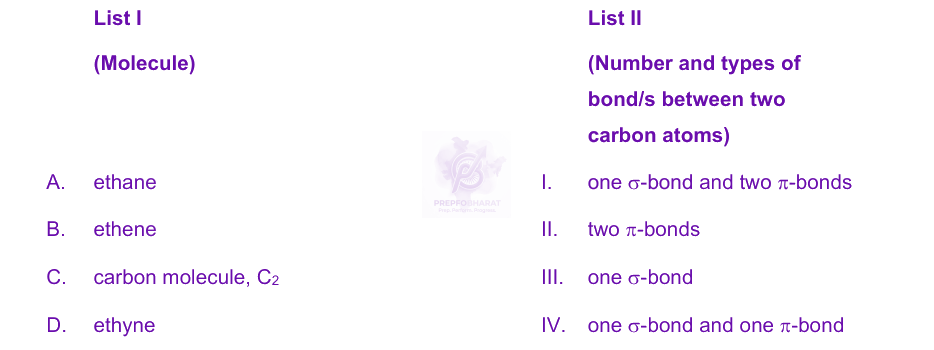 Choose the correct answer from the options given below:
Match List I with List II. 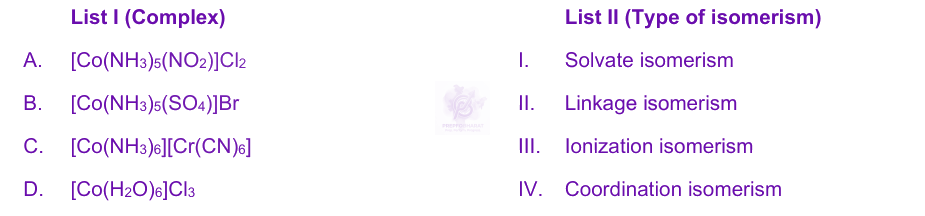 Choose the correct answer from the options given below:
The UV-visible absorption bands in the spectra of lanthanoid ions are ' $X$ ', probably because of the excitation of electrons involving ' $Y$ '. The ' $X$ ' and ' $Y$ ', respectively, are :
The oxidation states not shown by Mn in given reaction is : $3 \mathrm{MnO}_4^{2-}+4 \mathrm{H}^{+} \longrightarrow 2 \mathrm{MnO}_4^{-}+\mathrm{MnO}_2+2 \mathrm{H}_2 \mathrm{O}$ A. +6 B. +2 C. +4 D. +7 E. +3 Choose the most appropriate answer from the options given below :
Match List-I with List-II: 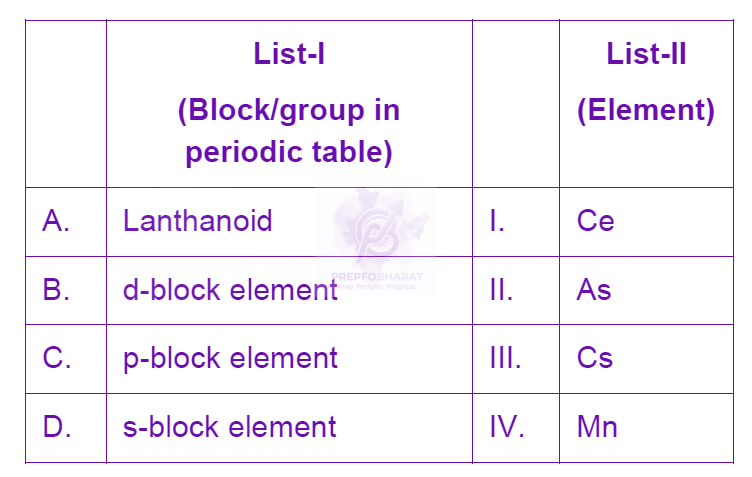 Choose the correct answer from the options given below:
Which of the following molecules has "NON ZERO" dipole moment value?
Identify the incorrect statement.
Identify the incorrect statement from the following:
During the preparation of Mohr's salt solution (Ferrous ammonium sulphate), which of the following acid is added to prevent hydrolysis of $\mathrm{Fe}^{2+}$ ion?
Match List-I with List-II : 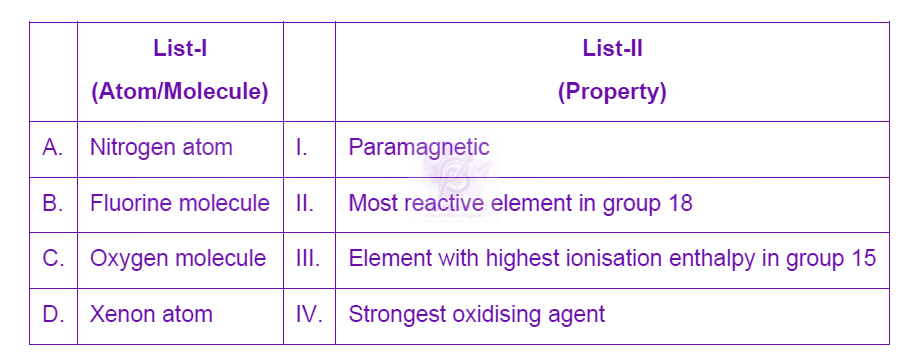 Identify the correct answer from the options given below:
The pair of lanthanoid ions which are diamagnetic is
Arrange the following elements in increasing order of first ionization enthalpy: $\mathrm{Li}, \mathrm{Be}, \mathrm{B}, \mathrm{C}, \mathrm{N}$ Choose the correct answer from the options given below:
Which of the following is not an ambidentate ligand?
Intramolecular hydrogen bonding is present in
Ethylene diaminetetraacetate ion is a/an:
Given below are two statements : Statement I: Both $\left[\mathrm{Co}\left(\mathrm{NH}_3\right)_6\right]^{3+}$ and $\left[\mathrm{CoF}_6\right]^{3-}$ complexes are octahedral but differ in their magnetic behaviour. Statement II: $\left[\mathrm{Co}\left(\mathrm{NH}_3\right)_6\right]^{3+}$ is diamagnetic whereas $\left[\mathrm{CoF}_6\right]^{3-}$ is paramagnetic. In the light of the above statements, choose the correct answer from the options given below:
Baeyer's reagent is :
'Spin only' magnetic moment is same for which of the following ions? A. $\mathrm{Ti}^{3+}$ B. $\mathrm{Cr}^{2+}$ C. $\mathrm{Mn}^{2+}$ D. $\mathrm{Fe}^{2+}$ E. $\mathrm{Sc}^{3+}$ Choose the most appropriate answer from the options given below.
Given below are two statements: Statement I: The boiling point of hydrides of Group 16 elements follow the order $\mathrm{H}_2 \mathrm{O}\gt\mathrm{H}_2 \mathrm{Te}\gt\mathrm{H}_2 \mathrm{Se}\gt\mathrm{H}_2 \mathrm{~S} \text {. }$ Statement II: On the basis of molecular mass, $\mathrm{H}_2 \mathrm{O}$ is expected to have lower boiling point than the other members of the group but due to the presence of extensive H -bonding in $\mathrm{H}_2 \mathrm{O}$, it has higher boiling point. In the light of the above statements, choose the correct answer from the options given below:
The correct decreasing order of atomic radii $(\mathrm{pm})$ of $\mathrm{Li}, \mathrm{Be}, \mathrm{B}$ and C is
Identify the correct answer.
Identify the incorrect statement about $\mathrm{PCl}_5$.
Given below are two statements : Statement I : $\left[\mathrm{Co}\left(\mathrm{NH}_3\right)_6\right]^{3+}$ is a homoleptic complex whereas $\left[\mathrm{Co}\left(\mathrm{NH}_3\right)_4 \mathrm{Cl}_2\right]^{+}$is a heteroleptic complex. Statement II : Complex $\left[\mathrm{Co}\left(\mathrm{NH}_3\right)_6\right]^{3+}$ has only one kind of ligands but $\left[\mathrm{Co}\left(\mathrm{NH}_3\right)_4 \mathrm{Cl}_2\right]^{+}$has more than one kind of ligands. In the light of the above statements, choose the correct answer from the options given below.
Match List-I with List-II : 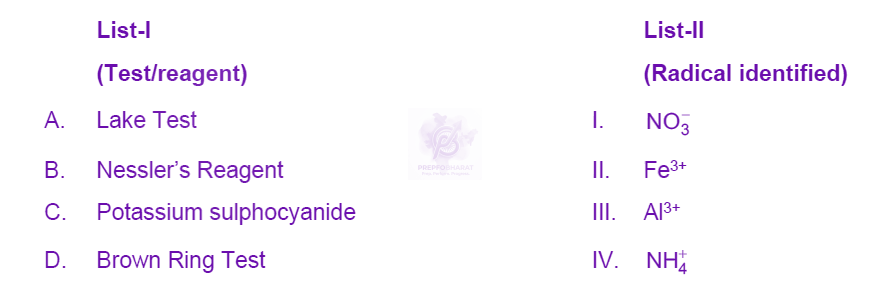 Choose the correct answer from the options given below:
Arrange the following compounds in increasing order of their solubilities in chloroform: $\mathrm{NaCl}, \mathrm{CH}_3 \mathrm{OH}$, cyclohexane, $\mathrm{CH}_3 \mathrm{CN}$
The products A and B obtained in the following reactions, respectively, are $\begin{aligned} & 3 \mathrm{ROH}+\mathrm{PCl}_3 \rightarrow 3 \mathrm{RCl}+\mathrm{A} \\ & \mathrm{ROH}+\mathrm{PCl}_5 \rightarrow \mathrm{RCl}+\mathrm{HCl}+\mathrm{B} \end{aligned}$
Match List-I will List-II: 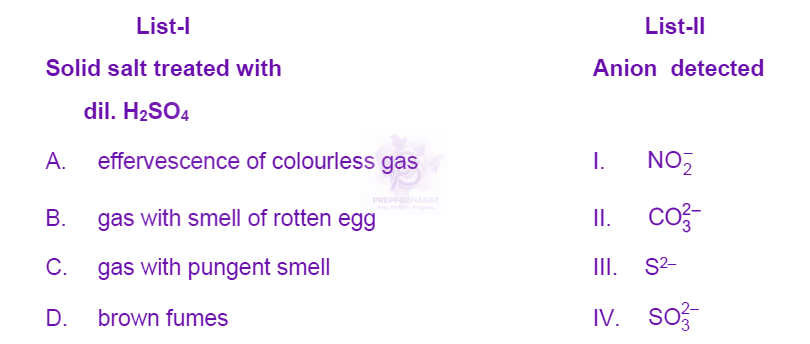 Choose the correct answer from the options given below:
The $\mathrm{E}^{\circ}$ value for the $\mathrm{Mn}^{3+} / \mathrm{Mn}^{2+}$ couple is more positive than that of $\mathrm{Cr}^{3+} / \mathrm{Cr}^{2+}$ or $\mathrm{Fe}^{3+} / \mathrm{Fe}^{2+}$ due to change of
$\left[\mathrm{Mn}_2(\mathrm{CO})_{10}\right]$ and $\left[\mathrm{Co}_2(\mathrm{CO})_8\right]$ structures have A. Metal-Metal linkage B. Terminal CO groups C. Bridging CO groups D. Metal in zero oxidation state Choose the correct answer from the options given below