| Element | Block/group in periodic table | |
| Ce (Z=58) | → | Lanthanoid |
| As (Z=33) | → | p-block element |
| Cs (Z=55) | → | s-block element |
| Mn (Z=25) | → | d-block element |
Match List-I with List-II: NEET 2024 Chemistry, Classification of Elements and Periodicity in Properties — question figure Choose the correct answer…
NEET UG 2024 — Chemistry Inorganic Chemistry
2024mcqmedium
Match List-I with List-II: 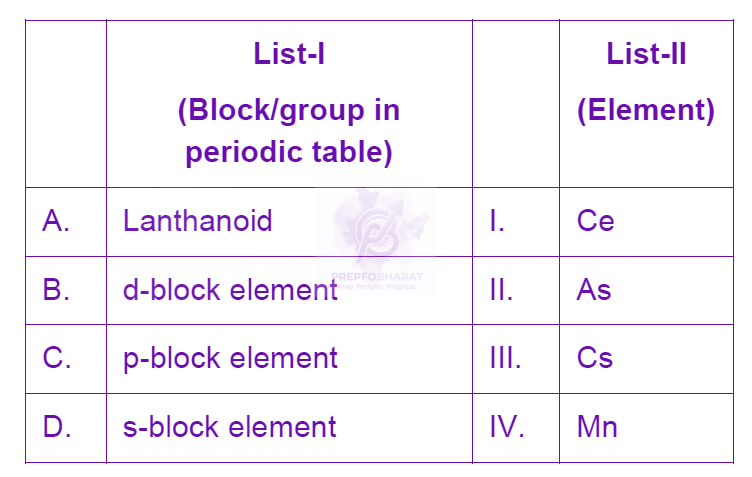
Choose the correct answer from the options given below:
Official previous-year question
Held on 30 Apr 2024 · Verified 9 Jul 2026.
Options
- A
A-I, B-II, C-IV, D-III
- B
A-I, B-IV, C-III, D-II
- C
A-I, B-IV, C-II, D-III
- D
A-IV, B-I, C-II, D-III
Did you get this right?
Sign in to track your attempts and accuracy.
Your note
Sign in to keep a private note on this question. Nothing you write is ever public.
NEET UG Inorganic Chemistry in other years
More NEET UG Inorganic Chemistry questions
Which of the following is the most electronegative element?
2026easy
Out of the following complex compounds, which of the compound will be having the minimum conductance in solution?
2025medium
Which among the following electronic configurations belong to main group elements? A. $[\mathrm{Ne}] 3 \mathrm{~s}^1$ B. $[\operatorname{Ar}] 3 \mathrm{~d}^3 4 \mathrm{~s}^2$ C. $[\mathrm{Kr}] 4 d^{10} 5 s^2 5 p^5$ D. $[\mathrm{Ar}] 3 \mathrm{~d}^{10} 4 \mathrm{~s}^1$ E. $[R n] 5 f^0 6 d^2 7 s^2$ Choose the correct answer from the option given below:
2025easy
Match List-I with List-II $\begin{array}{|l|l|l|l|}\hline & \text{List - I} & & \text{List - II} \\\hline \text{A}. & \text{Haber process} & \text{(i)} & \text {Fe catalyst} \\\hline \text{B.} & \text{Wacker oxidation} & \text{(ii)} & \mathrm{PdCl}_2 \\\hline \text{C.} & \text{Wilkinson catalyst} & \text{(iii)} & \left[\left(\mathrm{PPh}_3\right)_3 \mathrm{RhCl}\right] \\\hline \text{D.} & \text{Ziegler catalyst} & \text{(iv)} & \mathrm{TiCl}_4 \text{ with } \mathrm{Al}\left(\mathrm{CH}_3\right)_3 \\\hline\end{array}$ Choose the correct answer from the options given below :
2025medium
Identify the correct orders against the property mentioned (A) $\mathrm{H}_2 \mathrm{O}\gt\mathrm{NH}_3\gt\mathrm{CHCl}_3$ - dipole moment (B) $\mathrm{XeF}_4\gt\mathrm{XeO}_3\gt\mathrm{XeF}_2-$ number of lone pairs on central atom (C) $\mathrm{O}-\mathrm{H}\gt\mathrm{C}-\mathrm{H}\gt\mathrm{N}-\mathrm{O}-$ bond length (D) $\mathrm{N}_2\gt\mathrm{O}_2\gt\mathrm{H}_2$ - bond enthalpy Choose the correct answer from the options given below :
2025medium
Other Chemistry topics for NEET UG
Keep practicing Inorganic Chemistry
Work through every NEET UG Inorganic Chemistry PYQ, year by year.