Key Idea Only those transition metal complexes are expected to absorb visible light, in which d-subshell is incomplete (ie, has unpaired electron) and excitation of electron from a lower energy arbital to higher energy orbital is possible. (a) In [Sc(H2O)3(NH3)3]3+,Sc is present as Sc3+. Sc3+=[Ar]3 d0,4 s0 Since, in this complex excitation of electron is not possible, it will not absorb visible light. (b) In [Ti(en)2(NH3)2]4+,Ti is present as Ti4+. Ti4+=[Ar]3 d0,4 s0 Hence, it will not absorb visible light. (c) In [Cr(NH3)6]3+,Cr is present as Cr3+. Cr3+=[Ar]3 d3,4 s0 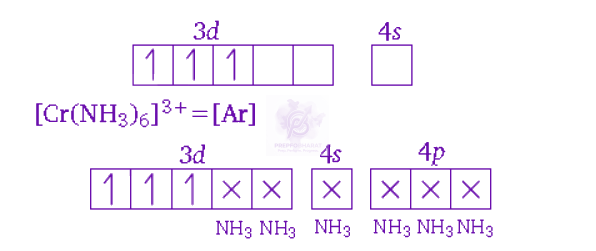
Since, this complex has three unpaired electrons, excitation of electrons is possible and thus, it is expected that this complex will absorb visible light. (d) In [Zn(NH3)6]2+,Zn is present as Zn2+. Zn2+=[Ar]3 d10,4 s0[Zn(NH3)6]2+=[Ar]3d10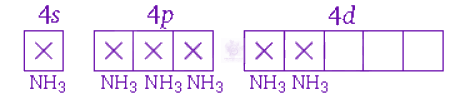
Hence, this complex will not absorb visible light.