NEET UG 2010 — Inorganic Chemistry
Chemistry Inorganic Chemistry questions from NEET UG 2010.
Other Years
22 Inorganic Chemistry Questions from 2010
Which one of the following compounds is a peroxide?
Which one of the following bonds produces a solid that reflects light in the visible region and whose electrical conductivity decreases with temperature and has high melting point ?
Some of the properties of the two species, $\mathrm{NO}_3^{-}$ and $\mathrm{H}_3 \mathrm{O}^{+}$are described below. Which one of them is correct?
Which of the following represents the correct order of increasing electron gain enthalpy with negative sign for the elements $\mathrm{O}, \mathrm{S}, \mathrm{F}$ and $\mathrm{Cl}$ ?
How many bridging oxygen atoms are present in $\mathrm{P}_4 \mathrm{O}_{10}$ ?
Oxidation states of $\mathrm{P}$ in $\mathrm{H}_4 \mathrm{P}_2 \mathrm{O}_5, \mathrm{H}_4 \mathrm{P}_2 \mathrm{O}_6$, $\mathrm{H}_4 \mathrm{P}_2 \mathrm{O}_7$, are respectively
The tendency of $\mathrm{BF}_3, \mathrm{BCl}_3$ and $\mathrm{BBr}_3$ to behave as Lewis acid decreases in the sequence
In which of the following pairs of molecules/ions, the central atoms have $\mathrm{sp}^2$ hybridisation?
Property of the alkaline earth metals that increases with their atomic number
Match List I (substances) with List II (processes employed in the manufacture of the substances) and select the correct option. 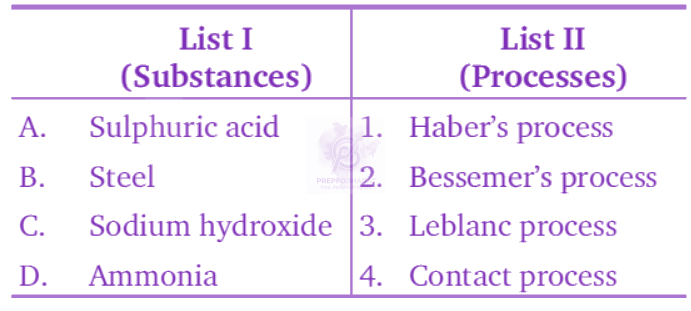 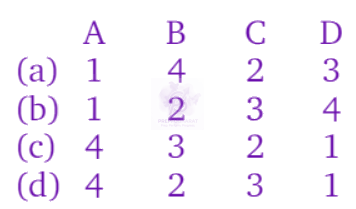
Which of the following oxidation states is the most common among the lanthanoids?
Among the elements $\mathrm{Ca}, \mathrm{Mg}, \mathrm{P}$ and $\mathrm{Cl}$, the order of increasing atomic radii is
Crystal field stabilization energy for high spin $\mathrm{d}^4$ octahedral complex is
Which of the following alkaline earth metal sulphates has hydration enthalpy higher than the lattice enthalpy?
In which one of the following species the central atom has the type of hybridisation which is not the same as that present in the other three?
Which one of the following complexes is not expected to exhibit isomerism?
Which of the following ions will exhibit colour in aqueous solutions ?
Which one of the following species does not exist under normal conditions ?
In which of the following molecules the central atom does not have $\mathrm{sp}^3$ hybridisation?
Among the following which one has the highest cation to anion size ratio?
The correct order of increasing bond angles in the following species is
Which of the following complex ions is not expected to absorb visible light?