Key Idea For the absorption of visible light, presence of unpaired d-electrons is the necessity. (a) In [Ni(CN)4]2−,Ni is present as Ni2+. Ni2+=[Ar]3 d84 s0 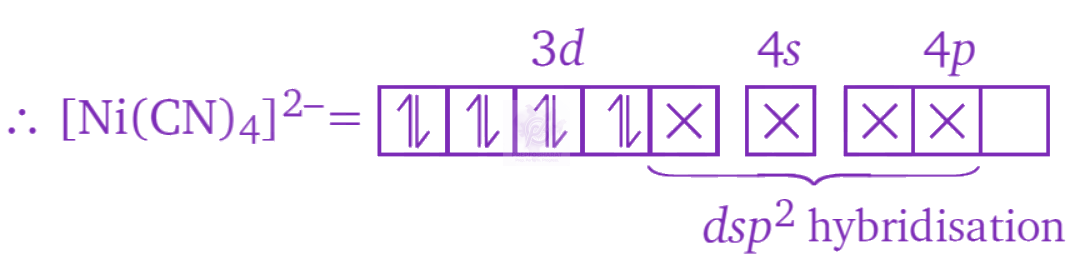
(Pairing occurs because CN−is a strong field ligand). Since, in [Ni(CN)4]2−, no unpaired electron is present in d-orbitals, it does not absorb visible light. (b) In [Cr(NH3)6]3+,Cr is present as Cr3+. Cr3+=[Ar]3 d34 s0 (Three unpaired electrons) (c) In [Fe(H2O)6]2+,Fe is present as Fe2+. Fe2+=[Ar]3 d64 s0 (Four unpaired electrons) (d) In [Ni(H2O)6]2+, Ni is present as Ni2+. Ni2+=[Ar]3 d84 s0 (Two unpaired electrons) The complexes given in option (b), (c), (d) have unpaired electrons, thus absorb visible light.