JEE Main Physics — Thermodynamics previous year questions with solutions.
A thermally insulated vessel contains an ideal gas of molecular mass $M$ and ratio of specific heats $1.4$. Vessel is moving with speed $v$ and is suddenly brought to rest. Assuming no heat is lost to the surrounding and vessel temperature of the gas increases by : ($R=$ universal gas constant)
A steam engine intakes $50g$ of steam at $100^{\circ}C$ per minute and cools it down to $20^{\circ}C$. If latent heat of vaporization of steam is $540\mathrm{cal}{g}^{-1}$, then the heat rejected by the steam engine per minute is _____ $\times {10}^{3}\mathrm{cal}$ (Given : specific heat capacity of water : $1\mathrm{cal}{g}^{-1}{C\circ }^{-1}$)
A solid metallic cube having total surface area $24{m}^{2}$ is uniformly heated. If its temperature is increased by $10^{\circ}C$, calculate the increase in volume of the cube. (Given $\alpha =5.0\times {10}^{-4}{C\circ }^{-1}$).
A sample of an ideal gas is taken through the cyclic process $ABCA$ as shown in figure. It absorbs, $40J$ of heat during the part $AB$, no heat during $BC$ and rejects $60J$ of heat during $CA$. A work of $50J$ is done on the gas during the part $BC$. The internal energy of the gas at $A$ is $1560J$. The work done by the gas during the part $CA$ is 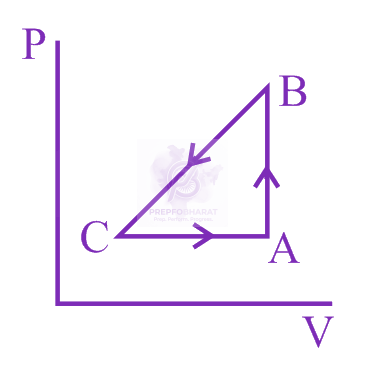
A $100g$ of iron nail is hit by a $1.5\mathrm{kg}$ hammer striking at a velocity of $60{\mathrm{ms}}^{-1}$. What will be the rise in the temperature of the nail if one fourth of energy of the hammer goes into heating the nail ? [Specific heat capacity of iron $=0.42{\mathrm{Jg}}^{-1}{C\circ }^{-1}$]
A monoatomic gas performs a work of $\frac{Q}{4}$ where $Q$ is the heat supplied to it. The molar heat capacity of the gas will be _____ $R$ during this transformation. Where $R$ is the gas constant.
A monoatomic gas at pressure $P$ and volume $V$ is suddenly compressed to one eighth of its original volume. The final pressure at constant entropy will be
A mixture of hydrogen and oxygen has volume $2000{\mathrm{cm}}^{3}$, temperature $300K$, pressure $100\mathrm{kPa}$ and mass $0.76g$. The ratio of number of moles of hydrogen to number of moles of oxygen in the mixture will be [Take gas constant $R=8.3J{K}^{-1}{\mathrm{mol}}^{-1}$]
A lead bullet penetrates into a solid object and melts. Assuming that $40%$ of its kinetic energy is used to heat it, the initial speed of bullet is (Given, initial temperature of the bullet $=127^{\circ}C$, Melting point of the bullet $=327^{\circ}C$, Latent heat of fusion of lead $=2.5\times {10}^{4}J{\mathrm{kg}}^{-1}$, Specific heat capacity of lead $=125J\mathrm{kg}{K}^{-1}$)
A geyser heats water flowing at a rate of $2.0\mathrm{kg}$ per minute from $30^{\circ}C$ to $70^{\circ}C$. If geyser operates on a gas burner, the rate of combustion of fuel will be _____ $g{\mathrm{min}}^{-1}$. [Heat of combustion $=8\times {10}^{3}{\mathrm{Jg}}^{-1}$, Specific heat of water $=4.2{\mathrm{Jg}}^{-1}{C\circ }^{-1}$]
A gas has $n$ degrees of freedom. The ratio of specific heat of gas at constant volume to the specific heat of gas at constant pressure will be
A flask contains argon and oxygen in the ratio of $3:2$ in mass and the mixture is kept at $27^{\circ}C$. The ratio of their average kinetic energy per molecule respectively
A diatomic gas $(\gamma =1.4)$ does $400J$ of work when it is expanded isobarically. The heat given to the gas in the process is _____ $J$.
A cylinder of fixed capacity of $44.8$ litres contains helium gas at standard temperature and pressure. The amount of heat needed to raise the temperature of gas in the cylinder by $20.0^{\circ}C$ will be (Given gas constant $R=8.3J{K}^{-1}{\mathrm{mol}}^{-1}$)
A copper block of mass $5.0\mathrm{kg}$ is heated to a temperature of $500^{\circ}C$ and is placed on a large ice block. What is the maximum amount of ice that can melt? [Specific heat of copper : $0.39{\mathrm{Jg}}^{-1}{C\circ }^{-1}$ and latent heat of fusion of water : $335{\mathrm{Jg}}^{-1}$]
A certain amount of gas of volume $V$ at $27^{\circ}C$ temperature and pressure $2\times {10}^{7}N{m}^{-2}$ expands isothermally until its volume gets doubled. Later it expands adiabatically until its volume gets redoubled. The final pressure of the gas will be (Use $\gamma =1.5$)
A block of ice of mass $120g$ at temperature $0^{\circ}C$ is put in $300g$ of water at $25^{\circ}C$. The $xg$ of ice melts as the temperature of the water reaches $0^{\circ}C$. The value of $x$ is [Use: Specific heat capacity of water $=4200J{\mathrm{kg}}^{-1}{K}^{-1}$, Latent heat of ice $=3.5\times {10}^{5}J{\mathrm{kg}}^{-1}$]
Which one is the correct option for the two different thermodynamic processes ? 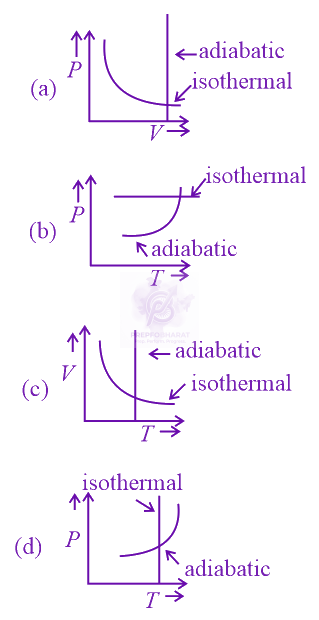
Which of the following graphs represent the behaviour of an ideal gas? Symbols have their usual meaning.
What will be the average value of energy for a monoatomic gas in thermal equilibrium at temperature $T?$
What will be the average value of energy along one degree of freedom for an ideal gas in thermal equilibrium at a temperature $T?$ (${k}_{B}$ is Boltzmann constant)
Two thin metallic spherical shells of radii ${r}_{1}$ and ${r}_{2}({r}_{1}<{r}_{2})$ are placed with their centres coinciding. A material of thermal conductivity $K$ is filled in the space between the shells. The inner shell is maintained at temperature ${\theta }_{1}$ and the outer shell at temperature ${\theta }_{2}({\theta }_{1}<{\theta }_{2}).$ The rate at which heat flows radially through the material is :
Two spherical soap bubbles of radii ${r}_{1}$ and ${r}_{2}$ in vacuum combine under isothermal conditions. The resulting bubble has a radius equal to:
Two identical metal wires of thermal conductivities ${K}_{1}$ and ${K}_{2}$ respectively are connected in series. The effective thermal conductivity of the combination is: