JEE Main Physics — Thermodynamics previous year questions with solutions.
Two thin metallic spherical shells of radii ${r}_{1}$ and ${r}_{2}({r}_{1}<{r}_{2})$ are placed with their centres coinciding. A material of thermal conductivity $K$ is filled in the space between the shells. The inner shell is maintained at temperature ${\theta }_{1}$ and the outer shell at temperature ${\theta }_{2}({\theta }_{1}<{\theta }_{2}).$ The rate at which heat flows radially through the material is :
In a certain thermodynamical process, the pressure of a gas depends on its volume as $k{V}^{3}$. The work done when the temperature changes from $100^{\circ}C$ to $300^{\circ}C$ will be $xnR$ where $n$ denotes number of moles of a gas find $x$ ;
Each side of a box made of metal sheet in cubic shape is $a$ at room temperature $T$, the coefficient of linear expansion of the metal sheet is $\alpha$. The metal sheet is heated uniformly, by a small temperature $\Delta T$, so that its new temperature is $T+\Delta T$. Calculate the increase in the volume of the metal box.
On the basis of kinetic theory of gases, the gas exerts pressure because its molecules:
Two spherical soap bubbles of radii ${r}_{1}$ and ${r}_{2}$ in vacuum combine under isothermal conditions. The resulting bubble has a radius equal to:
The volume $V$ of an enclosure contains a mixture of three gases, $16g$ of oxygen, $28g$ of nitrogen and $44g$ of carbon dioxide at absolute temperature $T$. Consider $R$ as universal gas constant. The pressure of the mixture of gases is :
One mole of an ideal gas at $27^{\circ}C$ is taken from $A$ to $B$ as shown in the given $PV$ indicator diagram. The work done by the system will be _______ $\times {10}^{-1}J.$ [Given, $R=8.3J{\mathrm{mole}}^{-1}K,\mathrm{ln}2=0.6931$] (Round off to the nearest integer) (Round off to the nearest integer) 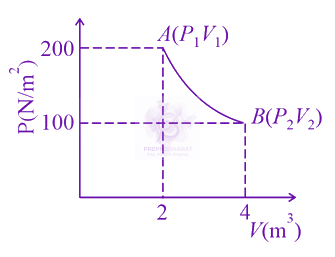
The number of molecules in one litre of an ideal gas at $300K$ and $2$ atmospheric pressure with mean kinetic energy $2\times {10}^{-9}J$ per molecule is:
In the reported figure, heat energy absorbed by a system in going through a cyclic process is ______$\pi J.$ 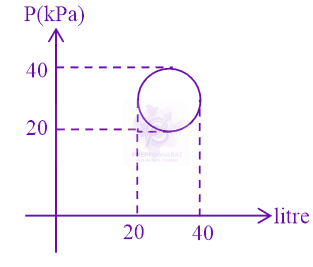
Given below are two statements: one is labelled as Assertion $A$ and the other is labelled as Reason $R$. Assertion $A$ : When a rod lying freely is heated, no thermal stress is developed in it. Reason $R$ : On heating, the length of the rod increases. In the light of the above statements, choose the correct answer from the options given below:
For an ideal gas the instantaneous change in pressure $P$ with volume $V$ is given by the equation $\frac{dP}{dV}=-aP.$ If $P={P}_{0}$ at $V=0$ is the given boundary condition, then the maximum temperature one mole of gas can attain is: (Here $R$ is the gas constant)
A $2\mathrm{kg}$ steel rod of length $0.6m$ is clamped on a table vertically at its lower end and is free to rotate in the vertical plane. The upper end is pushed so that the rod falls under gravity. Ignoring the friction due to clamping at its lower end, the speed of the free end of the rod when it passes through its lowest position is $_______m{s}^{-1}.$ (Take $g=10{ms}^{-2})$
$1$ mole of rigid diatomic gas performs a work of $\frac{Q}{5}$ when heat $Q$ is supplied to it. The molar heat capacity of the gas during this transformation is $\frac{xR}{8}.$ The value of $x$ is [$R$ universal gas constant]
A mixture of hydrogen and oxygen has volume $500{\mathrm{cm}}^{3},$ temperature $300K,$ pressure $400k\mathrm{Pa}$ and mass $0.76g.$ The ratio of masses of oxygen to hydrogen will be:
Which one is the correct option for the two different thermodynamic processes ? 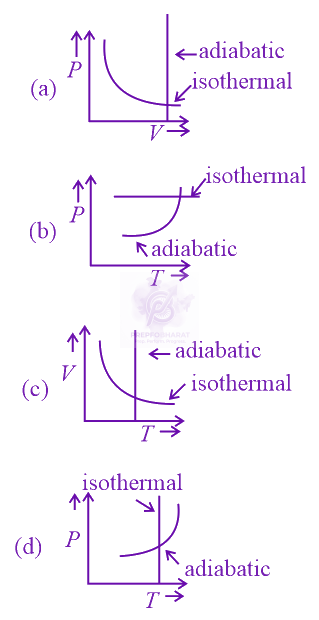
A Carnot engine operates between temperatures 600 K and 300 K...
If the R.M.S. speed of oxygen molecules at $0^{\circ}C$ is $160m{s}^{-1}$. Find the R.M.S. speed of hydrogen molecules at $0^{\circ}C$.
A system consists of two types of gas molecules $A$ and $B$ having the same number density $2\times {10}^{25}{m}^{-3}$. The diameter of $A$ and $B$ are $10A$ and $5A$ respectively. They suffer collisions at room temperature. The ratio of average distance covered by the molecule $A$ to that of $B$ between two successive collisions is ___________$\times {10}^{-2}$
Two identical metal wires of thermal conductivities ${K}_{1}$ and ${K}_{2}$ respectively are connected in series. The effective thermal conductivity of the combination is:
A polyatomic ideal gas has $24$ vibrational modes. What is the value of $\gamma ?$
Which of the following graphs represent the behaviour of an ideal gas? Symbols have their usual meaning.
Two different metal bodies $A$ and $B$ of equal mass are heated at a uniform rate under similar conditions. The variation of temperature of the bodies is graphically represented as shown in the figure. The ratio of specific heat capacities is: 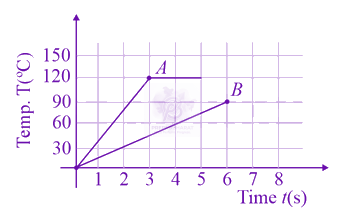
A container is divided into two chambers by a partition. The volume of first chamber is $4.5\mathrm{litre}$ and second chamber is $5.5\mathrm{litre}$. The first chamber contain $3.0$ moles of gas at pressure $2.0\mathrm{atm}$ and second chamber contain $4.0$ moles of gas at pressure $3.0\mathrm{atm}$. After the partition is removed and the mixture attains equilibrium, then, the common equilibrium pressure existing in the mixture is $x\times {10}^{-1}\mathrm{atm}$. Value of $x$ (nearest integer) is
The amount of heat needed to raise the temperature of $4\mathrm{moles}$ of a rigid diatomic gas from $0^{\circ}C$ to $50^{\circ}C$ when no work is done is$(R$ is the universal gas constant)