JEE Main Physics — Thermodynamics previous year questions with solutions.
The volume $V$ of a given mass of monoatomic gas changes with temperature $T$ according to the relation $V=K{T}^{\frac{2}{3}}$. The workdone when temperature changes by $90K$ will be $xR$. The value of $x$ is [$R$ universal gas constant ]
Thermodynamic process is shown below on a $P-V$ diagram for one mole of an ideal gas. If ${V}_{2}=2{V}_{1}$, then the ratio of temperature $\frac{{T}_{2}}{{T}_{1}}$ is : 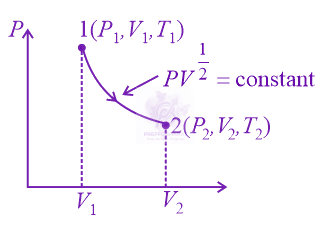
If one mole of an ideal gas at $({P}_{1},{V}_{1})$ is allowed to expand reversibly and isothermally ($A$ to $B$) its pressure is reduced to one-half of the original pressure (see figure). This is followed by a constant volume cooling till its pressure is reduced to one-fourth of the initial value $(B\rightarrow C).$ Then it is restored to its initial state by a reversible adiabatic compression ($C$ to $A$). The net workdone by the gas is equal to: 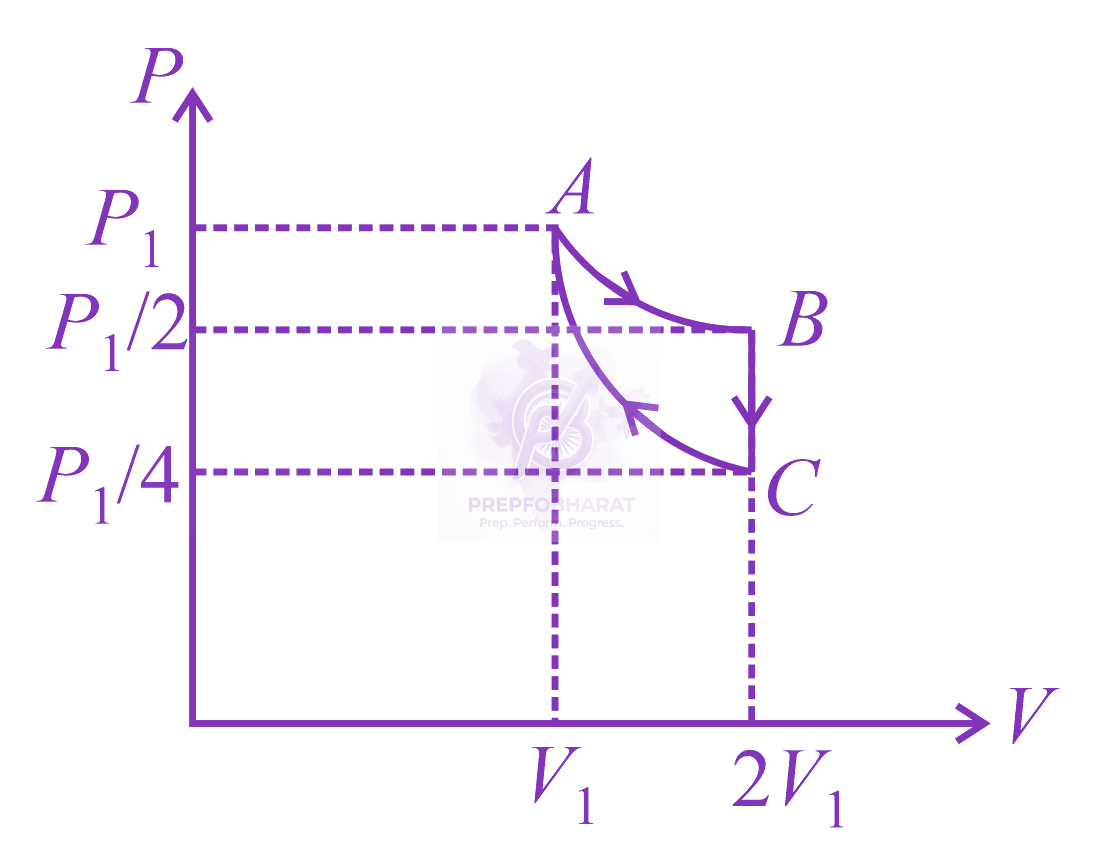
A uniform heating wire of resistance $36\Omega$ is connected across a potential difference of $240V.$ The wire is then cut into half and a potential difference of $240V$ is applied across each half separately. The ratio of power dissipation in first case to the total power dissipation in the second case would be $1:x,$ where $x$ is
What will be the average value of energy for a monoatomic gas in thermal equilibrium at temperature $T?$
What will be the average value of energy along one degree of freedom for an ideal gas in thermal equilibrium at a temperature $T?$ (${k}_{B}$ is Boltzmann constant)
Calculate the value of the mean free path $(\lambda )$ for oxygen molecules at temperature $27^{\circ}C$ and pressure $1.01\times {10}^{5}\mathrm{Pa}$. Assume the molecular diameter $0.3\mathrm{nm}$ and the gas is ideal. $(k=1.38\times {10}^{-23}J{K}^{-1})$
A diatomic gas, having ${C}_{P}=\frac{7}{2}R$ and ${C}_{V}=\frac{5}{2}R,$ is heated at constant pressure. The ratio $dU:dQ:dW$
A monoatomic gas of mass $4.0u$ is kept in an insulated container. The container is moving with velocity $30m{s}^{-1}$. If the container is suddenly stopped then a change in temperature of the gas ($R=$gas constant) is $\frac{x}{3R}$. Value of $x$ is,
The root-mean-square speed of molecules of a given mass of a gas at $27^{\circ}C$ and $1$ atmosphere pressure is $200m{s}^{-1}.$ The root-mean-square speed of molecules of the gas at $127^{\circ}C$ and $2$ atmosphere pressure is $\frac{x}{\sqrt{3}}m{s}^{-1}.$ The value of $x$ will be __________.
The internal energy $(U)$, pressure $(P)$ and volume $(V)$ of an ideal gas are related as $U=3PV+4.$ The gas is
The R.M.S. speeds of the molecules of Hydrogen, Oxygen, and Carbon dioxide at the same temperature are ${v}_{H},{v}_{O}$ and ${v}_{C}$ respectively, then:
The entropy of any system is given by, $S={\alpha }^{2}\beta \mathrm{ln}[\frac{\mu \mathrm{kR}}{J{\beta }^{2}}+3]$ where $\alpha$ and $\beta$ are the constants. $\mu ,J,k$ and $R$ are number of moles, mechanical equivalent of heat, Boltzmann's constant and gas constant, respectively. $[\text{Take }S=\frac{dQ}{T}]$ Choose the incorrect option from the following:
The correct relation between the degrees of freedom $f$ and the ratio of specific heat $\gamma$ is:
The temperature of equal masses of three different liquids $x,y$ and $z$ are $10^{\circ}C,20^{\circ}C$ and $30^{\circ}C$ respectively. The temperature of mixture when $x$ is mixed with $y$ is $16^{\circ}C$ and that when $y$ is mixed with $z$ is $26^{\circ}C$. The temperature of mixture when $x$ and $z$ are mixed will be :
For an adiabatic expansion of an ideal gas, the fractional change in its pressure is equal to (where $\gamma$ is the ratio of specific heats):
If one mole of the polyatomic gas is having two vibrational modes and $\beta$ is the ratio of molar specific heats for polyatomic gas $(\beta =\frac{{C}_{P}}{{C}_{v}})$ then the value of $\beta$ is :
Match List $I$ with List $\mathrm{II}.$ <table class="pyq-table"><tbody><tr><td></td><td>List $I$</td><td></td><td>List $\mathrm{II}$</td></tr><tr><td>(a)</td><td>Isothermal</td><td>(i)</td><td>Pressure constant</td></tr><tr><td>(b)</td><td>Isochoric</td><td>(ii)</td><td>Temperature constant</td></tr><tr><td>(c)</td><td>Adiabatic</td><td>(iii)</td><td>Volume constant</td></tr><tr><td>(d)</td><td>Isobaric</td><td>(iv)</td><td>Heat content is constant</td></tr></tbody></table>Choose the correct answer from the options given below:
A bimetallic strip consists of metals $A$ and $B$. It is mounted rigidly as shown. The metal $A$ has higher coefficient of expansion compared to that of metal $B$. When the bimetallic strip is placed in a cold both, it will : 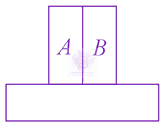
Two ideal polyatomic gases at temperatures ${T}_{1}$ and ${T}_{2}$ are mixed so that there is no loss of energy. If ${F}_{1}$ and ${F}_{2},{m}_{1}$ and ${m}_{2},{n}_{1}$ and ${n}_{2}$ be the degrees of freedom, masses, number of molecules of the first and second gas respectively, the temperature of mixture of these two gases is:
Consider a sample of oxygen behaving like an ideal gas. At $300K$, the ratio of root-mean-square (RMS) velocity to the average velocity of the gas molecule would be : (Molecular weight of oxygen is $32g{\mathrm{mol}}^{-1};R=8.3J{K}^{-1}{\mathrm{mol}}^{-1}$)
The temperature $\theta$ at the junction of two insulating sheets, having thermal resistances ${R}_{1}$ and ${R}_{2}$ as well as top and bottom temperatures ${\theta }_{1}$ and ${\theta }_{2}$ (as shown in figure) is given by : 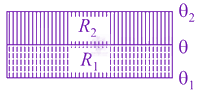
A sample of gas with $\gamma =1.5$ is taken through an adiabatic process in which the volume is compressed from $1200{\mathrm{cm}}^{3}$ to $300{\mathrm{cm}}^{3}.$ If the initial pressure is $200\mathrm{kPa}.$ The absolute value of the workdone by the gas in the process $=________J.$
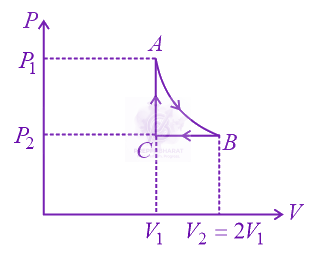
$n$ mole of a perfect gas undergoes a cyclic process $ABCA$ (see figure) consisting of the following processes. $A\rightarrow B:$ Isothermal expansion at temperature $T$ so that the volume is doubled from ${V}_{1}$ to ${V}_{2}=2{V}_{1}$ and pressure changes from ${P}_{1}$ to ${P}_{2}$ $B\rightarrow C:$ Isobaric compression at pressure ${P}_{2}$ to initial volume ${V}_{1}.$ $C\rightarrow A:$ Isochoric change leading to change of pressure from ${P}_{2}$ to ${P}_{1}$ Total work done in the complete cycle $ABCA$ is: