JEE Main Physics — Thermodynamics previous year questions with solutions.
A polyatomic ideal gas has $24$ vibrational modes. What is the value of $\gamma ?$
A monoatomic ideal gas, initially at temperature ${T}_{1}$ is enclosed in a cylinder fitted with a frictionless piston. The gas is allowed to expand adiabatically to a temperature ${T}_{2}$ by releasing the piston suddenly. If ${l}_{1}$ and ${l}_{2}$ are the lengths of the gas column, before and after the expansion respectively, then the value of $\frac{{T}_{1}}{{T}_{2}}$ will be:
A monoatomic gas of mass $4.0u$ is kept in an insulated container. The container is moving with velocity $30m{s}^{-1}$. If the container is suddenly stopped then a change in temperature of the gas ($R=$gas constant) is $\frac{x}{3R}$. Value of $x$ is,
A mixture of hydrogen and oxygen has volume $500{\mathrm{cm}}^{3},$ temperature $300K,$ pressure $400k\mathrm{Pa}$ and mass $0.76g.$ The ratio of masses of oxygen to hydrogen will be:
A diatomic gas, having ${C}_{P}=\frac{7}{2}R$ and ${C}_{V}=\frac{5}{2}R,$ is heated at constant pressure. The ratio $dU:dQ:dW$
A cylindrical container of volume $4.0\times {10}^{-3}{m}^{3}$ contains one mole of hydrogen and two moles of carbon dioxide. Assume the temperature of the mixture is $400K$. The pressure of the mixture of gases is : [Take gas constant as $8.3J{\mathrm{mol}}^{-1}{K}^{-1}]$
A container is divided into two chambers by a partition. The volume of first chamber is $4.5\mathrm{litre}$ and second chamber is $5.5\mathrm{litre}$. The first chamber contain $3.0$ moles of gas at pressure $2.0\mathrm{atm}$ and second chamber contain $4.0$ moles of gas at pressure $3.0\mathrm{atm}$. After the partition is removed and the mixture attains equilibrium, then, the common equilibrium pressure existing in the mixture is $x\times {10}^{-1}\mathrm{atm}$. Value of $x$ (nearest integer) is
A bimetallic strip consists of metals $A$ and $B$. It is mounted rigidly as shown. The metal $A$ has higher coefficient of expansion compared to that of metal $B$. When the bimetallic strip is placed in a cold both, it will : 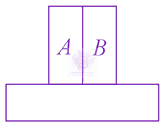
A balloon carries a total load of $185\mathrm{kg}$ at normal pressure and temperature of $27^{\circ}C.$ What load will the balloon carry on rising to a height at which the barometric pressure is $45\mathrm{cm}$ of $\mathrm{Hg}$ and the temperature is $-7^{\circ}C.$ Assuming the volume constant?
Which of the following is an equivalent cyclic process corresponding to the thermodynamic cyclic given in the figure? Where, $1\rightarrow 2$ is adiabatic. (Graphs are schematic and are not to scale) 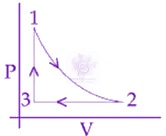
When the temperature of a metal wire is increased from $0ºC\mathrm{to}10ºC$, its length increases by $0.02%$.The percentage change in its mass density will be closed to:
Under an adiabatic process, the volume of an ideal gas gets doubled. Consequently, the mean collision time between the gas molecule changes from ${\tau }_{1}$ to ${\tau }_{2}$ . If $\frac{{C}_{P}}{{C}_{v}}=\gamma$ for this gas then a good estimate for $\frac{{\tau }_{2}}{{\tau }_{1}}$ is given by
Two moles of an ideal gas, with $\frac{{C}_{P}}{{C}_{V}}=\frac{5}{3}$, are mixed with three moles of another ideal gas $\frac{{C}_{P}}{{C}_{V}}=\frac{4}{3}$. The value of $\frac{{C}_{P}}{{C}_{V}}$ for the mixture is
Two gases - argon (atomic radius $0.07nm,$ atomic weight $40$ ) and xenon (atomic radius $0.1nm,$ atomic weight $140$ ) have the same number density and are at the same temperature. The ratio of their respective mean free times is closest to:
Two different wires having lengths ${L}_{1}$ and ${L}_{2}$ and respective temperature coefficient of linear expansion ${\alpha }_{1}$ and ${\alpha }_{2},$ are joined end-to-end. Then the effective temperature coefficient of linear expansion is :
To raise the temperature of a certain mass of gas by $50^{\circ}C$ at a constant pressure,$160$ calories of heat is required. When the same mass of gas is cooled by $100^{\circ}C$ at constant volume,$240$ calories of heat is released. How many degrees of freedom does each molecule of this gas have (assume gas to be ideal)?
Three rods of identical cross-section and length are made of three different materials of thermal conductivity ${K}_{1},{K}_{2}$ and ${K}_{3}$, respectively. They are joined together at their ends to make a long rod (see figure). One end of the long rod is maintained at $100^{\circ}C$ and the other at $0^{\circ}C$ (see figure). If the joints of the rod are at $70^{\circ}C$ and $20^{\circ}C$ in steady and there is no loss of energy from the surface of the rod, the correct relationship between ${K}_{1},{K}_{2}$ and ${K}_{3}$ is : 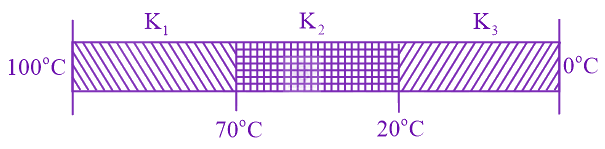
Three different processes that can occur in an ideal monoatomic gas are shown in the $P$ vs $V$ diagram. The paths are labelled as $A\rightarrow B,A\rightarrow C$ and $A\rightarrow D$. The change in internal energies during these process are taken as ${E}_{AB},{E}_{AC}$ and ${E}_{AD}$ and the work done as ${W}_{AB},{W}_{AC}$ and ${W}_{AD}$. The correct relation between these parameters are: 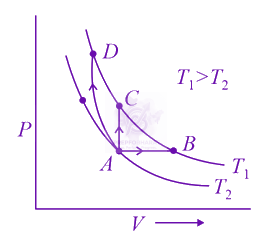
Three containers ${C}_{1},{C}_{2}$ and ${C}_{3}$ have water at different temperatures. The table below shows the final temperature $T$ when different amounts of water (given in liters) are taken from each container and mixed (assume no loss of heat during the process) <table class="pyq-table"><tbody><tr><th>${C}_{1}$</th><th>${C}_{2}$</th><th>${C}_{3}$</th><th>$T$</th></tr><tr><td>$1l$</td><td>$2l$</td><td>$--$</td><td>${60}^{o}C$</td></tr><tr><td>$--$</td><td>$1l$</td><td>$2l$</td><td>${30}^{o}C$</td></tr><tr><td>$2l$</td><td>$--$</td><td>$1l$</td><td>${60}^{o}C$</td></tr><tr><td>$1l$</td><td>$1l$</td><td>$1l$</td><td>$\theta$</td></tr></tbody></table> The value of $\theta$ (in ${}^{o}C$ to the nearest integer) is___________
The specific heat of water $=4200\text{ J}$ ${\text{kg}}^{–1}{\text{ K}}^{–1}$ and the latent heat of ice $=3.4\times {10}^{5}\text{ J}$ k${\text{g}}^{–1}$. $100$ grams of ice at $0{ }^{\text{o}}\text{C}$ is placed in $200\text{ g}$ of water at $25{ }^{\text{o}}\text{C}$. The amount of ice that will melt as the temperature of water reaches $0{ }^{\text{o}}\text{C}$ is close to (in grams)
The plot that depicts the behavior of the mean free time $\tau$ (time between two successive collisions) for the molecules of an ideal gas, as a function of temperature $(T),$ qualitatively, is: (Graphs are schematic and not drawn to scale)
The change in the magnitude of the volume of an ideal gas when a small additional pressure $\Delta P$ is applied at a constant temperature, is the same as the change when the temperature is reduced by a small quantity $\Delta T$ at constant pressure. The initial temperature and pressure of the gas were $300K$and $2\mathrm{atm}$ respectively. If $|\Delta T|=C|\Delta P|$ then value of $C$ in $(K/\mathrm{atm})$ is __________
Starting at temperature $300K,$ one mole of an ideal diatomic gas $(\gamma =1.4)$ is first compressed adiabatically from volume ${V}_{1}$ to ${V}_{2}=\frac{{V}_{1}}{16}.$ It is then allowed to expand isobarically to volume $2{V}_{2}$ . If all the processes are the quasi-static then the final temperature of the gas (in ${}^{o}K$ ) is (to the nearest integer) ___________.
Number of molecules in a volume of $4{\mathrm{cm}}^{3}$ of a perfect monoatomic gas at some temperature T and at a pressure of $2\mathrm{cm}$ of mercury is close to? (Given, mean kinetic energy of a molecule (at T) is $4\times {10}^{-14}\mathrm{erg},g=980\mathrm{cm}{s}^{-2}$ density of mercury $=13.6g{\mathrm{cm}}^{-3}$)