JEE Main Physics — Thermodynamics previous year questions with solutions.
A balloon filled with helium $(32^{\circ}C \mathrm{and} 1.7\mathrm{atm})$ bursts. Immediately after wards the expansion of helium can be considered as :
In an adiabatic process, the density of a diatomic gas becomes $32$$n$ times its initial value. The final pressure of the gas is found to be $n$ times the initial pressure. The value of $n$ is:
The change in the magnitude of the volume of an ideal gas when a small additional pressure $\Delta P$ is applied at a constant temperature, is the same as the change when the temperature is reduced by a small quantity $\Delta T$ at constant pressure. The initial temperature and pressure of the gas were $300K$and $2\mathrm{atm}$ respectively. If $|\Delta T|=C|\Delta P|$ then value of $C$ in $(K/\mathrm{atm})$ is __________
Starting at temperature $300K,$ one mole of an ideal diatomic gas $(\gamma =1.4)$ is first compressed adiabatically from volume ${V}_{1}$ to ${V}_{2}=\frac{{V}_{1}}{16}.$ It is then allowed to expand isobarically to volume $2{V}_{2}$ . If all the processes are the quasi-static then the final temperature of the gas (in ${}^{o}K$ ) is (to the nearest integer) ___________.
A bullet of mass $5\mathrm{gram}$, travelling with a speed of $210m{s}^{-1}$ strikes a fixed wooden target. One half of its kinetic energy is converted into heat in the wood. The rise of temperature of the bullet if the specific heat of its material is $0.030{(\mathrm{gram}^{\circ}C)}^{-1}(1\mathrm{calorie}=4.2\times {10}^{7}\mathrm{ergs})$ close to :
An ideal gas in a closed container is slowly heated. As its temperature increases, which of the following statements are true ? (A) the mean free path of the molecules decreases (B) the mean collision time between the molecules decreases. (C) the mean free path remains unchanged. (D) the mean collision time relations unchanged.
Two different wires having lengths ${L}_{1}$ and ${L}_{2}$ and respective temperature coefficient of linear expansion ${\alpha }_{1}$ and ${\alpha }_{2},$ are joined end-to-end. Then the effective temperature coefficient of linear expansion is :
When the temperature of a metal wire is increased from $0ºC\mathrm{to}10ºC$, its length increases by $0.02%$.The percentage change in its mass density will be closed to:
In a dilute gas at pressure $P$ and temperature '$t$', the time between successive collision of a molecule varies with $T$ as :
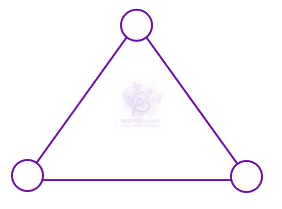 Consider a gas of triatomic molecules. The molecules are assumed to be triangular and made of massless rigid rods whose vertices are occupied by atoms. The internal energy of a mole of the gas at temperature T is:
Consider a mixture of $n$ moles of helium gas and $2n$ moles of oxygen gas (molecules taken to be rigid) as an ideal gas. Its $\frac{{C}_{P}}{{C}_{V}}$ value will be:
Two moles of an ideal gas, with $\frac{{C}_{P}}{{C}_{V}}=\frac{5}{3}$, are mixed with three moles of another ideal gas $\frac{{C}_{P}}{{C}_{V}}=\frac{4}{3}$. The value of $\frac{{C}_{P}}{{C}_{V}}$ for the mixture is
Three containers ${C}_{1},{C}_{2}$ and ${C}_{3}$ have water at different temperatures. The table below shows the final temperature $T$ when different amounts of water (given in liters) are taken from each container and mixed (assume no loss of heat during the process) <table class="pyq-table"><tbody><tr><th>${C}_{1}$</th><th>${C}_{2}$</th><th>${C}_{3}$</th><th>$T$</th></tr><tr><td>$1l$</td><td>$2l$</td><td>$--$</td><td>${60}^{o}C$</td></tr><tr><td>$--$</td><td>$1l$</td><td>$2l$</td><td>${30}^{o}C$</td></tr><tr><td>$2l$</td><td>$--$</td><td>$1l$</td><td>${60}^{o}C$</td></tr><tr><td>$1l$</td><td>$1l$</td><td>$1l$</td><td>$\theta$</td></tr></tbody></table> The value of $\theta$ (in ${}^{o}C$ to the nearest integer) is___________
Nitrogen gas is at $300^{\circ}C$ temperature. The temperature (in $K$ ) at which the rms speed of a ${H}_{2}$ molecule would be equal to the rms speed of a nitrogen molecule, is $\ldots \ldots \ldots .$ (Molar mass of ${N}_{2}$ gas $28g$ ).
A closed vessel contains $0.1$ mole of a monoatomic ideal gas at $200\text{ K}$. If $0.05$ mole of the same gas at $400K$ is added to it, the final equilibrium temperature (in $\text{K}$) of the gas in the vessel will be close to ______
Assuming the nitrogen molecule is moving with $r.m.s$. velocity at $400K$, the de-Broglie wave length of nitrogen molecule is close to : (Given : nitrogen molecule weight : $4.64\times {10}^{-26} \mathrm{kg}$, Boltzman constant : $1.38\times {10}^{-23} J{K}^{-1}$, Planck constant : $6.63\times {10}^{-34} Js$)
Three different processes that can occur in an ideal monoatomic gas are shown in the $P$ vs $V$ diagram. The paths are labelled as $A\rightarrow B,A\rightarrow C$ and $A\rightarrow D$. The change in internal energies during these process are taken as ${E}_{AB},{E}_{AC}$ and ${E}_{AD}$ and the work done as ${W}_{AB},{W}_{AC}$ and ${W}_{AD}$. The correct relation between these parameters are: 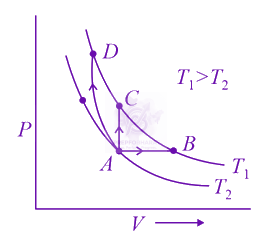
Two gases - argon (atomic radius $0.07nm,$ atomic weight $40$ ) and xenon (atomic radius $0.1nm,$ atomic weight $140$ ) have the same number density and are at the same temperature. The ratio of their respective mean free times is closest to:
Consider two ideal diatomic gases $A$ and $B$ at some temperature $T$ . Molecules of the gas $A$ are rigid, and have a mass $m$ . Molecules of the gas $B$ have an additional vibrational mode and have a mass $\frac{m}{4}$ . The ratio of the specific heats ${({C}_{V}^{})}_{A}\text{and }{({C}_{V}^{})}_{B}$ of gas $A$ and $B,$ respectively is:
$M$ grams of steam at ${100}^{o}C$ is mixed with $200g$ of ice at its melting point in a thermally insulated container. If it produces liquid water at ${40}^{o}C$ [heat of vaporization of water is $540cal/g$ and heat of fusion of ice is $80cal/g$ ], the value of $M$ is ________
Match the $\frac{{\text{C}}_{\text{p}}}{{\text{C}}_{\text{v}}}$ ratio for ideal gases with different type of molecules: <table class="pyq-table"><tbody><tr><td>Molecule Type</td><td>${\text{C}}_{\text{p}}/{\text{C}}_{\text{v}}$</td></tr><tr><td>(A) Monoatomic</td><td>(I) $7/5$</td></tr><tr><td>(B) Diatomic rigid molecules</td><td>(II) $9/7$</td></tr><tr><td>(C) Diatomic non-rigid molecules</td><td>(III) $4/3$</td></tr><tr><td>(D) Triatomic rigid molecules</td><td>(IV) $5/3$</td></tr></tbody></table>
The specific heat of water $=4200\text{ J}$ ${\text{kg}}^{–1}{\text{ K}}^{–1}$ and the latent heat of ice $=3.4\times {10}^{5}\text{ J}$ k${\text{g}}^{–1}$. $100$ grams of ice at $0{ }^{\text{o}}\text{C}$ is placed in $200\text{ g}$ of water at $25{ }^{\text{o}}\text{C}$. The amount of ice that will melt as the temperature of water reaches $0{ }^{\text{o}}\text{C}$ is close to (in grams)
A non-isotropic solid metal cube has coefficients of linear expansion as: $5\times { 10}^{ -5} / {}^{\text{o}} \text{C}$ along the x-axis and $5\times { 10}^{ -6} / {}^{\text{o}} \text{C}$ along the y and the z-axis. If the coefficient of volume expansion of the solid is $\text{C}\times { 10}^{ -6} / {}^{\text{o}} \text{C}$ then the value of $C$ is _____________
To raise the temperature of a certain mass of gas by $50^{\circ}C$ at a constant pressure,$160$ calories of heat is required. When the same mass of gas is cooled by $100^{\circ}C$ at constant volume,$240$ calories of heat is released. How many degrees of freedom does each molecule of this gas have (assume gas to be ideal)?