JEE Main Physics — Thermodynamics previous year questions with solutions.
When $100 \mathrm{~g}$ of a liquid $\mathrm{A}$ at $100^{\circ} \mathrm{C}$ is added to $50 \mathrm{~g}$ of a liquid $B$ at temperature $75^{\circ} \mathrm{C}$, the temperature of the mixture becomes $90^{\circ} \mathrm{C}$. The temperature of the mixture, if $100 \mathrm{~g}$ of liquid $A$ at $100^{\circ} \mathrm{C}$ is added to $50 \mathrm{~g}$ of liquid $\mathrm{B}$ at $50^{\circ} \mathrm{C}$, will be:
A $15g$ mass of nitrogen gas is enclosed in a vessel at a temperature, ${27}^{o}C$. The amount of heat transferred to the gas, so that $R.M.S.$ velocity of molecules is doubled, is about. $[R=8.3 J{(K \mathrm{mole})}^{-1}]$
When heat $Q$ is supplied to a diatomic gas of rigid molecules, at constant volume its temperature increases by $\Delta T$ . The heat required to produce the same change in temperature, at a constant pressure is:
The specific heats, ${C}_{p}$ and ${C}_{v}$ of a gas of diatomic molecules, $A,$ are given (in units of $J mo{l}^{-1} {K}^{-1}$ ) by $29$ and $22,$ respectively. Another gas of diatomic molecules, $B,$ has the corresponding values $30$ and $21.$ If they are treated as ideal gases, then:
The given diagram shows four processes i.e., isochoric, isobaric, isothermal and adiabatic. The correct assignment of the processes, in the same order is given by: 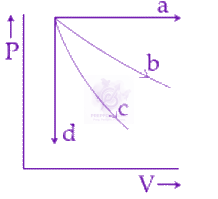
An unknown metal of mass $192 g$ heated to a temperature of $100^{\circ}C$ was immersed into a brass calorimeter of mass $128 g$ containing $240 g$ of water at a temperature of ${8.4}^{o}C.$ Calculate the specific heat of the unknown metal if water temperature stabilizes at ${21.5}^{o}C.$ $($ Specific heat of brass is $394J k{g}^{-1}{K}^{-1})$
A cylinder with fixed capacity of $67.2$ litre contains helium gas at STP. The amount of heat needed to raise the temperature of the gas by $20^{\circ}C$ is: [Given that $R=8.31 J mo{l}^{-1} {K}^{-1}]$
Two materials having coefficients of thermal conductivity $3K$ and $K$ and thickness $d$ and $3\text{d}$ respectively, are joined to form a slab as shown in the figure. The temperatures of the outer surfaces are ${\theta }_{2}$ and ${\theta }_{1}$ respectively, $({\theta }_{2}>{\theta }_{1}).$ The temperature at the interface is 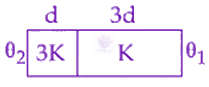
For the given cyclic process $CAB$ as shown for a gas, the work done is: 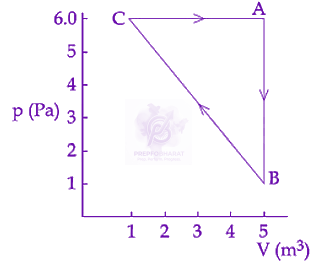
A diatomic gas with rigid molecules does $10 J$ of work when expanded at constant pressure. What would be the heat energy absorbed by the gas, in this process?
Following figure shows two processes $A$ and $B$ for a gas. If $\Delta {Q}_{A}$ and $\Delta {Q}_{B}$ are the amount of heat absorbed by the system in two cases, and $\Delta {U}_{A}$ and $\Delta {U}_{B}$ are changes in internal energies, respectively, then: 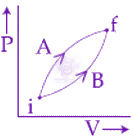
A metal ball of mass $0.1 \mathrm{~kg}$ is heated upto $500^{\circ} \mathrm{C}$ and dropped into a vessel of heat capacity $800 \mathrm{JK}^{-1}$ and containing $0.5 \mathrm{~kg}$ water. The initial temperature of water and vessel is $30^{\circ} \mathrm{C}$. What is the approximate percentage increment in the temperature of the water? [Specific Heat Capacities of water and metal are, respectively, $4200 \mathrm{Jkg}^{-}$ ${ }^{1} \mathrm{~K}^{-1}$ and $400 \mathrm{Jkg}^{-1} \mathrm{~K}^{-1}$ ]
In a process, temperature and volume of one mole of an ideal monoatomic gas are varied according to the relation $\mathrm{VT}=\mathrm{K},$ where $\mathrm{K}$ is a constant. In this process the temperature of the gas is increased by $\Delta \mathrm{T}$. The amount of heat absorbed by gas is (R is gas constant):
A cylinder of radius $R$ is surrounded by a cylindrical shell of inner radius $R$ and outer radius $2R$. The thermal conductivity of the material of the inner cylinder is ${K}_{1}$ and that of the outer cylinder is ${K}_{2}$. Assuming no loss of heat, the effective thermal conductivity of the system for heat flowing along the length of the cylinder is:
When ${M}_{1}$ gram of ice at $-{10}^{o}C$ (specific heat $=0.5 cal {g}^{-1} {℃}^{-1}$ ) is added to ${M}_{2}$ gram of water at ${50 }^{o}C,$ finally no ice is left and the water is at ${0 }^{o}C$ . The value of latent heat of ice, in $cal {g}^{-1}$ is:
A thermometer graduated according to a linear scale reads a value $x_{0}$ when in contact with boiling water, and $x_{0} / 3$ when in contact with ice. What is the temperature of an object in ${ }^{\circ} \mathrm{C}$, if this thermometer in the contact with the object reads $x_{0} / 2 ?$
Two identical beakers $A$ and $B$ contain equal volumes of two different liquids at $60^{\circ}C$ each and left to cool down. Liquid in $A$ has density of $8\times {10}^{2} kg{m}^{-3}$ and specific heat of $2000 J k{g}^{-1}{K}^{-1}$ while the liquid in $B$ has density ${10}^{3} kg{ m}^{-3}$ and specific heat of $4000 J k{g}^{-1}{K}^{-1}$. Which of the following best describes their temperature versus time graph schematically? (assume the emissivity of both the beakers to be the same)
$1\mathrm{kg}$ of water, at $20 ^{\circ}C$ is heated in an electric kettle whose heating element has a mean (temperature averaged) resistance of $20 \Omega .$ The rms voltage in the mains is $200 V$. Ignoring heat loss from the kettle, time taken for water to evaporate fully is close to [ Specific heat of water $=4200 J{\mathrm{kg}}^{-1}^{\circ}{C}^{-1}$ Latent heat of water $=2260 kJk{g}^{-1}$ ]
An $HCl$ molecule has rotational, translational and vibrational motions. If the rms velocity of $HCl$ molecules in its gaseous phase is $\overset{-}{\nu }$ , m is its mass and ${k}_{B}$ is Boltzmann's constant, then its temperature will be:
$n$ moles of an ideal gas with constant volume heat capacity ${C}_{v}$ undergo an isobaric expansion by certain volume. The ratio of the work done in the process, to the heat supplied is:
Two moles of helium gas is mixed with three moles of hydrogen molecules (taken to be rigid). What is the molar specific heat of mixture at constant volume? $(R=8.3 J/mol K)$
For given gas at $1 atm$ pressure, $rms$ speed of the molecules is $200 m/s$ at $127^{\circ}C.$ At $2 atm$ pressure and at $227^{\circ} C,$ the $rms$ speed of the molecules will be:
An ideal gas occupies a volume of $2{m}^{3}$ at a pressure of $3\times {10}^{6}Pa.$ The energy of the gas is:
A mixture of 2 moles of helium gas (atomic mass = 4u) $,$ and 1 mole of argon gas (atomic mass = 40 u) is kept at $300 K$ in a container. The ratio of their rms speeds $[\frac{{V}_{rms}(helium)}{{V}_{rms}(argon)}],$ is close to: