JEE Main Physics — Thermodynamics previous year questions with solutions.
A sample of an ideal gas is taken through the cyclic process $abca$ as shown in the figure. The change in the internal energy of the gas along the path $ca$ is $-180 J.$ The gas absorbs $250 J$ of heat along the path $ab$ and $60 J$ along the path $bc$ . The work done by the gas along the path $abc$ is: 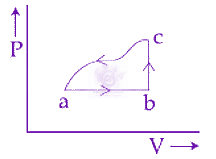
A gas mixture consists of 3 moles of oxygen and 5 moles of argon at temperature T. Considering only translational and rotational modes, the total internal energy of the system is
A massless spring $(k=800 N/m),$ attached with a mass $(500 g)$ is completely immersed in $1 kg$ of water. The spring is stretched by $2 cm$ and released so that it starts vibrating. What would be the order of magnitude of the change in the temperature of water when the vibrations stop completely? (Assume that the water container and spring receive negligible heat and specific heat of mass $=400 J/kg K,$ specific heat of water $=4184 J/kg K$ )
Ice at $-20^{\circ} \mathrm{C}$ is added to $50 \mathrm{~g}$ of water at $40^{\circ} \mathrm{C}$, When the temperature of the mixture reaches $0^{\circ} \mathrm{C},$ it is found that 20 $\mathrm{g}$ of ice is still unmelted. The amount of ice added to the water was close to (Specific heat of water $=4.2 \mathrm{~J} / \mathrm{g} /{ }^{\circ} \mathrm{C}$ Specific heat of Ice $=2.1 \mathrm{~J} / \mathrm{g} /{ }^{\circ} \mathrm{C}$ Heat of fusion of water at $\left.0^{\circ} \mathrm{C}=334 \mathrm{~J} / \mathrm{g}\right)$
Half mole of an ideal monoatomic gas is heated at a constant pressure of $1 \mathrm{atm}$ from $20^{\circ}C$ to $90^{\circ}C$. Work done by the gas is$($Gas constant,$R=8.21 J{\mathrm{mol}}^{-1}{K}^{-1}$)
The temperature, at which the root mean square velocity of hydrogen molecules equals their escape their escape velocity from the earth, is closest to: $[$ Boltzmann Constant ${k}_{B}=1.38\times {10}^{-23} J/K$ Avogadro number ${N}_{A}=6.02\times {10}^{26} /kg$ Radius of Earth: $6.4\times {10}^{6} m$ Gravitational acceleration on Earth $=10 m{s}^{-2}]$
Two rods $A$ and $B$ of identical dimensions are at temperature $30^{\circ} \mathrm{C}$. If $\mathrm{A}$ is heated upto $180^{\circ} \mathrm{C}$ and $\mathrm{B}$ upto $\mathrm{T}^{\circ} \mathrm{C},$ then the new lengths are the same. If the ratio of the coefficients of linear expansion of $\mathrm{A}$ and $\mathrm{B}$ is $4: 3,$ then the value of $T$ is
A gas can be taken from $A$ to $B$ via two different processes $\mathrm{ACB}$ and $\mathrm{ADB}$. 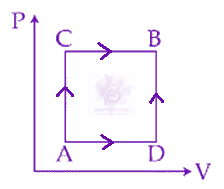 When path $\mathrm{ACB}$ is used $60 J$ of heat flows into the system and $30 J$ of work is done by the system. If the path $\mathrm{ADB}$ is used then work done by the system is $10 J$, the heat flows into the system in the path $\mathrm{ADB}$ is:
$2\mathrm{kg}$ of a monoatomic gas is at a pressure of $4\times {10}^{4}N{m}^{-2}$. The density of the gas is $8 \mathrm{kg}{m}^{-3}$. What is the order of energy of the gas due to its thermal motion?
A thermally insulated vessel contains $150 g$ of water at $0^{\circ}C$ . Then the air from the vessel is pumped out adiabatically. A fraction of water turns into ice and the rest evaporates at $0^{\circ}C$ itself. The mass of evaporated water will be closest to: (Latent heat of vaporization of water $=2.10\times {10}^{6} J k{g}^{-1}$ and Latent heat of Fusion of water $=3.36\times {10}^{5} J k{g}^{-1}$ )
A rigid diatomic ideal gas undergoes an adiabatic process at room temperature. The relation between temperature and volume for this process is $\mathrm{TV}^{\mathrm{x}}=$ constant, then $\mathrm{x}$ is:
An ideal gas is enclosed in a cylinder at pressure of $2$ atm and temperature, $300 K.$ The mean time between two successive collisions is $6\times {10}^{-8}s.$ If the pressure is doubled and temperature is increased to $500 K,$ the mean time between two successive collisions will be close to:
One mole of an ideal gas passes through a process where pressure and volume obey the relation $P={P}_{o}[1-\frac{1}{2}{(\frac{{V}_{o}}{V})}^{2}]$ . Here ${P}_{o}$ and ${V}_{o}$ are constants. Calculate the change in the temperature of the gas if its volume changes from ${V}_{o}$ to $2{V}_{o}$ .
A $25\times {10}^{-3} {m}^{3}$ volume cylinder is filled with $1$ mol of ${O}_{2}$ gas at room temperature $(300 K)$ . The molecular diameter of ${O}_{2}$ , and its root mean square speed, are found to be $0.3 nm$ and $200 m/s$ , respectively. What is the average collision rate (per second) for an ${O}_{2}$ molecule?
A heat source at $T={10}^{3}K$ is connected to another heat reservoir at $T={10}^{2}K$ by a copper slab which is $1 m$ thick. Given that the thermal conductivity of copper is $0.1 W{K}^{-1} {m}^{-1}$, the energy flux through it in the steady-state is:
At $40^{\circ}C,$ a brass wire of $1 mm$ radius is hung from the ceiling. A small mass, $M$ is hung from the free end of the wire. When the wire is cooled down from $40^{\circ}C$ to $20^{\circ}C$ it regains its original length of $0.2 m.$ The value of $M$ is close to: (Coefficient of linear expansion and Young’s modulus of brass are ${10}^{-5}{/}^{^{\circ}}C$ and ${10}^{11} N/{m}^{2},$ respectively; $g=10 m {s}^{-2}$ )
A uniform cylindrical rod of length $L$ and radius r, is made from a material whose Young’s modulus of Elasticity equals $Y.$ When this rod is heated by temperature T and simultaneously subjected to a net longutudinal compressional force F, its length remains unchanged. The coefficient of volume expansion, of the material of the rod, is (nearly) equal to:
The number density of molecules of a gas depends on their distance r from the origin as, $n(r)={n}_{0}{e}^{-\alpha {r}^{4}}.$ Then the numer of molecules is proportional to:
Temperature difference of ${120}^{o}C$ is maintained between two ends of a uniform rod $AB$ of length $2L.$ Another bent rod $PQ,$ of same cross-section as $AB$ and length $\frac{3L}{2},$ is connected across $AB$ (See figure). In steady state, temperature difference between $P$ and $Q$ will be close to: 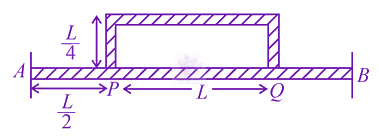
One mole of an ideal monoatomic gas is compressed isothermally in a rigid vessel to double its pressure at room temperature, $27^{\circ} \mathrm{C}$. The work done on the gas will be:
The value closest to the thermal velocity of a Helium atom at room temperature $(300 \mathrm{~K})$ in $\mathrm{ms}^{-1}$ is: $\left[\mathrm{k}_{\mathrm{B}}=1.4 \times 10^{-23} \mathrm{~J} / \mathrm{K} ; \mathrm{m}_{\mathrm{He}}=7 \times 10^{-27} \mathrm{~kg}\right]$
One mole of an ideal monatomic gas is taken along the path $ABCA$ as shown in the $PV$ diagram. The maximum temperature attained by the gas along the path $BC$ is given by: 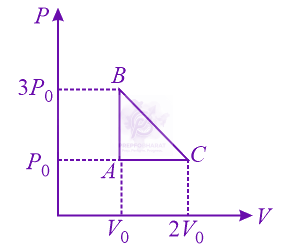
Two moles of an ideal monoatomic gas occupies a volume $V$ at ${27}^{o}C$ . The gas expands adiabatically to a volume $2V$. Calculate $(a)$ the final temperature of the gas and $(b)$ change in its internal energy.
One mole of an ideal monatomic gas is compressed isothermally in a rigid vessel to double its pressure at room temperature, ${27}^{o}C$ . The magnitude of work done on the gas will be: