JEE Main Physics — Thermodynamics previous year questions with solutions.
Two moles of helium are mixed with n moles of hydrogen. If $\frac{{C}_{p}}{{C}_{v}}=\frac{3}{2}$ for the mixture then the value of $n$ is,
$N$ moles of diatomic gas in a cylinder is at a temperature $T$. Heat is supplied to the cylinder such that the temperature remains constant but $n$ moles of the diatomic gas get converted into monoatomic gas. The change in the total kinetic energy of the gas is
A steel rail of length $5m$ and area of cross section $40 {\mathrm{cm}}^{2}$ is prevented from expanding along its length while the temperature rises by $10^{\circ}C$ . If coefficient of linear expansion and Young's modulus of steel are $1.2\times {10}^{-5} {K}^{-1}$ and $2\times {10}^{11} N{m}^{-2}$ respectively, the force developed in the rail is approximately:
In an experiment, a sphere of aluminium of mass $0.20\mathrm{kg}$ is heated up to $150^{\circ}C$ . Immediately, it is put into water of volume $150\mathrm{cc}$at ${27}^{o}C$ kept in a calorimeter of water equivalent to$0.025\mathrm{kg}$ . The final temperature of the system is ${40}^{o}C$ . The specific heat of the aluminium is(take $4.2\mathrm{Joule}=1\mathrm{calorie}$ )
A copper ball of mass $100 \text{g}$ is at a temperature $T$. It is dropped in a copper calorimeter of mass $100 \text{g,}$ filled with $170 \text{g}$ of water at room temperature. Subsequently, the temperature of the system is found to be $75^{\circ}C$. $T$ is given by: (Given: room temperature $=30^{\circ}C$, specific heat of copper $=0.1 \mathrm{cal}{g}^{-1} ^{\circ}{C}^{-1}$)
A compressive force, $F$ is applied at the two ends of a long thin steel rod. It is heated, simultaneously, such that its temperature increases by $\Delta T$. The net change in its length is zero. Let $l$ be the length of the rod, A its area of cross-section, $Y$ its Young's modulus, and $\alpha$ its coefficient of linear expansion. Then, $F$ is equal to:
The temperature of an open room of volume $30{m}^{3}$ increases from $17^{\circ}C$ to $27^{\circ}C$ due to the sunshine. The atmospheric pressure in the room remains $1\times {10}^{5}\mathrm{Pa}$. If ${n}_{i}$ and ${n}_{f}$ are the number of molecules in the room before and after heating, then ${n}_{f}-{n}_{i}$ will be:
An engine operates by taking $n$moles of an ideal gas through the cycle $ABCDA$ shown in figure. The thermal efficiency of the engine is: (Take ${C}_{v}=1.5R$, where$R$ is gas constant) 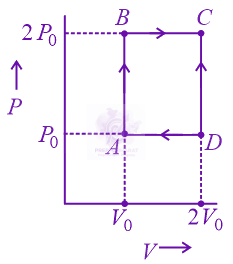
An ideal gas has molecules with $5$ degrees of freedom. The ratio of specific heats at constant pressure $({C}_{p})$ and at constant volume $({C}_{V})$ is:
For the $P-V$ diagram given for an ideal gas 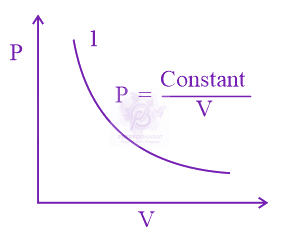 Out of the following which one correctly represents the $T-P$ diagram?
An external pressure $P$ is applied on a cube at $0^{\circ}C$ so that it is equally compressed from all sides. $K$ is the bulk modulus of the material of the cube and $\alpha$ is its coefficient of linear expansion. Suppose we want to bring the cube to its original size by heating. The temperature should be raised by:
${C}_{p}-{C}_{v}=\frac{R}{M}$ and ${C}_{v}$ are specific heats at constant pressure and constant volume respectively. It is observed that, ${C}_{p}-{C}_{v}=a$ for hydrogen gas and ${C}_{p}-{C}_{v}=b$ for nitrogen gas. The correct relation between $a$ and $b$ is:
An ideal gas undergoes a quasi-static, reversible process in which its molar heat capacity C remains constant. If during this process the relation of pressure P and volume V is given by $P{V}^{n}=$ constant, then n is given by (Here ${C}_{P}$ and ${C}_{V}$ are molar specific heat at constant pressure and constant volume, respectively) :
$200g$ water is heated from ${40}^{ o}C$ to ${60}^{ o}C$ . Ignoring the slight expansion of water, the change in its internal energy is close to (Given specific heat of water $=4184$ $J{\mathrm{kg}}^{-1}{K}^{-1}$):
The ratio of work done by an ideal monoatomic gas to the heat supplied to it in an isobaric process is
$n$ moles of an ideal gas undergoes a process $A\rightarrow B$ as shown in the figure. The maximum temperature of the gas during the process will be: 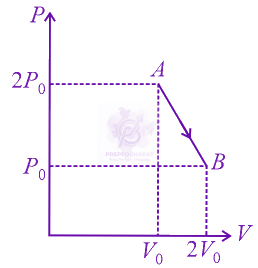
Which of the following shows the correct relationship between the pressure $'P'$ and density $\rho$ of an ideal gas at constant temperature ?
A simple pendulum made of a bob of mass m and a metallic wire of a negligible mass has a time period of $2s$ at $T=0^{\circ}C$. If the temperature of the wire is increased, and the corresponding change in its time period is plotted against its temperature, the resulting graph is a line of slope $S$. If the coefficient of linear expansion of metal is $\alpha$, then the value of $S$ is
A pendulum clock loses 12 s a day if the temperature is ${40}^{o}$ C and gains 4s a day if the temperature is ${20}^{o}$ C. The temperature at which the clock will show correct time, and the co-efficient of linear expansion $(\alpha )$ of the metal of the pendulum shaft are respectively:
In an ideal gas at temperature T, the average force that a molecule applies on the walls of a closed container depends on $T as {T}^{q}$ . A good estimate for q is:
An ideal gas goes through a reversible cycle $a\rightarrow b\rightarrow c\rightarrow d$ has the V - T diagram shown below. Process $d\rightarrow a and b\rightarrow c$ are adiabatic. 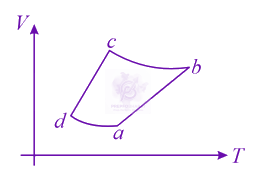 The corresponding P - V diagram for the process is (all figures are schematic and not drawn to scale) :
Consider an ideal gas confined in an isolated closed chamber. As the gas undergoes an adiabatic expansion, the average time of collision between molecules increases as ${V}^{q}$ , where $V$ is the volume of the gas. The value of $q$ is: $(\gamma =\frac{{C}_{P}}{{C}_{v}})$
Using equipartition of energy, the specific heat (in $J {\mathrm{kg}}^{-1} {K}^{-1}$ ) of Aluminium at high temperature can be estimated to be (atomic weight of Aluminium $=27$)
An experiment takes $10\mathrm{min}$ to raise the temperature of water in a container from ${0}^{o}C$ to ${100}^{o}C$ and another $55\mathrm{min}$ to convert it totally into steam by a heater supplying heat at a uniform rate. Neglecting the specific heat of the container and taking specific heat of the water to be $1\mathrm{cal}{({g}^{\circ }C)}^{-1}$ , the heat of vaporization according to this experiment will come out to be: