JEE Main Physics — Thermodynamics previous year questions with solutions.
A solid body of constant heat capacity $1J{(℃)}^{-1}$ is being heated by keeping it in contact with reservoirs in two ways: (i) Sequentially keeping in contact with 2 reservoirs such that each reservoir supplies the same amount of heat. (ii) Sequentially keeping in contact with $8$ reservoirs such that each reservoir supplies the same amount of heat. In both, cases the body is brought from initial temperature $100K$ to final temperature $200K$ . Entropy change of the body in the two cases respectively is: Note: This question was awarded as a bonus since temperatures were given in centigrade instead of in Kelvin. Proper corrections are made in the question to avoid it.
Consider a spherical shell of radius R at temperature T. The black body radiation inside it can be considered as an ideal gas of photons with internal energy per unit volume $u=\frac{U}{V}\propto {T}^{4}$ and pressure $p=\frac{1}{3}(\frac{U}{V})$ . If the shell now undergoes an adiabatic expansion the relation between T and R is:
A monoatomic gas is compressed from a volume of $2{m}^{3}$ to a volume of $1{m}^{3}$ at a constant pressure of $100N{m}^{2}$. Then it is heated at constant volume by supplying $150J$ of energy. As a result, the internal energy of the gas
An ideal monoatomic gas is confined in a cylinder by a spring loaded piston of cross section $8.0 \times 10^{-3} \mathrm{~m}^2$. Initially the gas is at $300 \mathrm{~K}$ and occupies a volume of $2.4 \times 10^{-3} \mathrm{~m}^3$ and the spring is in its relaxed state as shown in figure. The gas is heated by a small heater until the piston moves out slowly by $0.1 \mathrm{~m}$. The force constant of the spring is $8000 \mathrm{~N} / \mathrm{m}$ and the atmospheric pressure is $1.0 \times 10^5 \mathrm{~N} / \mathrm{m}^2$. The cylinder and the piston are thermally insulated. The piston and the spring are massless and there is no friction between the piston and the cylinder. The final temperature of the gas will be: (Neglect the heat loss through the lead wires of the heater. The heat capacity of the heater coil is also negligible). 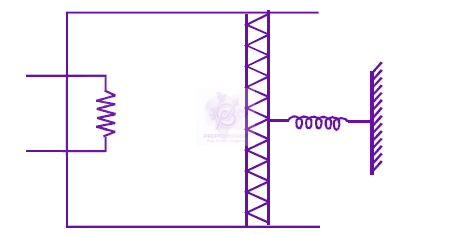
The equation of state for a gas is given by $\text{PV} = \text{nRT} + \alpha \text{V}$, where n is the number of moles and $\alpha$ is a positive constant. The initial temperature and pressure of one mole of the gas contained in a cylinder are T$_{0}$ and P$_{0}$ respectively. The work done by the gas when its temperature doubles isobarically will be :
Water of volume 2 L in a closed container is heated with a coil of 1 kW. While water is heated, the container loses energy at a rate of 160 J/s. In how much time will the temperature of water rise from 27$^{o}$C to 77$^{o}$C ? (Specific heat of water is 4.2 kJ/kg and that of the container is negligible).
One mole of diatomic ideal gas undergoes a cyclic process ABC as shown in figure. The process BC is adiabatic. The temperatures at A, B and C are 400 K, 800 K and 600 K respectively. Choose the correct statement : 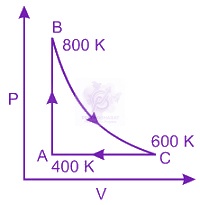
Modern vacuum pumps can evacuate a vessel down to a pressure of $\text{4.0} \times 1 {0}^{ - 1 5 }$ atm. at room temperature (300 K). Taking R = 8.3 JK$^{-1}$ mole$^{-1}$, 1 atm = 10$^{5}$ Pa and ${\text{N}}_{\text{Avogadro}} = 6 \times 1 {0}^{ 2 3 } {mole}^{ - 1 }$, the mean distance between molecules of gas in an evacuated vessel will be of the order of :
A black coloured solid sphere of radius $R$ and mass $M$ is inside a cavity with a vacuum inside. The walls of the cavity are maintained at temperature ${T}_{0}$. The initial temperature of the sphere is $3{T}_{0}$. If the specific heat of the material of the sphere varies as $\alpha {T}^{3}$ per unit mass with the temperature $T$ of the sphere, where $\alpha$ is a constant, then the time taken for the sphere to cool down to temperature $2{T}_{0}$ will be ($\sigma$ is Stefan Boltzmann constant)
At room temperature a diatomic gas is found to have an r.m.s. speed of $1930 \mathrm{~ms}^{-1}$. The gas is:
Three rods of Copper, Brass and Steel are welded together to form a Y-shaped structure. Area of cross-section of each rod is $4{\mathrm{cm}}^{2}$. End of copper rod is maintained at $100^{\circ}C$. Where as ends of brass and steel are kept at $0^{\circ}C$. Lengths of the copper, brass and steel rods are $46,13$and $12\mathrm{cms}$ respectively. The rods are thermally insulated from surroundings except at ends. Thermal conductivities of copper, brass and steel are $0.92,0.26$ and $0.12$ CGS units respectively. Rate of heat flow through copper rod is :
A gas molecule of mass $M$ at the surface of the earth has kinetic energy equivalent to $0^{\circ}C$. If it were to go up straight without colliding with any other molecules, how high it would rise? Assume that the height attained is much less than the radius of the earth. (${k}_{B}$ is Boltzmann constant)
During an adiabatic compression, $830 \mathrm{~J}$ of work is done on 2 moles of a diatomic ideal gas to reduce its volume by $50 \%$. The change in its temperature is nearly: $\left(\mathrm{R}=8.3 \mathrm{JK}^{-1} \mathrm{~mol}^{-1}\right)$
The pressure that has to be applied to the ends of a steel wire of length $10\mathrm{cm}$ to keep its length constant when its temperature is raised by $100^{\circ}C$ is : (For steel, Young's modulus is $2\times {10}^{11}N{m}^{-2}$ and coefficient of thermal expansion is $1.1\times {10}^{-5}{K}^{-1}$)
$500 \mathrm{~g}$ of water and $100 \mathrm{~g}$ of ice at $0^{\circ} \mathrm{C}$ are in a calorimeter whose water equivalent is $40 \mathrm{~g} .10 \mathrm{~g}$ of steam at $100^{\circ} \mathrm{C}$ is added to it. Then water in the calorimeter is : (Latent heat of ice $=80 \mathrm{cal} / \mathrm{g}$, Latent heat of steam $=540 \mathrm{cal} / \mathrm{g}$ )
A certain amount of gas is taken through a cyclic process (A B C D A) that has two isobars, one isochore and one isothermal. The cycle can be represented on a $\mathrm{P}-\mathrm{V}$ indicator diagram as :
The ratio of the coefficient of volume expansion of a glass container to that of a viscous liquid kept inside the container is $1: 4$. What fraction of the inner volume of the container should the liquid occupy so that the volume of the remaining vacant space will be same at all temperatures ?
Given that $1 \mathrm{~g}$ of water in liquid phase has volume $1 \mathrm{~cm}^3$ and in vapour phase $1671 \mathrm{~cm}^3$ at atmospheric pressure and the latent heat of vaporization of water is $2256 \mathrm{~J} / \mathrm{g}$; the change in the internal energy in joules for $1 \mathrm{~g}$ of water at $373 \mathrm{~K}$ when it changes from liquid phase to vapour phase at the same temperature is :
This question has Statement-1 and Statement-2. Of the four choices given after the Statements, choose the one that best describes the two Statements. Statement 1: The internal energy of a perfect gas is entirely kinetic and depends only on absolute temperature of the gas and not on its pressure or volume. Statement 2: A perfect gas is heated keeping pressure constant and later at constant volume. For the same amount of heat the temperature of the gas at constant pressure is lower than that at constant volume.
In the isothermal expansion of $10 \mathrm{~g}$ of gas from volume $\mathrm{V}$ to $2 \mathrm{~V}$ the work done by the gas is $575 \mathrm{~J}$. What is the root mean square speed of the molecules of the gas at that temperature?
An ideal gas at atmospheric pressure is adiabatically compressed so that its density becomes 32 times of its initial value. If the final pressure of gas is 128 atmospheres, the value of ' $\gamma$ 'of the gas is :
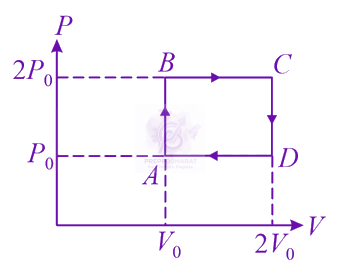 The above $P-V$ diagram represents the thermodynamic cycle of an engine, operating with an ideal mono-atomic gas. The amount of heat, extracted from the source in a single cycle, is:
A mass of $50 \mathrm{~g}$ of water in a closed vessel, with surroundings at a constant temperature takes 2 minutes to cool from $30^{\circ} \mathrm{C}$ to $25^{\circ} \mathrm{C}$. A mass of $100 \mathrm{~g}$ of another liquid in an identical vessel with identical surroundings takes the same time to cool from $30^{\circ} \mathrm{C}$ to $25^{\circ} \mathrm{C}$. The specific heat of the liquid is : (The water equivalent of the vessel is $30 \mathrm{~g}$.)
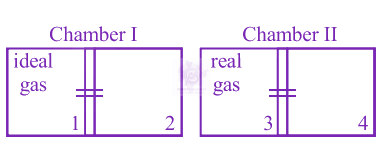 There are two identical chambers, completely thermally insulated from surroundings. Both chambers have a partition wall dividing the chambers in two compartments. Compartment $1$ is filled with an ideal gas and Compartment $3$ is filled with a real gas. Compartments $2$ and $4$ are vacuum. A small hole (orifice) is made in the partition walls and the gases are allowed to expand in vacuum. $\mathrm{Statement-1:}$ No change in the temperature of the gas takes place when ideal gas expands in vacuum. However, the temperature of real gas goes down (cooling) when it expands in vacuum. $\mathrm{Statement-2:}$ The internal energy of an ideal gas is only kinetic. The internal energy of a real gas is kinetic as well as potential.