JEE Main Physics — Thermodynamics previous year questions with solutions.
Figure shows the variation in temperature $(\Delta \mathrm{T})$ with the amount of heat supplied $\mathrm{(Q)}$ in an isobaric process corresponding to a monoatomic $\mathrm{(M)}$, diatomic $\mathrm{(D)}$ and a polyatomic $\mathrm{(P)}$ gas. The initial state of all the gases are the same and the scales for the two axes coincide. Ignoring vibrational degrees of freedom, the lines $a, b$ and $c$ respectively correspond to : 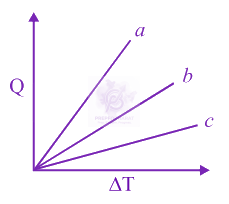
On a linear temperature scale $\mathrm{Y}$, water freezes at $-160^{\circ} \mathrm{Y}$ and boils at $-50^{\circ} \mathrm{Y}$. On this $\mathrm{Y}$ scale, a temperature of $340 \mathrm{~K}$ would be read as : (water freezes at $273 \mathrm{~K}$ and boils at $373 \mathrm{~K}$ )
A sample of gas expands from $V_1$ to $V_2$. In which of the following, the work done will be greatest? 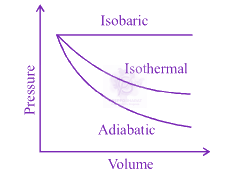
The pressure of an ideal gas varies with volume as $P=\alpha V$, where $\alpha$ is a constant. One mole of the gas is allowed to undergo expansion such that its volume becomes ' $m$ ' times its initial volume. The work done by the gas in the process is
A perfect gas at $27^{\circ} \mathrm{C}$ is heated at constant pressure so as to double its volume. The final temperature of the gas will be, close to
The heat radiated per unit area in 1 hour by a furnace whose temperature is $3000 \mathrm{~K}$ is $(\sigma=5.7 \times$ $10^{-8} \mathrm{~W} \mathrm{~m}^{-2} \mathrm{~K}^{-4}$ )
$n$ moles of an ideal gas undergo a process $A \rightarrow B$ as shown in the figure. Maximum temperature of the gas during the process is 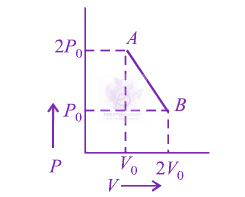
An ideal monatomic gas with pressure $P$, volume $V$ and temperature $T$ is expanded isothermally to a volume $2 V$ and a final pressure $P_i$. If the same gas is expanded adiabatically to a volume $2 \mathrm{~V}$, the final pressure is $P_a$. The ratio $\frac{P_a}{P_i}$ is
This question has Statement 1 and Statement 2. Of the four choices given after the Statements, choose the one that best describes the two Statements. Statement 1: In an adiabatic process, change in internal energy of a gas is equal to work done on/ by the gas in the process. Statement 2: The temperature of a gas remains constant in an adiabatic process.
A given ideal gas with $\gamma=\frac{C_p}{C_v}=1.5$ at a temperature $T$. If the gas is compressed adiabatically to one-fourth of its initial volume, the final temperature will be
Helium gas goes through a cycle $\mathrm{ABCDA}$ (consisting of two isochoric and two isobaric lines) as shown in figure. Efficiency of this cycle is nearly: (Assume the gas to be close to ideal gas) 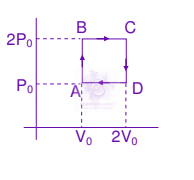
A wooden wheel of radius $\mathrm{R}$ is made of two semicircular parts (see figure); The two parts are held together by a ring made of a metal strip of cross sectional area S and length $L$. $L$ is slightly less than $2 \pi R$. To fit the ring on the wheel, it is heated so that its temperature rises by $\Delta \mathrm{T}$ and it just steps over the wheel. As it cools down to surrounding temperature, it presses the semicircular parts together. If the coefficient of linear expansion of the metal is $\alpha$, and its Youngs' modulus is $Y$, the force that one part of the wheel applies on the other part is : 
A large cylindrical rod of length $L$ is made by joining two identical rods of copper and steel of length $\left(\frac{L}{2}\right)$ each. The rods are completely insulated from the surroundings. If the free end of copper rod is maintained at $100^{\circ} \mathrm{C}$ and that of steel at $0^{\circ} \mathrm{C}$ then the temperature of junction is (Thermal conductivity of copper is 9 times that of steel)
Three perfect gases at absolute temperatures $T_1, T_2$ and $T_3$ are mixed. The masses of molecules are $m_1$, $m_2$ and $m_3$ and the number of molecules are $n_1, n_2$ and $n_3$ respectively. Assuming no loss of energy, the final temperature of the mixture is :
A thermally insulated vessel contains an ideal gas of molecular mass $M$ and ratio of specific heats $\gamma$. It is moving with speed $v$ and is suddenly brought to rest. Assuming no heat is lost to the surroundings, its temperature increases by :
$100 \mathrm{~g}$ of water is heated from $30^{\circ} \mathrm{C}$ to $50^{\circ} \mathrm{C}$. Ignoring the slight expansion of the water, the change in its internal energy is (specific heat of water is $4148 \mathrm{~J} / \mathrm{kg} / \mathrm{K}$ ):
A diatomic ideal gas is used in a Car engine as the working substance. If during the adiabatic expansion part of the cycle, volume of the gas increases from $\mathrm{V}$ to $32 \mathrm{~V}$ the efficiency of the engine is
Two conductors have the same resistance at $0^{\circ} \mathrm{C}$ but their temperature coefficients of resistance are $\alpha_1$ and $\alpha_2$. The respective temperature coefficients of their series and parallel combinations are nearly
The work done on the gas in taking it from $D$ to $A$ is
The net work done on the gas in the cycle ABCDA is
One kg of a diatomic gas is at a pressure of $8 \times 10^4 \mathrm{~N} / \mathrm{m}^2$. The density of the gas is $4 \mathrm{~kg} / \mathrm{m}^{-3}$. What is the energy of the gas due to its thermal motion?
Assuming the gas to be ideal the work done on the gas in taking it from $A$ to $B$ is
A long metallic bar is carrying heat from one of its ends to the other end under steady-state. The variation of temperature $\theta$ along the length $x$ of the bar from its hot end is best described by which of the following figure.
An insulated container of gas has two chambers separated by an insulating partition. One of the chambers has volume $V_1$ and contains ideal gas at pressure $P_1$ and temperature $T_1$. The other chamber has volume $V_2$ and contains ideal gas at pressure $P_2$ and temperature $T_2$. If the partition is removed without doing any work on the gas, the final equilibrium temperature of the gas in the container will be