JEE Main Physics — Thermodynamics previous year questions with solutions.
When a system is taken from state $i$ to state $f$ along the path $\mathrm{iaf}$, it is found that $Q=50 \mathrm{~cal}$ and $\mathrm{W}=20 \mathrm{~cal}$. Along the path' $\mathrm{ibf}$ $\mathrm{Q=36 ~cal}$. $\mathrm{W}$ along the path $\mathrm{ibf}$ is 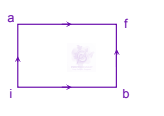
If $\mathrm{C}_p$ and $\mathrm{C}_{\mathrm{v}}$ denote the specific heats of nitrogen per unit mass at constant pressure and constant volume respectively, then
One end of a thermally insulated rod is kept at a temperature $T_1$ and the other at $T_2$. The rod is composed of two sections of lengths $\ell_1$ and $\ell_2$ and thermal conductivities $k_1$ and $k_2$ respectively. The temperature at the interface of the two sections is 
Assuming the sun to be a spherical body of radius $\mathrm{R}$ at a temperature of $\mathrm{T} \mathrm{K}$, evaluate the total radiant power, incident on Earth, at a distance $r$ from the Sun.
Two rigid boxes containing different ideal gases are placed on a table. Box A contains one mole of nitrogen at temperature $T_0$, while Box $B$ contains one mole of helium at temperature $(7 / 3) T_0$. The boxes are then put into thermal contact with each other and heat flows between them until the gases reach a common final temperature. (Ignore the heat capacity of boxes). Then, the final temperature of the gases, $T_f$, in terms of $T_0$ is
The work of $146 \mathrm{~kJ}$ is performed in order to compress one kilo mole of gas adiabatically and in this process the temperature of the gas increases by $7^{\circ} \mathrm{C}$. The gas is $\left(\mathrm{R}=8.3 \mathrm{~J} \mathrm{~mol}^{-1} \mathrm{~K}^{-1}\right)$
The temperature-entropy diagram of a reversible engine cycle is given in the figure. Its efficiency is 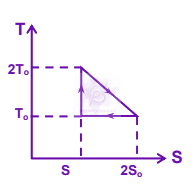
The figure shows a system of two concentric spheres of radii $r_1$ and $r_2$ and kept at temperatures $T_1$ and $T_2$ respectively. The radial rate of flow of heat in a substance between the two concentric sphere is proportional to 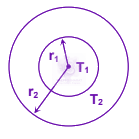
A gaseous mixture consists of $16 \mathrm{~g}$ of helium and $16 \mathrm{~g}$ of oxygen. The ratio $\frac{C_p}{C_v}$ of the mixture is
Which of the following is incorrect regarding the first law of thermodynamics?
A system goes from $A$ to $B$ via two processes I and II as shown in the figure. If $\Delta \mathrm{U}_1$ and $\Delta \mathrm{U}_2$ are the changes in internal energies in the processes I and II respectively, the 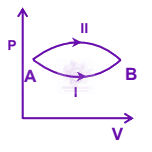
One mole of ideal monoatomic gas $(\gamma=5 / 30)$ is mixed with one mole of diatomic gas $(\gamma=7 / 5)$. What is $\gamma$ for the mixture? $\gamma$ denotes the ratio of specific heat at constant pressure, to that at constant volume.
If the temperature of the sun were to increase from $T$ to $2 T$ and its radius from $R$ to $2 R$, then the ratio of the radiant energy received on earth to what it was previously will be
Time taken by a $836 \mathrm{~W}$ heater to heat one litre of water from $10^{\circ} \mathrm{C}$ to $40^{\circ} \mathrm{C}$ is
Which of the following statements is correct for any thermodynamic system?
The temperature of two outer surfaces of a composite slab, consisting of two materials having coefficients of thermal conductivity $K$ and $2 K$ and thickness $x$ and $4 x$, respectively are $T_2$ and $T_1\left(T_2>T_1\right)$. The rate of heat transfer through the slab, in a steady state is $\left(\frac{A\left(T_2-T_1\right) K}{x}\right) f$, with $f$ equal to 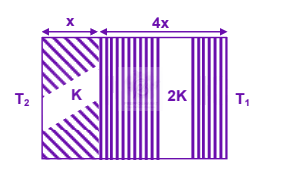
Two thermally insulated vessels 1 and 2 are filled with air at temperatures $\left(T_1, T_2\right)$, volume $\left(V_1, V_2\right)$ and pressure $\left(P_1, P_2\right)$ respectively. If the valve joining two vessels is opened, the temperature inside the vessel at equilibrium will be
The thermistors are usually made of
The thermo emf of a thermocouple varies with the temperature $\theta$ of the hot junction as $\mathrm{E}=\mathrm{a} \theta+\mathrm{b} \theta^2$ in volts where the ratio $\mathrm{a} / \mathrm{b}$ is $700^{\circ} \mathrm{C}$. If the cold junction is kept at $0^{\circ} \mathrm{C}$, then the neutral temperature is
Which of the following parameters does not characterize the thermodynamic state of matter?
"Heat cannot by itself flow from a body at lower temperature to a body at higher temperature" is a statement or consequence of
In the nuclear fusion reaction ${ }_1^2 \mathrm{H}+{ }_1^3 \mathrm{H} \rightarrow{ }_2^4 \mathrm{He}+\mathrm{n}$ given that the repulsive potential energy between the two nuclei is $\sim 7.7 \times 10^{-14} \mathrm{~J}$, the temperature at which the gases must be heated to initiate the reaction is nearly [Boltzmann's Constant $\mathrm{k}=1.38 \times 10^{-23} \mathrm{~J} / \mathrm{K}$ ]
The earth radiates in the infra-red region of the spectrum. The spectrum is correctly given by
During an adiabatic process, the pressure of a gas is found to be proportional to the cube of its absolute temperature. The ratio $\mathrm{C}_{\mathrm{p}} / \mathrm{C}_{\mathrm{v}}$ for the gas is