In a cyclic process, ΔU=0
From 1st law of thermodynamics
Q=ΔU+W
Q=W
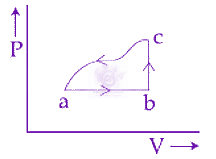
Qab+Qbc+Qca=Wabc+Wca
Wabc=Qab+Qbc+Qca−Wca
Wabc=Qab+Qbc+Uca
Wabc=250+60−180=130J
JEE Main 2019 — Physics Thermodynamics
A sample of an ideal gas is taken through the cyclic process abca as shown in the figure. The change in the internal energy of the gas along the path ca is −180J. The gas absorbs 250J of heat along the path ab and 60J along the path bc . The work done by the gas along the path abc is:
Held on 12 Apr 2019 · Verified 6 Jul 2026.
130J
100J
120J
140J
Sign in to track your attempts and accuracy.
Sign in to keep a private note on this question. Nothing you write is ever public.
10 mole of oxygen is heated at constant volume from $30^{\circ} \mathrm{C}$ to $40^{\circ} \mathrm{C}$. The change in the internal energy of the gas is $\_\_\_\_$ cal. (The molecular specific heat of oxygen at constant pressure, $C_{P}=7 \mathrm{cal} / \mathrm{mol}.{ }^{\circ} \mathrm{C}$ and $\mathrm{R}=2 \mathrm{cal} / \mathrm{mol}.{ }^{\circ} \mathrm{C}$.)
An ideal gas at pressure $P$ and temperature $T$ is expanding such that $PT^3 = $ constant. The coefficient of volume expansion of the gas is _______.
In the following $p-V$ diagram the equation of state along the curved path is given by $(V-2)^{2}=4 a p$ where $a$ is a constant. The total work done in the closed path is 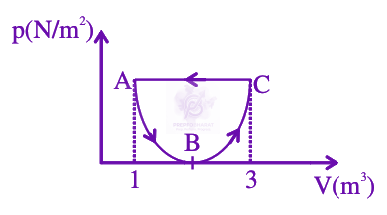
The volume of an ideal gas increases 8 times and temperature becomes $(1 / 4)^{\text {th }}$ of initial temperature during a reversible change. If there is no exchange of heat in this process $(\Delta \mathrm{Q}=0)$ then identify the gas from the following options (Assuming the gases given in the options are ideal gases):
A certain gas is isothermally compressed to $\left(\dfrac{1}{3}\right)^{rd}$ of its initial volume ($V_o = 3$ litre) by applying required pressure. If the bulk modulus of the gas is $3 \times 10^5$ N/m$^2$, the magnitude of work done on the gas is _______ J.
Work through every JEE Main Thermodynamics PYQ, year by year.