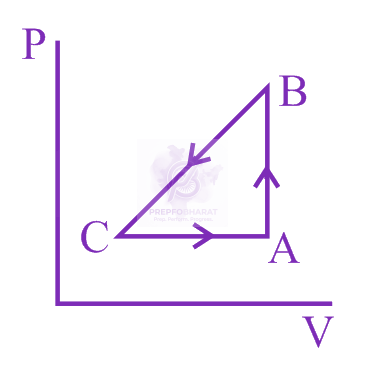
In the part A→B, the volume remains constant. Thus, the work done by the gas is zero. It is given that the heat absorbed by the gas is 40J. From first law of thermodynamics, Q=ΔU+W
⇒40=ΔU+0⇒ΔU=40J
or ΔU=UB−UA=40J
The increase in internal energy from A to B is 40J. The internal energy is 1560J at A, then
UB−1560=40J⇒UB=1600J
In the part B→C, the work done by the gas is W=50J and no heat is given to the system. Again using Q=ΔU+W
0=ΔU−50 or ΔU=UC−UB=50J
UC−1600=50J⇒UC=1650J
The change in internal energy from C→A,
ΔU=1560−1650=−90J
The heat given to the system is Q=−60J
Using Q=ΔU+W, we get W=Q−ΔU=−60−(−90)=30J