JEE Main Physics — Thermodynamics previous year questions with solutions.
Two metallic blocks ${M}_{1}$ and ${M}_{2}$ of same area of cross-section are connected to each other (as shown in figure). If the thermal conductivity of ${M}_{2}$ is $K$ then the thermal conductivity of ${M}_{1}$ will be : [Assume steady state heat conduction] 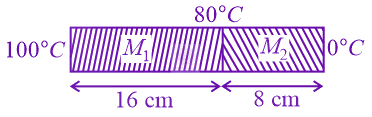
Following statements are given (1) The average kinetic energy of a gas molecule decreases when the temperature is reduced. (2) The average kinetic energy of a gas molecule increases with increase in pressure at constant temperature. (3) The average kinetic energy of a gas molecule decreases with increases in volume. (4) Pressure of a gas increases with increase in temperature at constant volume. (5) The volume of gas decreases with increase in temperature. Choose the correct answer from the options given below :
A thermally insulated vessel contains an ideal gas of molecular mass $M$ and ratio of specific heats $1.4$. Vessel is moving with speed $v$ and is suddenly brought to rest. Assuming no heat is lost to the surrounding and vessel temperature of the gas increases by : ($R=$ universal gas constant)
A $100g$ of iron nail is hit by a $1.5\mathrm{kg}$ hammer striking at a velocity of $60{\mathrm{ms}}^{-1}$. What will be the rise in the temperature of the nail if one fourth of energy of the hammer goes into heating the nail ? [Specific heat capacity of iron $=0.42{\mathrm{Jg}}^{-1}{C\circ }^{-1}$]
If ${K}_{1}$ and ${K}_{2}$ are the thermal conductivities ${L}_{1}$ and ${L}_{2}$ are the lengths and ${A}_{1}$ and ${A}_{2}$ are the cross sectional areas of steel and copper rods respectively such that $\frac{{K}_{2}}{{K}_{1}}=9,\frac{{A}_{1}}{{A}_{2}}=2,\frac{{L}_{1}}{{L}_{2}}=2$. Then, for the arrangement as shown in the figure. The value of temperature $T$ of the steel - copper junction in the steady state will be 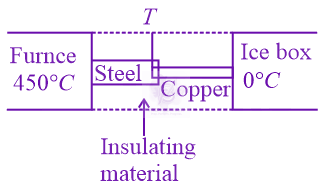
As per the given figure, two plates $A$ and $B$ of thermal conductivity $K$ and $2K$ are joined together to form a compound plate. The thickness of plates are $4.0\mathrm{cm}$ and $2.5\mathrm{cm}$ respectively and the area of cross-section is $120{\mathrm{cm}}^{2}$ for each plate. The equivalent thermal conductivity of the compound plate is $(1+\frac{5}{\alpha })K$, then the value of $\alpha$ will be _____ . 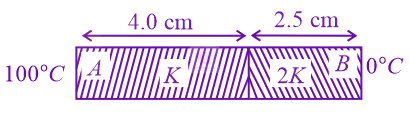
At a certain temperature, the degrees of freedom per molecule for gas is $8$. The gas performs $150J$ of work when it expands under constant pressure. The amount of heat absorbed by the gas will be _____ $J$.
A unit scale is to be prepared whose length does not change with temperature and remains $20\mathrm{cm}$, using a bimetallic strip made of brass and iron each of different length. The length of both components would change in such a way that difference between their lengths remains constant. If length of brass is $40\mathrm{cm}$ and length of iron will be _____ $\mathrm{cm}$. $({\alpha }_{\mathrm{iron}}=1.2\times {10}^{-5}{K}^{-1}$ and ${\alpha }_{\mathrm{brass}}=1.8\times {10}^{-5}{K}^{-1})$.
A solid metallic cube having total surface area $24{m}^{2}$ is uniformly heated. If its temperature is increased by $10^{\circ}C$, calculate the increase in volume of the cube. (Given $\alpha =5.0\times {10}^{-4}{C\circ }^{-1}$).
A cylinder of fixed capacity of $44.8$ litres contains helium gas at standard temperature and pressure. The amount of heat needed to raise the temperature of gas in the cylinder by $20.0^{\circ}C$ will be (Given gas constant $R=8.3J{K}^{-1}{\mathrm{mol}}^{-1}$)
Given below are two statements: Statement I :The average momentum of a molecule in a sample of an ideal gas depends on temperature. Statement II : The rms speed of oxygen molecules in a gas is $v$. If the temperature is doubled and the oxygen molecules dissociate into oxygen atoms, the rms speed will become $2v$. In the light of the above statements, choose the correct answer from the options given below :
One mole of a monoatomic gas is mixed with three moles of a diatomic gas. The molecular specific heat of mixture at constant volume is $\frac{{\alpha }^{2}}{4}RJ\mathrm{mol}{K}^{-1}$; then the value of $\alpha$ will be _____ . (Assume that the given diatomic gas has no vibrational mode.)
A mixture of hydrogen and oxygen has volume $2000{\mathrm{cm}}^{3}$, temperature $300K$, pressure $100\mathrm{kPa}$ and mass $0.76g$. The ratio of number of moles of hydrogen to number of moles of oxygen in the mixture will be [Take gas constant $R=8.3J{K}^{-1}{\mathrm{mol}}^{-1}$]
$0.056\mathrm{kg}$ of Nitrogen is enclosed in a vessel at a temperature of $127^{\circ}C$. The amount of heat required to double the speed of its molecules is_____ $\mathrm{kcal}$. (Take $R=2\mathrm{cal}\mathrm{mole}{K-1}^{-1}$ )
An ice cube of dimensions $60\mathrm{cm}\times 50\mathrm{cm}\times 20\mathrm{cm}$ is placed in an insulation box of wall thickness $1\mathrm{cm}$. The box keeping the ice cube at $0^{\circ}C$ of temperature is brought to a room of temperature $40^{\circ}C$. The rate of melting of ice is approximately: (Latent heat of fusion of ice is $3.4\times {10}^{5}J{\mathrm{kg}}^{-1}$ and thermal conducting of insulation wall is $0.05W{m}^{-1}^{\circ}{C}^{-1}$)
A block of ice of mass $120g$ at temperature $0^{\circ}C$ is put in $300g$ of water at $25^{\circ}C$. The $xg$ of ice melts as the temperature of the water reaches $0^{\circ}C$. The value of $x$ is [Use: Specific heat capacity of water $=4200J{\mathrm{kg}}^{-1}{K}^{-1}$, Latent heat of ice $=3.5\times {10}^{5}J{\mathrm{kg}}^{-1}$]
The ratio of specific heats $(\frac{{C}_{P}}{{C}_{V}})$ in terms of degree of freedom $(f)$ is given by :
Starting with the same initial conditions, an ideal gas expands from volume ${V}_{1}$ to ${V}_{2}$ in three different ways. The work done by the gas is ${W}_{1}$ if the process is purely isothermal, ${W}_{2}$, if the process is purely adiabatic and ${W}_{3}$ if the process is purely isobaric. Then, choose the correct option
A geyser heats water flowing at a rate of $2.0\mathrm{kg}$ per minute from $30^{\circ}C$ to $70^{\circ}C$. If geyser operates on a gas burner, the rate of combustion of fuel will be _____ $g{\mathrm{min}}^{-1}$. [Heat of combustion $=8\times {10}^{3}{\mathrm{Jg}}^{-1}$, Specific heat of water $=4.2{\mathrm{Jg}}^{-1}{C\circ }^{-1}$]
The relation between root mean square speed $({v}_{\mathrm{rms}})$ and most probable speed $({v}_{p})$ for the molar mass $M$ of oxygen gas molecule at the temperature of $300K$ will be
A lead bullet penetrates into a solid object and melts. Assuming that $40%$ of its kinetic energy is used to heat it, the initial speed of bullet is (Given, initial temperature of the bullet $=127^{\circ}C$, Melting point of the bullet $=327^{\circ}C$, Latent heat of fusion of lead $=2.5\times {10}^{4}J{\mathrm{kg}}^{-1}$, Specific heat capacity of lead $=125J\mathrm{kg}{K}^{-1}$)
According to kinetic theory of gases, A. The motion of the gas molecules freezes at $0^{\circ}C$. B. The mean free path of gas molecules decreases if the density of molecules is increased. C. The mean free path of gas molecules increases if temperature is increased keeping pressure constant. D. Average kinetic energy per molecule per degree of freedom is $\frac{3}{2}{k}_{B}T$ (for monoatomic gases). Choose the most appropriate answer from the options given below
An ideal gas undergoes a cyclic process ABCA where AB is isothermal...
$7$ mole of certain monoatomic ideal gas undergoes a temperature increase of $40K$ at constant pressure. The increase in the internal energy of the gas in this process is (Given $R=8.3J{K}^{-1}{\mathrm{mol}}^{-1}$)