JEE Main Physics — Thermodynamics previous year questions with solutions.
A source supplies heat to a system at the rate of $1000W.$ If the system performs work at a rate of $200W.$ The rate at which internal energy of the system increases is
A thermodynamic system is taken through cyclic process. The total work done in the process is : 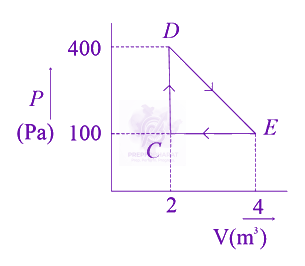
The $\mathrm{rms}$ speed of oxygen molecule in a vessel at particular temperature is ${(1+\frac{5}{x})}^{\frac{1}{2}}v,$ when $v$ is the average speed of the molecule. The value of $x$ will be: (take $\pi =\frac{22}{7}$)
The mean free path of molecules of a certain gas at STP is $1500d$, where $d$is the diameter of the gas molecules. While maintaining the standard pressure, the mean free path of the molecules at $373K$ is approximately:
The number of air molecules per ${\mathrm{cm}}^{3}$ is increased from $3\times {10}^{19}$ to $12\times {10}^{19}.$ The ratio of collision frequency of air molecules before and after the increase in number respectively is :
The average kinetic energy of a molecule of the gas is
A bicycle tyre is filled with air having pressure of $270\mathrm{kPa}$ at $27^{\circ}C$. The approximate pressure of the air in the tyre when the temperature increases to $36^{\circ}C$ is
Three vessels of equal volume contain gases at the same temperature and pressure. The first vessel contains neon (monoatomic), the second contains chlorine (diatomic) and third contains uranium hexafluoride (polyatomic). Arrange these on the basis of their root mean square speed $({v}_{rms})$ and choose the correct answer from the options given below:
A flask contains Hydrogen and Argon in the ratio $2:1$ by mass. The temperature of the mixture is $30^{\circ}C$. The ratio of average kinetic energy per molecule of the two gases $(\frac{{K}_{\mathrm{argon}}}{{K}_{\mathrm{hydrogen}}})$ is: (Given : Atomic Weight of $Ar=39.9$)
At $300K$, the rms speed of oxygen molecules is $\sqrt{\frac{\alpha +5}{\alpha }}$ times to that of its average speed in the gas. Then, the value of $\alpha$ will be (use $\pi =\frac{22}{7}$)
Match List I with List II : <table class="pyq-table"><tbody><tr><td></td><td>List I</td><td></td><td>List II</td></tr><tr><td>A</td><td>Isothermal Process</td><td>I</td><td>Work done by the gas decreases internal energy</td></tr><tr><td>B</td><td>Adiabatic Process</td><td>II</td><td>No change in internal energy</td></tr><tr><td>C</td><td>Isochoric Process</td><td>III</td><td>The heat absorbed goes partly to increase internal energy and partly to do work</td></tr><tr><td>D</td><td>Isobaric Process</td><td>IV</td><td>No work is done on or by the gas</td></tr></tbody></table>Choose the correct answer from the options given below :
A hole is drilled in a metal sheet. At $27^{\circ}C$, the diameter of hole is $5\mathrm{cm}$. When the sheet is heated to $177^{\circ}C$, the change in the diameter of hole is $d\times {10}^{-3}\mathrm{cm}$ . The value of $d$ will be _____, if coefficient of linear expansion of the metal is $1.6\times {10}^{-5}/C\circ$
The thermodynamic process, in which internal energy of the system remains constant is
A thin rod having a length of $1m$ and area of cross-section $3\times {10}^{-6}{m}^{2}$ is suspended vertically from one end. The rod is cooled from $210^{\circ}C$ to $160^{\circ}C$. After cooling, a mass $M$ is attached at the lower end of the rod such that the length of rod again becomes $1m$. Young's modulus and coefficient of linear expansion of the rod are $2\times {10}^{11}N{m}^{-2}$ and $2\times {10}^{-5}{K}^{-1}$, respectively. The value of $M$ is ______ $\mathrm{kg}$. (Take $g=10m{s}^{-2}$)
Let ${\gamma }_{1}$ be the ratio of molar specific heat at constant pressure and molar specific heat at constant volume of a monoatomic gas and ${\gamma }_{2}$ be the similar ratio of diatomic gas. Considering the diatomic gas molecule as a rigid rotator, the ratio $\frac{{\gamma }_{1}}{{\gamma }_{2}}$ is:
A certain amount of gas of volume $V$ at $27^{\circ}C$ temperature and pressure $2\times {10}^{7}N{m}^{-2}$ expands isothermally until its volume gets doubled. Later it expands adiabatically until its volume gets redoubled. The final pressure of the gas will be (Use $\gamma =1.5$)
The efficiency of a Carnot engine working between 127°C and 27°C is:
A gas has $n$ degrees of freedom. The ratio of specific heat of gas at constant volume to the specific heat of gas at constant pressure will be
What will be the effect on the root mean square velocity of oxygen molecules if the temperature is doubled and oxygen molecule dissociates into atomic oxygen?
Resistance of the wire is measured as $2\Omega$ and $3\Omega$ at $10^{\circ}C$ and $30^{\circ}C$ respectively. Temperature coefficient of resistance of the material of the wire is
A copper block of mass $5.0\mathrm{kg}$ is heated to a temperature of $500^{\circ}C$ and is placed on a large ice block. What is the maximum amount of ice that can melt? [Specific heat of copper : $0.39{\mathrm{Jg}}^{-1}{C\circ }^{-1}$ and latent heat of fusion of water : $335{\mathrm{Jg}}^{-1}$]
The root mean square speed of smoke particles of mass $5\times {10}^{-17}\mathrm{kg}$ in their Brownian motion in air at NTP is approximately. [Given $k=1.38\times {10}^{-23}J{K}^{-1}$]
A monoatomic gas performs a work of $\frac{Q}{4}$ where $Q$ is the heat supplied to it. The molar heat capacity of the gas will be _____ $R$ during this transformation. Where $R$ is the gas constant.
At what temperature a gold ring of diameter $6.230\mathrm{cm}$ be heated so that it can be fitted on a wooden bangle of diameter $6.241\mathrm{cm}$? Both the diameters have been measured at room temperature $(27^{\circ}C)$. (Given: coefficient of linear thermal expansion of gold ${\alpha }_{L}=1.4\times {10}^{-5}{K}^{-1}$)