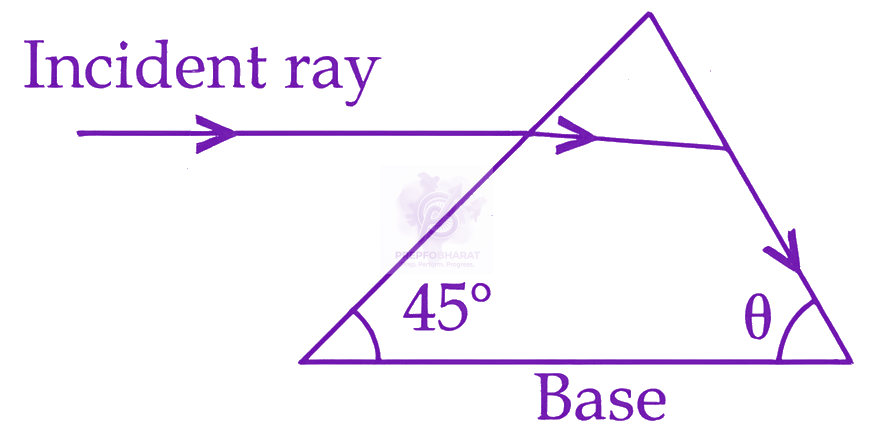
From the geometry of the prism, the angle of the prism is A=180∘−(45∘+θ).
The incident ray is parallel to the base, so the angle of incidence i at the first surface is equal to the base angle 45∘. Thus, i=45∘.
Applying Snell's law at the first surface: 1⋅sin(45∘)=μsin(r1).
Given μ=2, we have 21=2sin(r1)⟹sin(r1)=21⟹r1=30∘.
At the second surface, the emergent ray grazes the surface, so the angle of emergence e=90∘.
Applying Snell's law at the second surface: μsin(r2)=1⋅sin(90∘).
2sin(r2)=1⟹sin(r2)=21⟹r2=45∘.
The relation between prism angle and internal angles is A=r1+r2.
A=30∘+45∘=75∘.
Substituting A in the first equation: 75∘=180∘−(45∘+θ).
75∘=135∘−θ⟹θ=135∘−75∘=60∘.