δmin=2i−A
A=2i−A
A=i
μ=sin(2A)sin(2δmin+A)=sin(2A)sin(A)=sin30∘sin60∘
μ=3
v=μc=33×108ms−1
t=vAP=(33×108)53×10−2=5×10⁻¹⁰s
So, x=5
JEE Main 2021 — Physics Optics
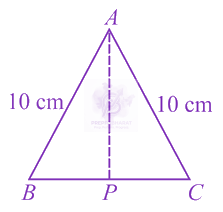
Cross-section view of a prism is the equilateral triangle ABC shown in the figure. The minimum deviation is observed using this prism when the angle of incidence is equal to the prism angle. The time taken by light to travel from P (midpoint of BC) to A is ___________ ×10−10s. (Given, speed of light in vacuum =3×10⁸ms−1 and cos30∘=23)
Held on 31 Aug 2021 · Verified 6 Jul 2026.
Sign in to track your attempts and accuracy.
Sign in to keep a private note on this question. Nothing you write is ever public.
In a microscope of tube length 10 cm two convex lenses are arranged with focal length of 2 cm and 5 cm. Total magnification obtained with this system for normal adjustment is $(5)^{k}$. The value of $k$ is $\_\_\_\_$.
In Young's double slit experiment, the fringe width of the interference pattern produced on the screen is $2.4$ $\mu$m. If the experiment is carried out in another medium having refractive index $1.2$, the fringe width will be _____ $\mu$m.
The magnitudes of power of a biconvex lens (refractive index 1.5) and that of a plano-concave lens (refractive index $=1.7$) are same. If the curvature of planoconcave lens exactly matches with the curvature of back surface of the biconvex lens, then ratio of radius of curvature of front and back surface of the biconvex lens is $\_\_\_\_$.
The exit surface of a prism with refractive index $n$ is coated with a material having refractive index $\frac{n}{2}$. When this prism is set for minimum angle of deviation, it exactly meets the condition of critical angle. The prism angle is $\_\_\_\_$.
An unpolarized light of certain intensity passes through a combination of two polarizers whose transmission axes are at $30°$ and $90°$, respectively, with respect to the horizontal axis. A third polarizer with its transmission axis at $60°$ with the horizontal axis is placed between the two existing polarizers. The ratio of the output intensities with and without the third polarizer is ______.
Work through every JEE Main Optics PYQ, year by year.