ω1=0.02;μ1=1.5;ω2=0.03;μ2=1.6
Achromatic combination
∴θnet=0
θ1−θ2=0
θ1=θ2
ω1δ1=ω2δ2
and δnet=δ1−δ2=2∘
δ1−ω2ω1δ1=2∘
δ1(1−ω2ω1)=2∘
δ1(1−32)=2∘
δ1=6∘
δ1=(μ1−1)A1
6∘=(1.5−1)A1
A1=12∘
JEE Main 2021 — Physics Optics
A deviation of 2∘ is produced in the yellow ray when prism of crown and flint glass are achromatically combined. Taking dispersive powers of crown and flint glass are 0.02 and 0.03 respectively and refractive index for yellow light for these glasses are 1.5 and 1.6 respectively. The refracting angles for crown glass prism will be ________∘ (in degree)
(Round off to the Nearest Integer)
Held on 16 Mar 2021 · Verified 6 Jul 2026.
Sign in to track your attempts and accuracy.
Sign in to keep a private note on this question. Nothing you write is ever public.
A parallel beam of light travelling in air (refractive index 1.0) is incident on a convex spherical glass surface of radius of curvature 50 cm. Refractive index of glass is 1.5. The rays converge to a point at a distance $x \mathrm{~cm}$ from the centre of the curvature of the spherical surface. The value of $x$ is $\_\_\_\_$ cm.
A thin biconvex lens is prepared from the glass ($\mu=1.5$) both curved surfaces of which have equal radii of $20$ cm each. Left side surface of the lens is silvered from outside to make it reflecting. To have the position of image and object at the same place, the object should be placed, from the lens at a distance of ________ cm.
A concave mirror of focal length $10$ cm forms an image which is double the size of object when the object is placed at two different positions. The distance between the two positions of the object is __________ cm.
Consider light travelling from a medium $A$ to medium $B$ separated by a plane interface. If the light undergoes total internal reflection during its travel from medium $A$ to $B$ and the speed of light in media $A$ and $B$ are $2.4 \times 10^{8} \mathrm{~m} / \mathrm{s}$ and $2.7 \times 10^{8} \mathrm{~m} / \mathrm{s}$, respectively, then the value of critical angle is :
In a Young double slit experiment, the wavelength of incident light is $6000$ Å, the separation between slits $S_1$ and $S_2$ is $5$ cm and the distance between slits plane and screen is $50$ cm, as shown in the figure below. If the resultant intensity at $P$ is equal to the intensity due to individual slits, the path difference between interfering waves is __________ Å. 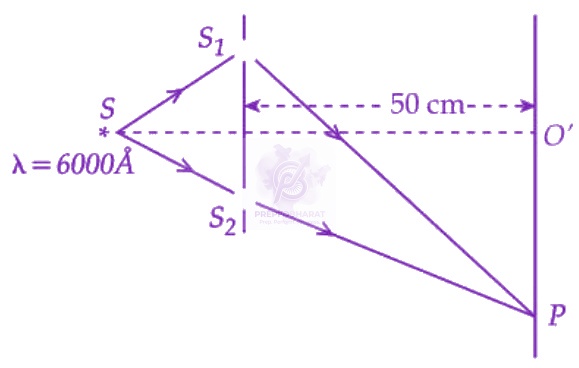
Work through every JEE Main Optics PYQ, year by year.