Modern Physics PYQ — Page 23
JEE Main Physics — Modern Physics previous year questions with solutions.
All Modern Physics Questions (652)
The maximum velocity of the photoelectrons emitted from the surface is $v$ when light of frequency $n$ falls on a metal surface. If the incident frequency is increased to $3n$, the maximum velocity of the ejected photoelectrons will be:
A particle $A$ of mass $m$ and initial velocity $v$ collides with a particle $B$ of mass $\frac{m}{2}$ which is at rest. The collision is head on, and elastic. The ratio of the de-Broglie wavelengths ${\lambda }_{A}$ to ${\lambda }_{B}$ after the collision is:
The $V-I$ characteristic of a diode is shown in the figure. The ratio of forward to reverse bias resistance is: 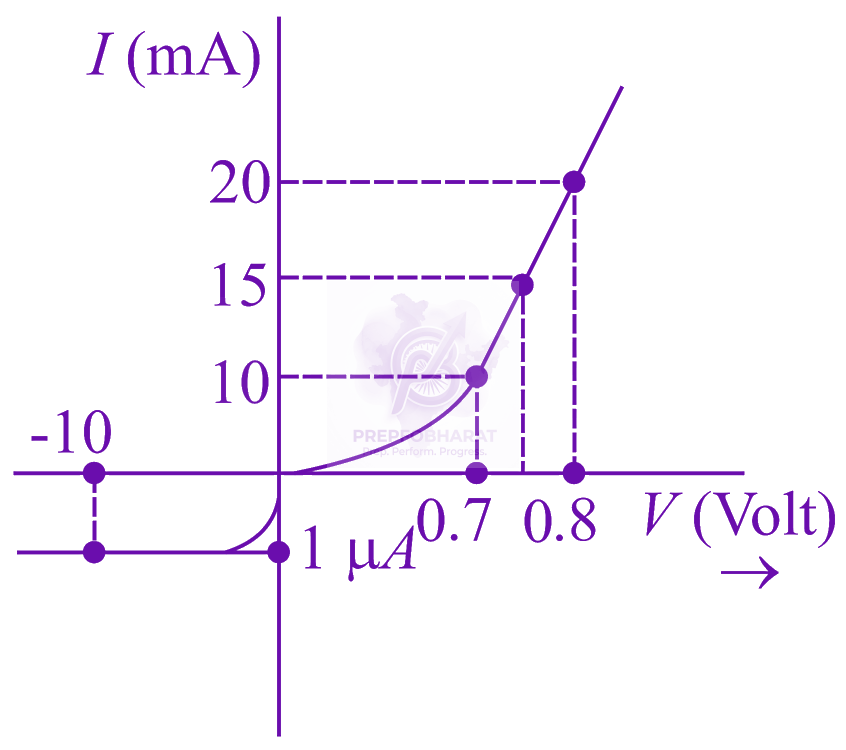
According to Bohr's theory, the time averaged magnetic field at the centre (i.e., nucleus) of a hydrogen atom due to the motion of electrons in the ${n}^{th}$ orbit is proportional to: ($n=$ principal quantum number)
A neutron moving with a speed 'v' makes a head on collision with a stationary hydrogen atom in ground state. The minimum kinetic energy of the neutron for which perfactly inelastic collision will take place is :
The truth table given in fig. represents: <table class="pyq-table"><tbody><tr><td>A</td><td>B</td><td>Y</td></tr><tr><td>0</td><td>0</td><td>0</td></tr><tr><td>0</td><td>1</td><td>1</td></tr><tr><td>1</td><td>0</td><td>1</td></tr><tr><td>1</td><td>1</td><td>1</td></tr></tbody></table>
If a, b, c, d are inputs to a gate and $x$ is its output, then, as per the following time graph, the gate is: 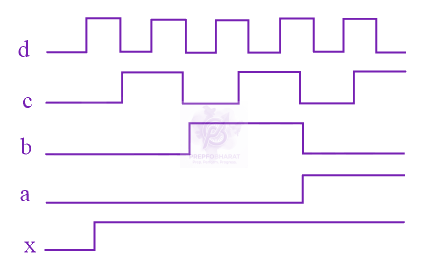
To get an output of $1$ from the circuit shown in the figure the input must be: 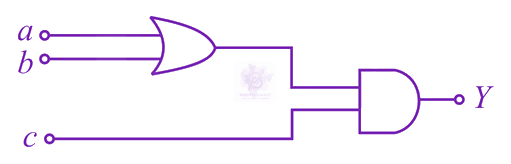
Identify the semiconductor devices whose characteristics are given below, in the order $(a), (b), (c), (d)$: 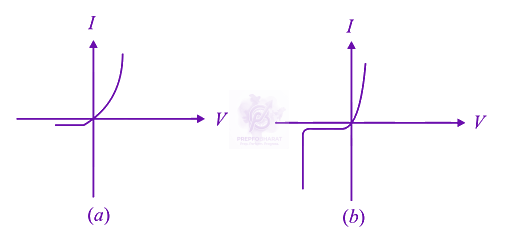 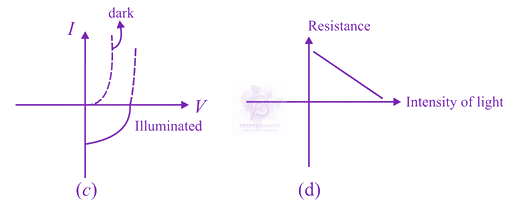
A Zener diode with a breakdown voltage of $4V$ is connected in series with a resistance $R$ to a battery of emf $10V$. The maximum power dissipation rating for the Zener diode is $1W$. The value of $R$ to ensure maximum power dissipation across the diode is
A photoelectric surface is illuminated successively by monochromatic light of wavelengths $\lambda and \frac{\lambda }{2}.$ If the maximum kinetic energy of the emitted photoelectrons in the second case is 3 times that in the first case, the work function of the surface is :
When photons of wavelength ${\lambda }_{1}$ are incident on an isolated sphere, the corresponding stopping potential is found to be $V$. When photons of wavelength ${\lambda }_{2}$ are used, the corresponding stopping potential was thrice that of the above value. If light of wavelength ${\lambda }_{3}$ is used then find the stopping potential for this case:
An electron in a hydrogen atom makes a transition from $n=2$ to $n=1$ and emits a photon. This photon strikes a doubly ionized lithium atom which was already in an excited state and completely removes the orbiting electron. The least quantum number for the excited state of the lithium-ion for the process is
Radiation of wavelength $\lambda$ is incident on a photocell. The fastest emitted photoelectron has a speed $v$. If the wavelength is changed to $\frac{3\lambda }{4}$, the speed of the fastest emitted photoelectron will be
The temperature dependence of resistance of $\mathrm{Cu}$ and undoped $\mathrm{Si}$ in the temperature range $300-400K$ is best described by
If one were to apply the Bohr model to a particle of mass $'m'$ and charge $'q'$ moving in a plane under the influence of a magnetic field 'B', the energy of the charged particle in the ${n}^{th}$ level will be:
The de-Broglie wavelength associated with the electron in the $n=4$ level is:
As an electron makes a transition from an excited state to the ground state of a hydrogen-like atom/ion
A $2V$ battery is connected across $AB$ as shown in the figure. The value of the current supplied by the battery when in first case battery's positive terminal is connected to $A$ and in second case when positive terminal of battery is connected to $B$ will respectively be: 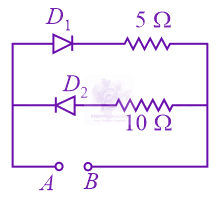
The value of the resistor, ${R}_{S}$, needed in the DC voltage regulator circuit shown here, equals: 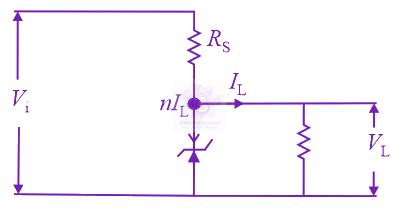
De-Broglie wavelength of an electron accelerated by a voltage of $50 \text{V}$ is close to $(|e|=1.6\times {10}^{-19} C, {m}_{e}=9.1\times {10}^{-31} kg, h=6.6\times {10}^{-34} J s)$
In an unbiased p - n junction electrons diffuse from n-region to p-region because:
A beam of light has two wavelengths of $4972 Å$ and $6216 Å$ with a total intensity of $3.6 \times 10^{-3}$ $\mathrm{Wm}^{-2}$ equally distributed among the two wavelengths. The beam falls normally on an area of $1 \mathrm{~cm}^2$ of a clean metallic surface of work function $2.3 \mathrm{eV}$. Assume that there is no loss of light by reflection and that each capable photon ejects one electron. The number of photoelectrons liberated in $2 \mathrm{~s}$ is approximately:
For which of the following particles will it be most difficult to experimentally verify the de-Broglie relationship?