Modern Physics PYQ — Page 24
JEE Main Physics — Modern Physics previous year questions with solutions.
All Modern Physics Questions (652)
Hydrogen ($_{1}$H$^{1}$), Deuterium ($_{1}$H$^{2}$), singly ionised Helium ($_{2}$He$^{4}$)$^{+}$ and doubly ionised lithium ($_{3}$Li$^{6}$)$^{++}$ all have one electron around the nucleus. Consider an electron transition from $n=2$ to $n=1$. If the wave lengths of emitted radiation are ${\lambda }_{1} \text{, } {\lambda }_{2} \text{, } {\lambda }_{3}$ and ${\lambda }_{4}$ respectively then approximately which one of the following is correct ?
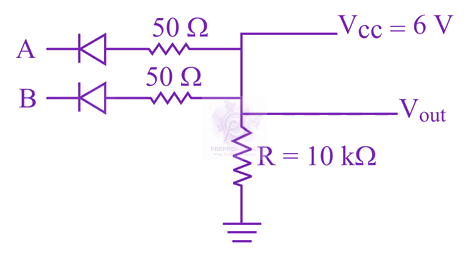 Given, $A$ and $B$ are input terminals Logic $1$ is$>5V$ Logic $0$ is$<1V$ Which logic gate operation, the following circuit does? Note: This question was awarded a bonus. $C$ option changed.
For LED's to emit light in visible region of electromagnetic light, it should have energy band gap in the range of:
A Zener diode is connected to a battery and a load as show below: 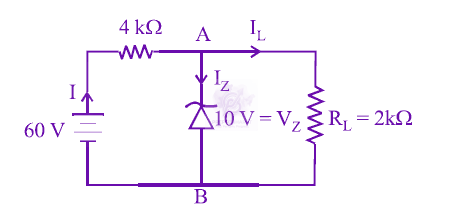 The currents, $\mathrm{I}, \mathrm{I}_{\mathrm{Z}}$ and $\mathrm{I}_{\mathrm{L}}$ are respectively.
The radiation corresponding to $3 \rightarrow 2$ transition of hydrogen atom falls on a metal surface to produce photoelectrons. These electrons are made to enter a magnetic field of $3 \times 1 {0}^{ - 4 } T$. If the radius of the largest circular path followed by these electrons is 10.0 mm, the work function of the metal is close to :
Identify the gate and match $A,B,Y$ in the bracket to check. 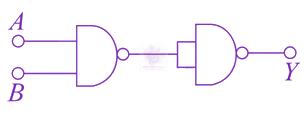
If the binding energy of the electron in a hydrogen atom is $13.6\mathrm{eV}$, the energy required to remove the electron from the first excited state of ${\mathrm{Li}}^{++}$ is :
The forward biased diode connection is :
Match the List-I (Phenomenon associated with electromagnetic radiation) with List-II (Part of electromagnetic spectrum) and select the correct code from the choices given below this lists: 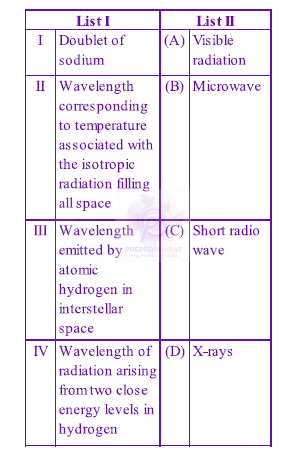
Which of the following circuits correctly represents the following truth table ? 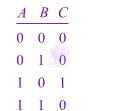
In an experiment on photoelectric effect, a student plots stopping potential $\mathrm{V}_0$ against reciprocal of the wavelength $\lambda$ of the incident light for two different metals $\mathrm{A}$ and $\mathrm{B}$. These are shown in the figure. 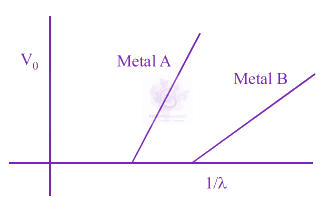 Looking at the graphs, you can most appropriately say that:
A system of four gates is set up as shown. The 'truth table' corresponding to this system is : 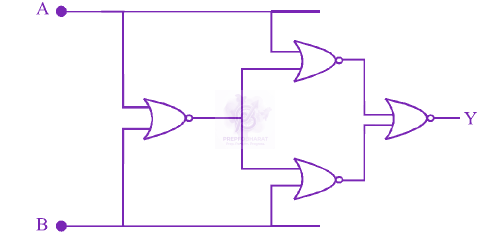
Electrons are accelerated through a potential difference $\mathrm{V}$ and protons are accelerated through a potential difference $4 \mathrm{~V}$. The de-Broglie wavelengths are $\lambda_e$ and $\lambda_p$ for electrons and protons respectively. The ratio of $\frac{\lambda_e}{\lambda_p}$ is given by: (given $m_e$ is mass of electron and $m_p$ is mass of proton).
The anode voltage of a photocell is kept fixed. The wavelength $\lambda$ of the light falling on the cathode is gradually changed. The plate current $\text{I}$ of the photocell varies as follows :
When Uranium is bombarded with neutrons, it undergoes fission. The fission reaction can be written as : ${ }_{92} \mathrm{U}^{235}+{ }_0 n^1 \rightarrow{ }_{56} \mathrm{Ba}^{141}+{ }_{36} \mathrm{Kr}^{92}+3 x+\mathrm{Q}($ energy) where three particles named $x$ are produced and energy $\mathrm{Q}$ is released. What is the name of the particle $x$ ?
In the Bohr model an electron moves in a circular orbit around the proton. Considering the orbiting electron to be a circular current loop, the magnetic moment of the hydrogen atom, when the electron is in $n^{\text {th }}$ excited state, is :
Orbits of a particle moving in a circle are such that the perimeter of the orbit equals an integer number of de-Broglie wavelengths of the particle. For a charged particle moving in a plane perpendicular to a magnetic field, the radius of the $n^{\text {th }}$ orbital will therefore be proportional to :
In the Bohr's model of hydrogen-like atom the force between the nucleus and the electron is modified as $F=\frac{e^2}{4 \pi \varepsilon_0}\left(\frac{1}{r^2}+\frac{\beta}{r^3}\right)$, where $\beta$ is a constant. For this atom, the radius of the $n^{\text {th }}$ orbit in terms of the Bohr radius $\left(a_0=\frac{\varepsilon_0 h^2}{m \pi e^2}\right)$ is :
The $\text{I} - \text{V}$ characteristics of an $\text{LED}$ is:
In a hydrogen like atom electron makes transition from an energy level with quantum number $\text{n}$ to another with quantum number $( \text{n} - 1 )$. If $\text{n >> 1}$, the frequency of radiation emitted is proportional to :
A diode detector is used to detect an amplitude modulated wave of 60% modulation by using a condenser of capacity 250 pico farad in parallel with a load resistance of 100 kilo ohm. Find the maximum modulated frequency which could be detected by it.
Consider two npn transistors as shown in figure. If 0 Volts corresponds to false and 5 Volts correspond to true then the output at C corresponds to : 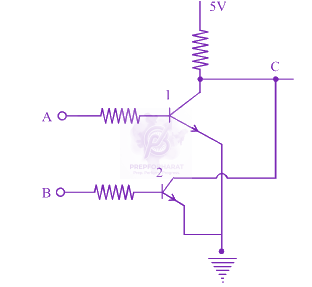
A copper ball of radius $1 \mathrm{~cm}$ and work function $4.47 \mathrm{~eV}$ is irradiated with ultraviolet radiation of wavelength $2500 ~Å$. The effect of irradiation results in the emission of electrons from the ball. Further the ball will acquire charge and due to this there will be a finite value of the potential on the ball. The charge acquired by the ball is :
A $12.5 \mathrm{eV}$ electron beam is used to bombard gaseous hydrogen at room temperature. It will emit: