Modern Physics PYQ — Page 25
JEE Main Physics — Modern Physics previous year questions with solutions.
All Modern Physics Questions (652)
Figure shows a circuit in which three identical diodes are used. Each diode has forward resistance of $20 \Omega$ and infinite backward resistance. Resistors $\mathrm{R}_1=\mathrm{R}_2=\mathrm{R}_3=50 \Omega$. Battery voltage is $6 \mathrm{~V}$. The current through $\mathrm{R}_3$ is : 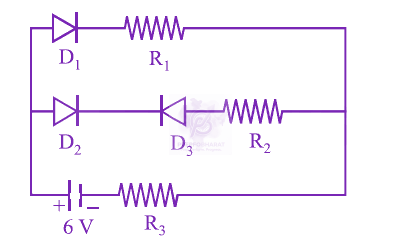
In the Rutherford experiment, $\alpha$-particles are scattered from a nucleus as shown. Out of the four paths, which path is not possible? 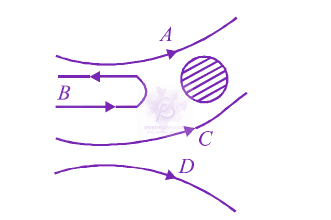
Hydrogen atom is excited from ground state to another state with principal quantum number equal to $4$. Then the number of spectral lines in the emission spectra will be
Which of the following Statements is correct?
A diatomic molecule is made of two masses $m_1$ and $m_2$ which are separated by a distance $r$. If we calculate its rotational energy by applying Bohr's rule of angular momentum quantization, its energy will be given by ( $n$ is an integer)
This question has Statement 1 and Statement 2. Of the four choices given after the Statements, choose the one that best describes the two Statements. Statement 1: A pure semiconductor has negative temperature coefficient of resistance. Statement 2: On raising the temperature, more charge carriers are released into the conduction band.
This question has Statement 1 and Statement 2. Of the four choices given after the Statements, choose the one that best describes the two Statements. Statement 1: A metallic surface is irradiated by a monochromatic light of frequency $v>v_0$ (the threshold frequency). If the incident frequency is now doubled, the photocurrent and the maximum kinetic energy are also doubled. Statement 2: The maximum kinetic energy of photoelectrons emitted from a surface is linearly dependent on the frequency of the incident light. The photocurrent depends only on the intensity of the incident light.
Ionisation energy of Li (Lithium) atom in ground state is $5.4 \mathrm{eV}$. Binding energy of an electron in $\mathrm{Li}^{+}$ion in ground state is $75.6 \mathrm{eV}$. Energy required to remove all three electrons of Lithium (Li) atom is
Which one of the following is the Boolean expression for NOR gate?
The electron of a hydrogen atom makes a transition from the $(n+1)^{\text {th }}$ orbit to the $n^{\text {th }}$ orbit. For large $\mathrm{n}$ the wavelength of the emitted radiation is proportional to
A doubly ionised $\mathrm{Li}$ atom is excited from its ground $\operatorname{state}(n=1)$ to $n=3$ state. The wavelengths of the spectral lines are given by $\lambda_{32}, \lambda_{31}$ and $\lambda_{21}$. The ratio $\lambda_{32} / \lambda_{31}$ and $\lambda_{21} / \lambda_{31}$ are, respectively
Truth table for system of four NAND gates as shown in figure is 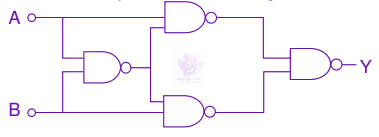
Which of the plots shown in the figure represents speed $(v)$ of the electron in a hydrogen atom as a function of the principal quantum number $(n)$ ? 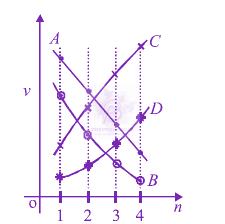
Assume that a neutron breaks into a proton and an electron. The energy released during this process is (Mass of neutron $=1.6725 \times 10^{-27} \mathrm{~kg} ;$ mass of proton $=1.6725 \times 10^{-27} \mathrm{~kg} ;$ mass of electron $=9 \times 10^{-31}$ $\mathrm{kg})$
A hypothetical atom has only three energy levels. The ground level has energy, $E_1=-8 \mathrm{eV}$. The two excited states have energies, $E_2=-6 \mathrm{eV}$ and $E_3=-2 \mathrm{eV}$. Then which of the following wavelengths will not be present in the emission spectrum of this atom?
Photoelectrons are ejected from a metal when light of frequency $v$ falls on it. Pick out the wrong statement from the following.
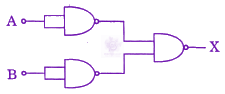
Which logic gate with inputs $\mathrm{A}$ and $\mathrm{B}$ performs the same operation as that performed by the following circuit? 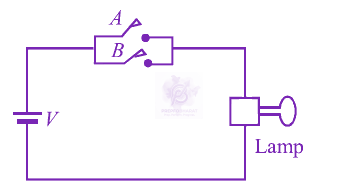
The figure shows a combination of two NOT gates and a NOR gate. 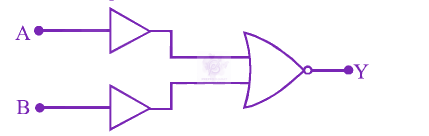 The combination is equivalent to $\mathrm{a}$
This question has Statement $-1$ and Statement $-2$. Of the four choices given after the statements, choose the one that best describes the two statements. Statement-1 : A metallic surface is irradiated by a monochromatic light of frequency $v>v_0$ (the threshold frequency). The maximum kinetic energy and the stopping potential are $\mathrm{K}_{\max }$ and $\mathrm{V}_0$ respectively. If the frequency incident on the surface doubled, both the $\mathrm{K}_{\max }$ and $\mathrm{V}_0$ are also doubled. Statement-2 : The maximum kinetic energy and the stopping potential of photoelectrons emitted from a surface are linearly dependent on the frequency of incident light.
Energy required for the electron excitation in $\mathrm{Li}^{++}$from the first to the third Bohr orbit is :
Statement-1 : When ultraviolet light is incident on a photocell, its stopping potential is $V_0$ and the maximum kinetic energy of the photoelectrons is $\mathrm{K}_{\max }$. When the ultraviolet light is replaced by $\mathrm{X}-$ rays, both $\mathrm{V}_0$ and $\mathrm{K}_{\max }$ increase. Statement-2 : Photoelectrons are emitted with speeds ranging from zero to a maximum value because of the range of frequencies present in the incident light. Of the four choices given after the statements, choose the one that best describes the two statements.
A nucleus of mass $M+\Delta m$ is at rest and decays into two daughter nuclei of equal mass $\frac{M}{2}$ each. Speed of light is $\mathrm{c}$. 40. The binding energy per nucleon for the parent nucleus is $E_1$ and that for the daughter nuclei is $E_2$. Then
A nucleus of mass $M+\Delta m$ is at rest and decays into two daughter nuclei of equal mass $\frac{M}{2}$ each. Speed of light is $\mathrm{C}$. The speed of daughter nuclei is
The combination of gates shown below yields