Modern Physics PYQ — Page 26
JEE Main Physics — Modern Physics previous year questions with solutions.
All Modern Physics Questions (652)
The above is a plot of binding energy per nucleon $E_b$, against the nuclear mass $M ; A, B, C, D, E, F$ correspond to different nuclei. Consider four reactions: (i) $A+B \rightarrow C+\varepsilon$ (ii) $\mathrm{C} \rightarrow \mathrm{A}+\mathrm{B}+\varepsilon$ (iii) $\mathrm{D}+\mathrm{E} \rightarrow \mathrm{F}+\varepsilon$ and (iv) $F \rightarrow D+E+\varepsilon$ where $\varepsilon$ is the energy released? In which reactions is $\varepsilon$ positive? 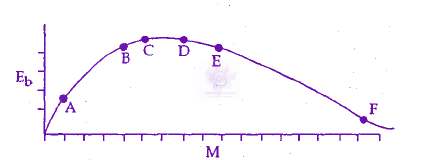
The surface of a metal is illuminated with the light of $400 \mathrm{~nm}$. The kinetic energy of the ejected photoelectrons was found to be $1.68 \mathrm{eV}$. The work function of the metal is $(\mathrm{hc}=1240 \mathrm{eV} \mathrm{nm})$
The logic circuit shown below has the input waveforms 'A' and 'B' as shown. Pick out the correct output waveform. 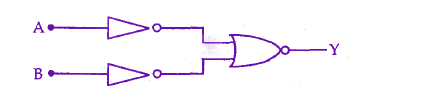 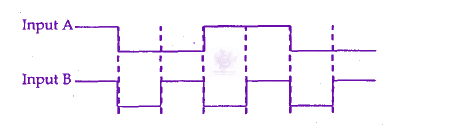
The transition from the state $n=4$ to $n=3$ in a hydrogen like atom results in ultraviolet radiation. Infrared radiation will be obtained in the transition from
A p-n junction (D) shown in the figure can act as a rectifier. An alternating current source $(V)$ is connected in the circuit. 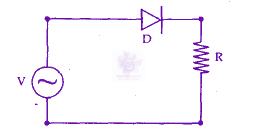
This question contains Statement $-1$ and Statement-2. Of the four choices given after the statements, choose the one that best describes the two statements. Statement - I: Energy is released when heavy nuclei undergo fission or light nuclei undergo fusion. and Statement - II For heavy nuclei, binding energy per nucleon increases with increasing $Z$ while for light nuclei it decrease with increasing $Z$.
Suppose an electron is attracted towards the origin by a force $k / r$ where ' $k$ ' is a constant and ' $r$ ' is the distance of the electron from the origin. By applying Bohr model to this system, the radius of the $n^{\text {th }}$ orbital of the electron is found to be ' $r_n$ ' and the kinetic energy of the electron to be $T_n$. Then which of the following is true?
In the circuit below, $A$ and $B$ represent two inputs and $C$ represents the output. The circuit represents 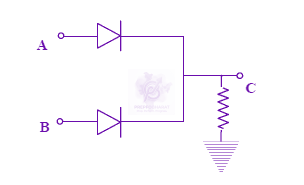
Carbon, silicon and germanium have four valence electrons each. At room temperature which one of the following statements is most appropriate?
Photon of frequency $\mathrm{v}$ has a momentum associated with it. If $\mathrm{c}$ is the velocity of light, the momentum is
If $\mathrm{M_o}$ is the mass of an oxygen isotope $\mathrm{{ }_8 O^{17}, M_p}$ and $\mathrm{M_N}$ are the masses of a proton and a neutron respectively, the nuclear binding energy of the isotope is
Which of the following transitions in hydrogen atoms emit photons of highest frequency?
If in a $\mathrm{p-n}$ junction diode, a square input signal of $10 \mathrm{~V}$ is applied as shown  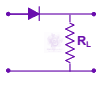 Then the output signal across $R_{\mathrm{L}}$ will be
If the binding energy per nucleon in ${ }_3^7 \mathrm{Li}$ and ${ }_2^4 \mathrm{He}$ nuclei are $5.60 \mathrm{MeV}$ and $7.06 \mathrm{MeV}$ respectively, then in the reaction $\mathrm{p}+{ }_3^7 \mathrm{Li} \rightarrow 2{ }_2^4 \mathrm{He}$ energy of proton must be
A solid which is transparent to visible light and whose conductivity increases with temperature is formed by
If the ratio of the concentration of electrons that of holes in a semiconductor is $\frac{7}{5}$ and the ratio of currents is $\frac{7}{4}$, then what is the ratio of their drift velocities?
In the following, which one of the diodes is reverse biased?
The anode voltage of a photocell is kept fixed. The wavelength $\lambda$ of the light falling on the cathode is gradually changed. The plate current $\mathrm{I}$ of the photocell varies as follows :
If the lattice constant of this semiconductor is decreased, then which of the following is correct? 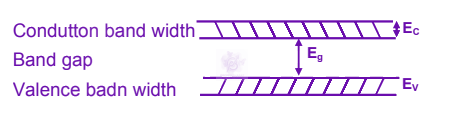
An alpha nucleus of energy $\frac{1}{2} m v^2$ bombards a heavy nuclear target of charge Ze. Then the distance of closest approach for the alpha nucleus will be proportional to
The time by a photoelectron to come out after the photon strikes is approximately
The threshold frequency for a metallic surface corresponds to an energy of $6.2 \mathrm{eV}$, and the stopping potential for a radiation incident on this surface $5 \mathrm{~V}$. The incident radiation lies in
When ${ }_3 \mathrm{Li}^{\prime}$ nuclei are bombarded by protons, and the resultant nuclei are ${ }_4 \mathrm{Be}^8$, the emitted particles will be
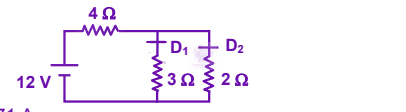
The circuit has two oppositely connect ideal diodes in parallel. What is the current following in the circuit?