JEE Main 2009 — Modern Physics
Physics Modern Physics questions from JEE Main 2009.
Other Years
5 Modern Physics Questions from 2009
The surface of a metal is illuminated with the light of $400 \mathrm{~nm}$. The kinetic energy of the ejected photoelectrons was found to be $1.68 \mathrm{eV}$. The work function of the metal is $(\mathrm{hc}=1240 \mathrm{eV} \mathrm{nm})$
The logic circuit shown below has the input waveforms 'A' and 'B' as shown. Pick out the correct output waveform. 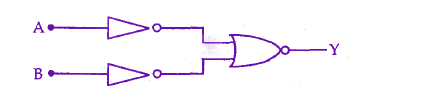 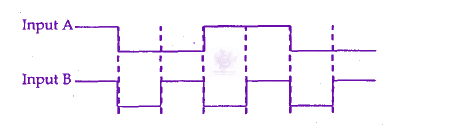
The transition from the state $n=4$ to $n=3$ in a hydrogen like atom results in ultraviolet radiation. Infrared radiation will be obtained in the transition from
A p-n junction (D) shown in the figure can act as a rectifier. An alternating current source $(V)$ is connected in the circuit. 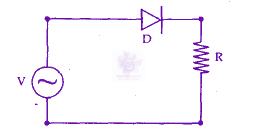
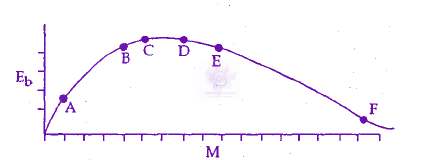
The above is a plot of binding energy per nucleon $E_b$, against the nuclear mass $M ; A, B, C, D, E, F$ correspond to different nuclei. Consider four reactions: (i) $A+B \rightarrow C+\varepsilon$ (ii) $\mathrm{C} \rightarrow \mathrm{A}+\mathrm{B}+\varepsilon$ (iii) $\mathrm{D}+\mathrm{E} \rightarrow \mathrm{F}+\varepsilon$ and (iv) $F \rightarrow D+E+\varepsilon$ where $\varepsilon$ is the energy released? In which reactions is $\varepsilon$ positive?